

What if preventing garage clutter from getting worse starts with a small system you can keep using, not another full-scale cleanout? The fear of garage clutter getting worse can make the whole space feel urgent and impossible to tackle, especially when past cleanouts haven’t lasted and every item raises the question of whether to keep it. For homeowners in Davie, Florida, the first step can be as simple as identifying one area that would make the garage easier to use.
That worry makes sense. A crowded garage can be hard to navigate, and buying storage before you know what needs to go where can add cost and complexity. You don’t have to solve everything today. A low-pressure first step can help make the space safer and easier to use without turning the process into another overwhelming project.
This article will help you identify what’s driving the worry, choose one manageable place to begin, and decide what belongings deserve a spot. Then you’ll learn how to create practical storage zones and simple routines around your household’s everyday habits, so clutter is less likely to build back up.
Key Takeaways
- Recognize how the fear of garage clutter getting worse can make choosing a starting point feel difficult, without treating that worry as a diagnosis.
- Track what comes into the garage, where it gets left, and what you can’t reach to identify the pattern behind the buildup.
- Keep cleanout sessions contained by limiting the work area and decisions, and preserving a clear route through the garage.
- Match storage zones to how often you use each item, and consider access before placing belongings on walls or overhead.
- Use a repeatable reset to return items, review new arrivals, and spot blocked zones before clutter builds again.
Why fear of garage clutter getting worse can make starting feel harder
An overfilled garage can make even choosing a first task feel daunting. The floor may be crowded, shelves may hold unrelated belongings, and the items you need could be buried behind things you rarely use. If you’ve cleaned up before and watched the clutter return, starting again can feel like taking on the whole problem at once.
The fear of garage clutter getting worse is the worry that belongings will keep accumulating until the garage becomes harder to use and harder to organize. It’s an everyday concern, not a diagnosis. A small, reversible first step can lower the stakes: you’re testing what helps, not committing to a complete cleanout or deciding the fate of every item today.
What makes a garage cleanout feel overwhelming?
Visible volume is only part of the challenge. A garage might serve as storage, a work area, and a place to leave items between errands, so one pile can contain tools, sports gear, seasonal items, and things waiting to be returned. That mix makes it difficult to know what belongs together or where to begin.
Decisions can slow progress, too. You may be unsure whether to keep, donate, or discard an item, or need to ask someone else before deciding. The reasons vary by household. Start by noticing what feels unclear, rather than judging yourself for having belongings you haven’t sorted.
Clutter alone doesn’t establish a mental health condition. For context on how a clinical condition differs from ordinary organizing challenges, see this overview of the psychology of clutter and hoarding. It isn’t a tool for diagnosing yourself or anyone else.
Does starting small really count as progress?
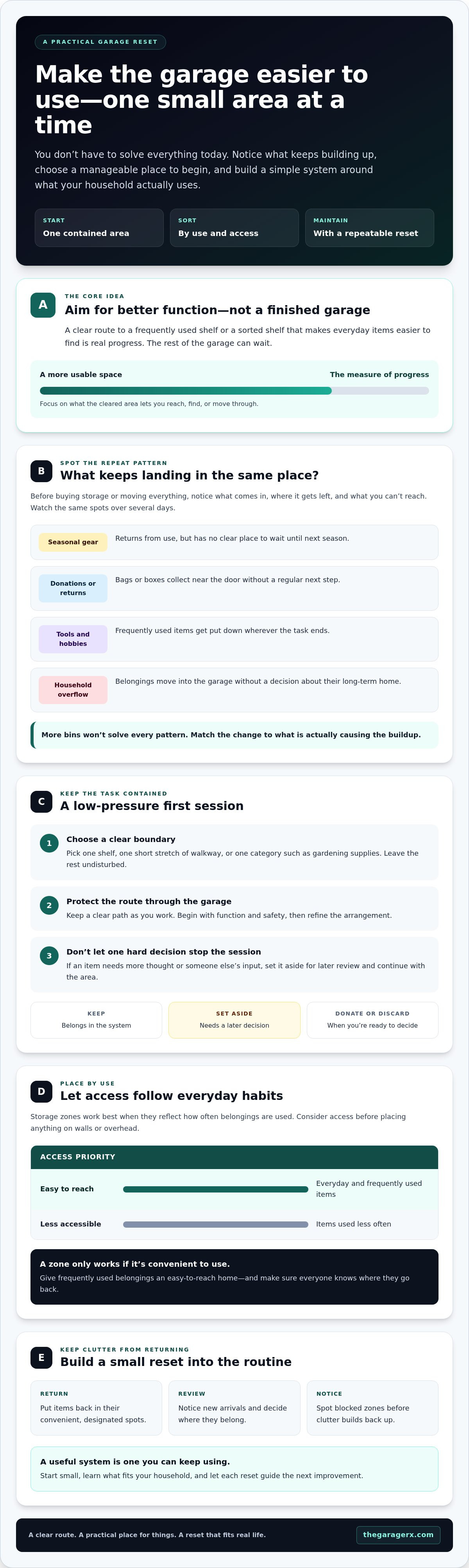
Yes. Choose a boundary that keeps the task contained: one shelf, one short stretch of walkway, or one category such as gardening supplies. Keep the rest of the garage undisturbed. If an item raises a difficult question, set it aside for later review instead of letting one decision stall the whole session.
Measure progress by function, not by whether the garage looks finished. A clear route from the door to a frequently used shelf can make the space easier to navigate. A sorted shelf can make everyday items easier to find. Either is a real improvement, even while other areas still need attention.
Think of this first step as a low-pressure assessment. Notice what you use, what blocks access, and where decisions get stuck. That information gives you a practical starting point for the next session, without requiring a bigger cleanout plan before you’re ready.
Find the patterns that keep garage clutter building up
Before buying bins or shifting everything onto the driveway, take a short inventory of how the garage works now. Notice what comes in, where it gets left, and which items are difficult to reach. The fear of garage clutter getting worse often points to a recurring problem, but the right fix depends on what keeps causing the buildup.
Look for the difference between limited storage and a system that doesn’t fit your routine. If seasonal gear has no designated home, you may need a place for it. If donations sit by the door for weeks, the issue may be an unfinished drop-off routine. If tools are buried behind rarely used boxes, access and placement may be the problem. More bins won’t solve every pattern.
Which items and routines create repeat clutter?
Observe the same spots over several days before making changes. Note whether clutter tends to be:
- Seasonal gear: Items return from use but don’t have a clear place to wait until next season.
- Donations or returns: Bags and boxes collect near the door without a regular next step.
- Tools and hobby supplies: Frequently used items get put down wherever the task ends.
- Household overflow: Belongings move into the garage when indoor storage feels full, without a decision about their long-term home.
Ask whether everyone in the household knows where frequently used belongings go back. A simple return spot can help, but only if it’s convenient to use. The American Cleaning Institute offers additional practical ideas to keep clutter from recollecting, including habits for managing incoming items.
An item’s destination should match how often you use it: keep everyday belongings easy to reach and reserve less accessible storage for items used less often.
How do you separate safety issues from organizing preferences?
Start with function and safety, then refine the layout. Keep a clear route through the garage and maintain access to doors and essential equipment. Check that stored items are stable and not at risk of tipping or falling. These are practical priorities. Preferences such as matching containers or neatly grouped categories can come later.
Use extra caution with heavy items, overhead storage, and anything that may be hazardous, such as chemicals. Don’t guess whether a rack or shelf can support a load. Follow the product’s instructions and seek appropriate professional help if an item is unsafe to move or store.
Once you’ve spotted the pattern, decide whether a small routine change will help or whether the household needs a more intentional storage layout. If storage design is part of the solution, explore garage storage options that can be matched to your belongings, access needs, and available space.
How to avoid mess during a garage cleanout
A cleanout can feel worse before it feels better if belongings spread across the whole floor. Keep the work contained: choose one small area, preserve a clear route through the garage, and decide in advance where sorted items can safely wait. You don’t need to empty the space to make useful progress.
Use this simple sequence to set limits before you begin:
- Step 1: Define the boundary. Pick one shelf, corner, or category, and decide what counts as finished for this session. Don’t expand into nearby areas just because you’ve started.
- Step 2: Protect access. Set aside only enough room to sort the selected items. Keep walkways, doors, and essential equipment accessible. Avoid spreading belongings across the garage floor.
- Step 3: Set a stopping point. Choose a time to finish or a manageable number of decisions to make. A limit helps prevent the session from growing into a larger project than you planned.
- Step 4: Sort only where it’s safe. If space allows, use temporary keep, relocate, donate, and discard areas. Label them clearly. If the garage is too crowded for separate zones, sort a few items at a time instead of creating more piles.
- Step 5: Close the session. Return kept items to a temporary, labeled location and clear the sorting area. If the process becomes unmanageable, stop and reset the space before continuing another time.
How can you make the first session feel contained?
Choose a task with an obvious endpoint, such as sorting the contents of one shelf without emptying adjacent shelves. Keep the route through the garage open as you work. At the end, put the items you’re keeping back in their temporary location, label them, and leave the area orderly enough to use. That’s a complete session, even if the rest of the garage remains untouched.
What should you do with uncertain items?
Don’t let one difficult decision stop every other task. Put uncertain belongings in a small, designated review area, then write down a date to revisit them and a clear limit for how much can stay there. For example, make the review space one labeled box rather than an expanding corner. If an item belongs to another household member, involve them before deciding whether to donate or discard it.
The fear of garage clutter getting worse can make every choice feel urgent. A bounded session offers a calmer alternative: protect access, make only the decisions within your chosen scope, and leave the garage ready for daily use when you stop.
Build a garage organization plan around what your household actually uses
Once you’ve identified what tends to accumulate, give each recurring category a practical home. The right system should fit the garage’s layout, the belongings you need to store, and the way your household uses them. Don’t force a storage solution into the space just because it looks tidy in a catalog.
Use frequency and ease of access to guide placement. Everyday items should be simple to reach and return. Belongings used only occasionally can go in less accessible zones, provided they’re safe to retrieve.
Which belongings belong on the floor, wall, or overhead?
Think of each storage zone as a trade-off between access and floor space. Keep items that are frequently used, awkward to lift, or needed quickly within easy reach. Walls can suit appropriate tools or equipment when they’re secured for the intended use and don’t obstruct walkways. Overhead storage may work for items used less often, but check the specific product’s installation instructions and load requirements before placing anything there.
| Item type | Use frequency | Suitable storage zone | Access caution |
|---|---|---|---|
| Frequently used hand tools | Often | Easy-reach wall storage or work area | Keep within comfortable reach and return them after use. |
| Cleaning or household supplies | Regularly | Accessible cabinet or shelf | Store safely and keep items you need together. |
| Seasonal decorations | Occasionally | Cabinet or suitable overhead storage | Consider safe retrieval before placing items overhead. |
| Bulky, awkward-to-lift belongings | Varies | Floor-level or another easy-access zone | Avoid overhead placement if lifting or lowering is difficult. |
For ideas on enclosed storage, explore custom garage cabinets. If wall space is a better fit, review options for garage wall organization systems.
How can storage choices prevent clutter from returning?
Assign each repeat-use category a recognizable home, and make sure household members can identify where it belongs. Leave enough practical room to return belongings without forcing them into a container or stacking them unsafely. If an area is consistently overfilled, reassess the category and its assigned space instead of adding another pile nearby.
Overhead storage racks may suit belongings that are used infrequently and can be safely stored and retrieved. Review overhead garage storage racks only if that placement fits your items, access needs, and garage. A considered layout can make the fear of garage clutter getting worse easier to address with a system that supports everyday habits. For help exploring storage options, connect with a garage storage design professional.
Keep garage clutter from returning with a realistic maintenance plan
A garage system lasts when it fits the way your household uses the space. Build a short reset into an existing routine, such as putting tools away after a project or checking the entry area when bringing home new purchases. Keep the goal practical: return items to their assigned zones, review incoming belongings before they become long-term storage, and notice when a walkway or frequently used area starts getting blocked.
What simple habits help keep a garage usable?
Choose check-ins your household can maintain rather than following a schedule that feels like another chore. A quick reset after using shared equipment may work better than waiting for a large monthly cleanup. During each check-in, look for items left outside their zones, boxes that have accumulated, and belongings that are difficult to reach.
- Return: Put items back in their designated places after use.
- Review: Decide where new arrivals belong before they become unclaimed garage storage.
- Notice: Check whether paths, doors, or regularly used storage areas are becoming blocked.
A temporary drop spot can be useful, but set a clear limit and empty it regularly so it doesn’t become permanent. Reassess the layout when household routines change or seasonal belongings rotate in. If a category no longer fits its assigned space, adjust the zone rather than forcing items into an overfilled shelf or stacking them unsafely.
When is it time to ask for professional garage help?
Professional input may help when it’s difficult to assess how much storage the garage needs, where items should go, or how to preserve safe, convenient access. Sorting can clarify what you own, but a larger storage plan may be useful when recurring categories still have no practical home or simple changes haven’t made the space easier to maintain.
The Garage RX designs and installs garage storage systems for homeowners across Broward, Miami-Dade, and Palm Beach counties, including Davie. Depending on the belongings and available space, options include custom garage cabinets, slatwall systems, overhead storage racks, and workbenches. A tailored project discussion can help clarify the scope and which options may suit your household. It’s an option, not a requirement for making progress.
The fear of garage clutter getting worse can ease when you have a manageable routine and a layout that supports everyday use. If you’re considering a more complete storage plan, explore garage organization systems in South Florida as a low-pressure next step.
Make your next garage step manageable
A more usable garage doesn’t require one exhausting cleanout. Start by noticing what keeps collecting, choose a contained area to address, and give regularly used belongings a clear, accessible home. Then build simple reset habits around your household’s routines. These small decisions can help ease the fear of garage clutter getting worse and make progress easier to maintain.
If sorting alone hasn’t solved your storage challenges, a professionally planned layout may help clarify which options fit your belongings and available space. The Garage RX is based in Davie, Florida, and designs and installs custom garage cabinets, slatwall, overhead storage, and workbenches for homeowners in Broward, Miami-Dade, and Palm Beach counties. The company also offers polyaspartic and epoxy floor coatings for garage flooring projects.
Contact The Garage RX to discuss a tailored garage storage project in Davie when you’re ready. You can begin with one practical change today, and build from there.
Frequently Asked Questions
Why am I afraid my garage clutter will keep getting worse?
The fear of garage clutter getting worse can grow when belongings keep arriving without clear places to go, or when past cleanouts haven’t stayed organized. A crowded floor, blocked shelves, and uncertainty about what to keep can make the problem feel like it’s expanding faster than you can manage it. Treat the worry as a prompt to identify one recurring pattern, not as proof you need to fix everything at once.
How do I start decluttering a garage without making a bigger mess?
Start with one contained area, such as a single shelf or a small group of similar items. Set aside just enough space to sort, and keep a clear path through the garage. Use labeled temporary spots for items you’ll keep, relocate, donate, or discard only if there’s room to do so safely. Before you begin, decide where kept items will go when the session ends.
What should I do if I feel overwhelmed while organizing my garage?
Pause and make the space usable again before continuing. Put kept items back in a temporary, labeled location, clear the sorting area, and restore access to walkways and doors. If a decision is holding you up, place that item in a small review area and choose a date to revisit it. You can stop after one task; a finished shelf or clear route is meaningful progress.
Should I buy garage storage before decluttering?
Usually, wait until you’ve identified what you own, what you use often, and what needs to be easy to reach. Buying storage too early can leave you with containers or fixtures that don’t fit the belongings or available space. First observe where items collect and what remains inaccessible. Then choose storage, such as cabinets, wall systems, or overhead racks, based on actual needs and safe access.
How can I stop garage clutter from coming back?
Give recurring categories clear homes, and make those spots easy for everyone in the household to recognize and use. Return items after use, review new arrivals before they become long-term storage, and check for blocked paths or overfilled zones. Choose a short reset routine that fits your household, then adjust the layout when your habits or seasonal belongings change. Leave room to put items away without forcing or unsafe stacking.
When should I hire a professional garage organizer?
Consider professional help if you’ve sorted belongings but still can’t determine a practical layout, storage needs, or safe access. The Garage RX provides professional storage design and installation, including custom garage cabinets, slatwall systems, overhead storage, and workbenches. Based in Davie, Florida, the company serves homeowners in Broward, Miami-Dade, and Palm Beach counties. A project discussion can help clarify scope and suitable options; it’s not a requirement for getting started.