

The sun-drenched days of a Florida summer might seem like the perfect opportunity for home improvement, but for your garage floor, those humid afternoons are actually a recipe for disaster. You likely want a showroom finish that resists hot tire pickup and stays bonded for decades. However, choosing the best time of year to coat garage floor in Florida involves more than just checking the calendar; it requires a diagnostic look at the state's unique moisture vapor transmission levels.
We understand the frustration of seeing a brand-new coating bubble or peel because of trapped sub-slab moisture. It's a common spatial ailment in South Florida where the water table is high and the air is thick. This guide provides the professional prescription for a flawless, long-lasting transformation. You'll discover why the dry season from November to April offers the safest window for your project. We also explain how advanced polyaspartic floor coatings and moisture-mitigation technology allow for successful installations even when the Florida weather is unpredictable. By the end, you'll know exactly how to secure a high-end floor that survives the heat.
Key Takeaways
- Identify why the dry season from November to April remains the optimal window for installation due to reduced humidity and lower water tables.
- Understand the mechanics of Moisture Vapor Transmission (MVT) and how it dictates the long-term success of your floor's bond.
- Discover why polyaspartic floor coatings are the professional prescription for year-round durability, even when Florida heat is at its peak.
- Learn why determining the best time of year to coat garage floor in Florida involves a professional diagnostic assessment rather than just checking the weather app.
- Recognize the importance of mechanical diamond grinding over acid etching to ensure your high-end finish survives the "hot tire pickup" phenomenon.
Why Florida’s Climate Makes Garage Floor Coating a Unique Challenge
Florida’s environment is uniquely hostile to standard home improvement materials. Most homeowners view their garage slab as a solid, inert block of stone. In reality, concrete acts like a dense, porous sponge. Because South Florida sits on a porous limestone shelf with a high water table, moisture constantly migrates upward through the slab. This environmental pressure makes determining the best time of year to coat garage floor in Florida a technical necessity rather than a simple scheduling preference. Without the professional diagnostic approach utilized by The Garage RX, even the most expensive materials will eventually fail.
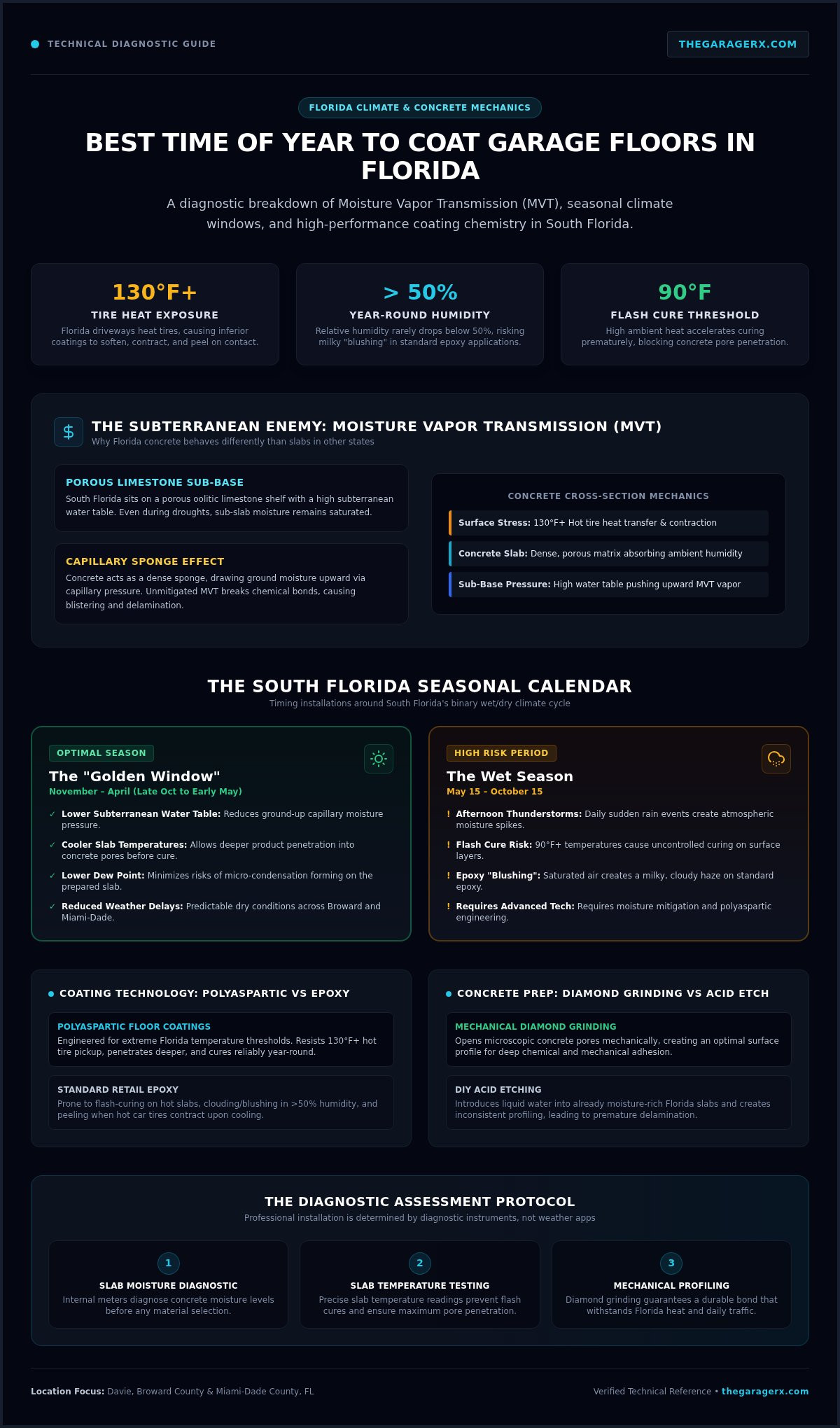
Then there is the issue of heat. The Florida sun bakes driveways, and tires often reach temperatures exceeding 130 degrees during a midday drive. When you pull into your garage, that intense heat transfers directly to the floor coating. Inferior products soften under these conditions. As the tires cool, they contract and literally peel the coating off the concrete. This "hot tire pickup" is the primary cause of floor failure in Broward and Miami-Dade counties, turning a high-end upgrade into a peeling mess within months.
The Impact of High Humidity on Adhesion
High humidity levels are a constant factor for homeowners in Davie and the surrounding areas. Florida's seasonal climate patterns show that relative humidity rarely drops below 50 percent, even during the official dry season. This ambient moisture interferes with the chemical bond of standard epoxy coatings. If the air is too saturated, the material may develop "blushing," a milky or cloudy haze that ruins the aesthetic finish. Many DIYers assume a floor is ready because the surface looks dry. However, deep-seated moisture often remains trapped in the concrete pores, leading to delamination weeks after the project is finished.
Heat and the "Flash Cure" Risk
Temperature control is vital for a successful installation. On a typical 90-degree day, the chemical reaction in many retail-grade coatings accelerates uncontrollably. This is known as a "flash cure." The material hardens on the surface before it can properly penetrate the concrete pores to create a mechanical bond. Professional-grade Polyaspartic Floor Coatings are specifically engineered to handle these temperature thresholds, but they still require expert timing. Our team treats every floor as a unique case. Our diagnostic process measures slab temperature and internal moisture levels before we begin. This professional prescription ensures your floor doesn't just look good today, but survives the relentless Florida climate for the long haul.
The South Florida Calendar: Dry Season vs. Wet Season
South Florida doesn't follow the traditional four-season calendar. Instead, it operates on a binary cycle of wet and dry. This seasonal shift dictates the success of any structural coating project. While many homeowners assume they can schedule a project whenever they have a free weekend, the best time of year to coat garage floor in Florida is during the dry season, typically spanning from late October to early May. During this window, the subterranean water table recedes, and atmospheric conditions become far more stable for chemical curing.
Dry weather doesn't automatically mean the concrete is ready for a coating. Even during a drought, Florida’s oolitic limestone base remains saturated. This causes moisture to move upward through the slab via capillary action. A professional installer doesn't just look at the sky; they diagnose the slab. We use specialized meters to ensure the internal moisture levels won't compromise the bond. In Davie, managing this schedule requires a combination of local expertise and high-performance materials.
Winter and Spring: The "Golden Window"
November through March offers the most predictable results for high-end floor transformations. Cooler concrete temperatures allow for deeper material penetration before the curing process begins. This ensures a mechanical bond that resists the stresses of daily vehicle traffic. Because the dew point remains lower, the risk of micro-condensation forming on the slab is significantly reduced. This period is the peak season for professional installations in Broward County because it minimizes the risk of weather-related delays or moisture-induced failures.
Summer and Fall: Navigating the Humidity
The rainy season, running from May 15 through October 15, presents a different set of challenges. Afternoon thunderstorms are almost guaranteed. These storms can be disastrous for a project where the garage door must remain open during application. According to the Florida Climate Center's humidity analysis, dew points routinely exceed 70°F during these months. High humidity can cause traditional epoxies to cure too quickly or develop a hazy surface finish known as amine blush.
Even in the height of summer, a professional installation is possible. It simply requires a more rigorous diagnostic approach. We monitor Moisture Vapor Transmission (MVT) levels to ensure the slab is ready for treatment. If you're unsure if your floor is a candidate for a summer upgrade, you can consult with our specialists to receive a professional assessment. Our use of high-performance Polyaspartic Floor Coatings allows us to navigate these humidity spikes, providing a durable finish that DIY kits simply cannot match. We adjust our application schedule to avoid predictable afternoon washouts, ensuring every layer cures in a controlled environment.
The Hidden Enemy: Moisture Vapor Transmission (MVT)
Florida concrete is never truly dry. Because our homes sit on porous oolitic limestone, water vapor is constantly pushed upward by hydrostatic pressure. This phenomenon is known as Moisture Vapor Transmission (MVT). It acts as a silent saboteur for any floor transformation. Even if the surface looks pristine, the best time of year to coat garage floor in Florida is only after a professional diagnostic check of these internal levels. Without this step, you're simply trapping water under a lid, leading to inevitable failure.
Look for "efflorescence," a white, salty powder on the concrete surface. This is a clear indicator of active moisture movement. Other symptoms include bubbling or peeling in previous paint or DIY epoxy applications. These aren't just aesthetic flaws. They are clinical signs of a dysfunctional slab that requires a specialized intervention before any new Polyaspartic Floor Coatings are applied. Identifying these issues early prevents the frustration of a short-lived renovation.
The Calcium Chloride and Relative Humidity Tests
A professional "Rx" for your garage starts with quantifiable data. We utilize the ASTM F1869 standard for measuring moisture vapor emissions. This test calculates exactly how many pounds of water vapor are escaping 1,000 square feet of your slab every 24 hours. Most standard coatings fail if this rate exceeds 3 pounds. Understanding these metrics is vital when determining the best time of year to coat garage floor in Florida for your specific property. We also use in-situ probes to check the internal relative humidity (RH) of the concrete, ensuring the slab is healthy enough for a permanent bond.
Moisture Mitigating Primers
When diagnostic tests reveal high moisture levels, a standard base coat isn't enough. We prescribe a Moisture Vapor Barrier (MVB) epoxy primer. These specialized resins penetrate deep into the concrete pores to seal the slab from the bottom up. While a typical coating might lift under pressure, an MVB system can withstand emissions up to 15 or 20 pounds. This step is non-negotiable for many Davie area homes built on low-lying lots. It provides the relief of knowing your high-end floor won't blister when the summer rains raise the water table. We don't just cover the problem; we resolve it at the source.
Polyaspartic vs. Epoxy: Which Wins the Florida Calendar?
Choosing between traditional epoxy and modern polyaspartic is the most critical decision in your floor transformation. While epoxy has been the industry standard for decades, it possesses a very narrow "weather window" in the tropics. Traditional epoxy requires low humidity and moderate temperatures to bond correctly. This often limits your project to a few weeks in the winter. In contrast, Polyaspartic Floor Coatings are the professional choice for year-round South Florida installs. They offer the chemical flexibility to cure properly even when the atmospheric conditions are less than ideal.
The Florida sun presents another challenge. Standard epoxy is not UV-stable. Over time, exposure to the intense sunlight that hits your garage threshold causes epoxy to yellow and become brittle. Polyaspartic systems are 100% UV-stable. They maintain their high-end, clear finish regardless of solar exposure. This makes polyaspartic the superior choice for homes in Davie, where the sun is relentless. By selecting the right material, the best time of year to coat garage floor in Florida becomes a matter of your convenience rather than a battle with the elements.
The Durability Factor
A high-performance polyaspartic floor finish is engineered to handle the unique stresses of our environment. Florida concrete is constantly expanding and contracting due to thermal shifts. Polyaspartic is more flexible than epoxy; this allows it to move with the slab rather than cracking or delaminating. It also provides a clinical level of resistance against salt, sand, and automotive chemicals. These coastal elements quickly degrade lower-quality DIY kits. A professional application ensures a bond that penetrates the concrete pores, creating a permanent structural union.
Installation Speed and Humidity Tolerance
The most significant advantage of polyaspartic is its moisture-cure technology. It actually utilizes ambient humidity to facilitate the chemical reaction. This allows for successful installations even during the humid summer months when the best time of year to coat garage floor in Florida seems like a distant memory. We can complete a full transformation in a single day. This "One Day" advantage is vital during hurricane season. It minimizes the time your garage contents are exposed to the elements and prevents afternoon rain from ruining a curing floor. You can return to full service, including parking your vehicle, in as little as 24 hours.
If you are ready to move from a stained, dysfunctional space to a clean, high-end environment, schedule your professional floor consultation today.
The Garage RX Prescription: Expert Installation in Davie, FL
Local knowledge in Broward and Miami-Dade counties is the foundation of a successful floor transformation. We treat every garage as a unique case requiring a specific professional intervention. Our approach combines high-performance Polyaspartic Floor Coatings with comprehensive storage solutions to ensure a total recovery of your space. By installing custom garage cabinets, we eliminate the clutter that often hides floor damage. These garage organization systems protect your investment by keeping heavy items off the ground. This integrated plan turns a chaotic storage area into a high-end, durable environment that adds measurable property value.
Navigating the best time of year to coat garage floor in Florida requires more than just checking the weather app. It requires a disciplined, detail-oriented team that understands how our coastal environment affects material curing. We don't just apply a product; we implement a specialized plan of action designed to survive the relentless Florida sun and humidity. This professional prescription ensures your garage moves from a state of frustration to one of serene organization.
Professional Surface Preparation
We never cut corners with acid etching. This outdated method introduces gallons of water into a concrete slab that is already struggling with sub-surface moisture. Instead, we utilize heavy planetary diamond grinders with HEPA dust extraction. This mechanical process removes the "laitance," or the weak top layer of the concrete, to expose the aggregate. It creates a specific Concrete Surface Profile (CSP 2-3) that allows our coatings to achieve a permanent mechanical bond. We also meticulously repair cracks and spalling before the first layer is applied, ensuring a smooth and resilient final state.
Ready for Your Consultation?
Determining the best time of year to coat garage floor in Florida shouldn't be a guessing game for the homeowner. Our Davie-based team provides a formal diagnostic consultation at your property. We measure internal moisture levels, evaluate the health of your concrete, and design a customized resolution for your space. You can expect transparent communication regarding the project scope and a methodical installation process. Stop settling for a dysfunctional, peeling floor. Schedule your professional garage floor diagnostic today!
Secure Your High-End Garage Transformation
Transforming your garage from a cluttered, dysfunctional space into a high-end environment requires more than a weekend DIY kit. You now understand that while the dry season is the traditional best time of year to coat garage floor in Florida, modern diagnostic tools and advanced materials have expanded that window. Diagnostic moisture testing and diamond grinding are the only ways to guarantee a bond that survives the Florida water table. By choosing high-performance Polyaspartic Floor Coatings, you protect your investment against UV damage and the heat that causes inferior products to peel.
Our team serves homeowners throughout Davie, Miami-Dade, and Palm Beach Counties with a disciplined, expert-led approach. We include diagnostic moisture testing in every project to ensure structural integrity. This ensures your space remains as orderly and resilient as the systems we implement. Don't let environmental chaos or unpredictable weather dictate the state of your home. It's time to reclaim your space with a finish that matches your lifestyle. You deserve a space that reflects the pride you take in your home.
Get a Professional Prescription for Your Garage Floor
Frequently Asked Questions
Can I coat my garage floor during the rainy season in Florida?
Yes, but it requires professional expertise and high-performance materials. While the dry season is technically the best time of year to coat garage floor in Florida, polyaspartic systems are moisture-tolerant and cure quickly. This allows our team to work effectively between afternoon showers. We monitor local weather patterns and relative humidity levels to ensure the concrete slab remains within the safe diagnostic threshold for a successful, long-lasting application.
How long does the garage floor coating process take with The Garage RX?
Most professional installations are completed in a single day. We utilize a rapid-cure polyaspartic system that allows for light foot traffic within 4 to 8 hours of the final coat. You can typically return your vehicles and heavy items to the garage within 24 hours. This efficiency is a hallmark of our diagnostic approach, minimizing the time your home is in a state of transition and quickly delivering a clean, organized environment.
What is the difference between epoxy and polyaspartic for Florida homes?
Polyaspartic coatings are superior for the local climate because they are 100% UV-stable and more flexible than traditional epoxy. Epoxy often yellows or becomes brittle when exposed to the intense Florida sun at the garage threshold. Additionally, polyaspartic systems handle thermal expansion better as concrete temperatures shift throughout the day. While we offer both, polyaspartic is our primary prescription for long-term durability and resistance to common chemical spills and abrasions.
Will high humidity cause my garage floor to peel?
High humidity can interfere with the curing process of standard coatings, leading to poor adhesion or a cloudy finish. This is why professional surface preparation and moisture testing are non-negotiable in Davie. If ambient humidity exceeds 85%, standard epoxies often fail. We mitigate this risk by using moisture-tolerant primers and polyaspartic topcoats that utilize atmospheric moisture to facilitate a stronger chemical bond rather than fighting against the humid environment.
Do I need to stay off the floor during the curing process?
Yes, adherence to the curing timeline is essential for a high-end result. While foot traffic is often permitted after 8 hours, we recommend waiting a full 24 hours before parking vehicles. This allows the coating to reach its full structural hardness. Driving on a curing floor too early can cause permanent indentations or compromise the bond, leading to future maintenance issues that disrupt the functionality of your newly organized space.
Is a moisture test necessary before coating my garage floor?
Moisture testing is a mandatory step in our professional diagnostic process. Because Davie sits on a porous limestone shelf, water vapor is constantly moving through your concrete slab. We use industrial-standard tests to measure the Moisture Vapor Emission Rate. If these levels are high, we apply specialized moisture-mitigating primers to prevent the coating from bubbling or delaminating. This ensures your investment survives the best time of year to coat garage floor in Florida and the worst.
Can polyaspartic coatings handle the intense Florida heat and UV rays?
Yes, polyaspartic coatings are specifically engineered for extreme environmental resistance. Unlike epoxy, which can amber and degrade under UV exposure, polyaspartic maintains its clarity and structural integrity over time. It also withstands high surface temperatures without softening or becoming tacky. This makes it the ideal solution for South Florida garages where the sun hits the floor directly, ensuring your high-end transformation remains aesthetically pleasing and functional for years to come.
What is hot tire pickup and how do I prevent it?
Hot tire pickup occurs when heated tires soften a low-quality floor coating and pull it off the concrete as they cool and contract. This is a common failure in the intense Florida heat. You prevent this by choosing professional-grade Polyaspartic Floor Coatings and ensuring expert mechanical preparation. Our diamond-grinding process creates a deep mechanical bond that resists the high-friction pull of cooling tires, providing a permanent resolution to this frustrating spatial issue.