

Your garage workbench shouldn't be fighting the climate just as hard as you are. If you've ever watched a perfectly good wooden worktop warp and bow after a single Miami summer, or pulled a tool from a drawer only to find rust creeping along the steel surface, you already know the problem isn't your equipment. It's the environment your workspace was never designed to handle. For homeowners searching for custom garage workbenches in Miami, the real question isn't simply about size or storage. It's about what materials and construction methods can actually survive a non-climate-controlled garage in South Florida's relentless heat and humidity.
You're right to want more than a big-box kit bolted to a wall. Those solutions weren't built with Miami-Dade in mind. This guide walks you through exactly what separates a durable, high-performance workbench from one that degrades within a season. You'll discover the right material specifications, how to match weight capacity to your actual workflow, and how a properly designed workbench integrates seamlessly with slatwall systems and overhead storage to create a workspace that's genuinely clutter-free and built to last.
Key Takeaways
- South Florida's heat, humidity, and salt air destroy standard off-the-shelf workbenches fast — the right material specifications are what separate a lasting workspace from a seasonal casualty.
- Custom garage workbenches in Miami require moisture-resistant substrates and powder-coated finishes engineered specifically for the South Florida climate, not generic big-box solutions.
- Your garage layout determines whether a suspended or floor-mounted workbench delivers better performance — and the distinction matters more than most homeowners realize.
- A structured 5-step diagnostic process helps you match your workbench design to your actual workflow, from automotive projects to crafting, before a single bolt is installed.
- A locally based, professional installation team that understands Miami-Dade's unique environmental demands is the difference between a workbench that performs and one that simply occupies space.
What is a Custom Garage Workbench and Why Does Miami Need Them?
A workbench in its most fundamental form is a load-bearing surface engineered for focused work. But a custom garage workbench is something more deliberate: it's an integrated workspace solution designed around your specific dimensions, workflow, and environment. It's not a shelf with legs. It's a structural system that anchors your entire garage's productivity, connecting vertical storage, floor space, and tool accessibility into a single, cohesive prescription for how you actually work.
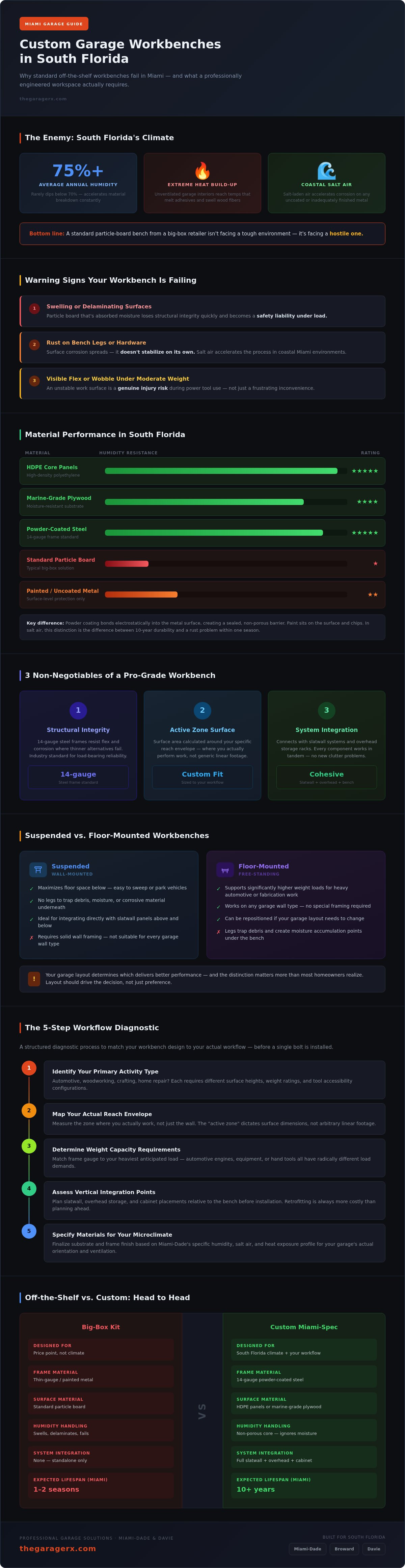
That distinction matters even more when your garage sits in South Florida. Miami's climate isn't just inconvenient; it's actively destructive to materials that weren't specified for it. Average annual humidity in Miami-Dade regularly exceeds 75 percent, and summer garage interiors without climate control can reach temperatures that accelerate the breakdown of adhesives, swell wood fibers, and corrode uncoated metal. Salt air from coastal proximity compounds the problem. A standard particle-board bench from a big-box retailer isn't facing a tough environment; it's facing a hostile one.
This is what separates a professionally prescribed installation from a temporary fix. Off-the-shelf kits are engineered to a price point, not a climate. Custom garage workbenches in Miami require material specifications and finish systems chosen specifically because they can tolerate what South Florida delivers season after season.
The Anatomy of a Professional-Grade Workspace
Professional-grade workbenches are built around three non-negotiable elements. First, structural integrity: 14-gauge steel frames are the industry standard for load-bearing reliability, resisting flex and corrosion where thinner-gauge alternatives fail. Second, surface area is calculated around your "active zone," the reach envelope where you actually perform work, not just a generic linear footage. Third, integration matters. A workbench that doesn't connect with your slatwall system or overhead storage racks creates new clutter problems rather than solving existing ones. Every component should work in tandem.
Signs Your Current Garage Setup Needs a Professional Intervention
Clutter fatigue is real. If you're moving stacked items just to access a single tool, your workspace isn't functioning; it's resisting you. Watch for these specific warning signs:
- Swelling or delaminating surfaces: Particle board that's absorbed moisture loses structural integrity quickly and becomes a safety liability under load.
- Rust on bench legs or hardware: Surface corrosion spreads. It doesn't stabilize on its own.
- Visible flex or wobble under moderate weight: An unstable work surface isn't just frustrating; it's a genuine injury risk during power tool use.
These aren't cosmetic issues. They're diagnostic signals that your garage needs a real intervention, not another temporary solution. Recovering your floor space and workflow starts with replacing what's failing with something built to perform.
Materials and Durability: Engineering for the South Florida Climate
The material specification process for custom garage workbenches in Miami isn't a preference exercise. It's a clinical decision. South Florida's combination of sustained heat, coastal salt air, and humidity that rarely dips below 70 percent creates a degradation environment that exposes every weakness in a material's composition. The right substrate doesn't just resist that environment. It ignores it.
Moisture-resistant substrates are the foundation of any bench that survives longer than a season. High-density polyethylene (HDPE) core panels and marine-grade plywood both outperform standard particle board significantly in humid conditions because they don't absorb water at the fiber level. Particle board swells, delaminates, and loses its load-bearing capacity when moisture penetrates the surface. A properly specified substrate maintains dimensional stability even when garage humidity spikes during summer storm cycles. Mold has no foothold in a non-porous core material. That distinction alone separates a professional installation from a hardware store solution.
Powder-coated steel frames are the other half of the durability equation. Unlike paint, which sits on the surface of metal and chips under UV exposure and salt air, powder coating is electrostatically applied and cured under heat to form a continuous, bonded skin over the steel. It doesn't peel. It doesn't bubble. It resists the oxidation that Miami's coastal proximity accelerates in uncoated or paint-finished metal. For homeowners who've invested in a polyaspartic floor coating, rust bleed from corroding bench legs is a direct threat to that investment. Powder-coated frames eliminate that risk at the source.
Countertop Selection: Form Meets Heavy-Duty Function
Three countertop materials dominate professional workbench installations, and each serves a distinct workflow:
- Butcher block: Dense hardwood laminations absorb impact and resist splitting under mallet and chisel work, making it the natural choice for woodworking and carpentry. It requires periodic sealing in humid climates to prevent moisture absorption at the end grain.
- Stainless steel: Non-porous and chemically resistant, stainless is the correct specification for automotive work, fluid handling, and any task requiring a surface that wipes completely clean. It doesn't harbor bacteria or absorb solvents.
- Industrial laminate: High-pressure laminate over a moisture-resistant substrate delivers strong impact resistance with a customizable finish palette. It's a practical choice when aesthetics matter alongside durability, and it performs reliably across a wide range of general workshop tasks.
Matching the countertop to the actual work performed isn't cosmetic. It's the same logic applied to ergonomic workbench design standards: the surface should serve the task, not resist it.
Hardware That Survives the Broward County Humidity
Hardware is where budget installations fail quietly over time. Full-extension ball-bearing drawer slides rated for heavy tool loads don't bind or corrode when specified correctly for humid environments. Soft-close hinges prevent the mechanical wear that repeated slamming accelerates in a busy garage. Fasteners are the detail most overlooked: zinc-plated or stainless steel hardware won't leach rust streaks onto a finished floor surface the way standard carbon steel hardware does after a single rainy season. Every component in the system needs to hold its performance standard, not just the surface you can see.
If you're ready to move from a failing setup to a system that's actually specified for where you live, explore professional workbench solutions built for South Florida and see what a properly engineered installation looks like from the ground up.
Suspended vs. Floor-Mounted: The Best Layout for Miami Garages
Choosing between a suspended and floor-mounted workbench isn't a style preference. It's a diagnostic decision, one that should be driven by your garage's flood exposure, your workflow demands, and the specific tasks you perform at that bench every week. Get this choice right, and the rest of your layout falls into place. Get it wrong, and even the best materials specification won't save you from a workspace that fights you.
South Florida adds a variable that most workbench guides ignore entirely: flood risk. Miami-Dade and Broward counties experience significant standing water events during heavy rain seasons, and garages with poor drainage can accumulate moisture at floor level within hours of a storm. Keeping cabinetry and bench structures elevated isn't an aesthetic choice here. It's a structural precaution that protects both the installation and anything stored inside it.
The Case for Suspended Workbenches
A wall-mounted, off-the-floor bench eliminates the dead zone beneath it entirely. That gap does more than look clean. It actively improves air circulation at floor level, which matters in a non-climate-controlled Miami garage where stagnant humid air accelerates surface degradation. Suspended systems also remove the hidden corners where moisture, pests, and debris accumulate invisibly over time. Maintenance becomes straightforward: sweep under, wipe down, done.
The ergonomic benefit is equally practical. A properly installed suspended bench incorporates toe-kick clearance, allowing you to stand closer to the work surface without compensating your posture. Over the course of a long project, that positioning difference is significant. And from a purely visual standpoint, a floating bench creates the kind of clean, intentional aesthetic that signals a workspace built with purpose, not assembled from whatever was available at the hardware store.
When to Choose Floor-Mounted Foundations
Some workflows demand floor-mounted construction. Heavy-duty vises, drill presses, and bench grinders generate torque and vibration that a wall-mounted system simply can't absorb at the anchor points. Floor-mounted frames distribute that load directly downward, which is the correct mechanical path for serious equipment.
Floor-mounted systems also integrate more naturally with custom garage cabinets when you're designing a seamless wall-to-wall installation. The visual continuity of a full run of cabinetry anchored to the floor creates a unified, high-end result that suspended systems can't always replicate across longer spans. One critical detail for Florida installs: heavy-duty adjustable leveling legs are non-negotiable. Garage floors in South Florida are frequently sloped for drainage, and a bench that's even slightly off-level becomes a liability the moment you're working with precision tools.
For homeowners evaluating custom garage workbenches in Miami, the honest answer is that neither system is universally superior. The correct prescription depends on your specific garage, your specific workflow, and how seriously you want to protect that installation against the next tropical storm season.
Designing Your Workflow: The 5-Step Diagnostic Process
A workbench designed without a workflow diagnosis is just furniture. Before a single measurement is taken, the right prescription requires understanding exactly how you use your garage, what tasks you perform most frequently, and how your space needs to function around those habits. This five-step process is how custom garage workbenches in Miami get designed to actually work, not just occupy wall space.
Step 1: Identify your primary work mode. Are you doing automotive maintenance, DIY home repairs, crafting, or primarily using the bench as a staging area for organized storage? Your dominant work mode determines everything downstream: surface material, depth, height, and load requirements. A homeowner rebuilding carburetors needs a completely different prescription than one assembling furniture or running a hobby workshop. Get this wrong at the start, and every subsequent decision compounds the error.
Step 2: Map your vertical real estate. The wall above your bench is as productive as the bench itself, but only when it's properly organized. Garage wall organization systems transform raw wall space into a structured tool management zone, keeping surfaces clear and frequently used items within immediate reach. Vertical mapping happens before installation, not after.
Step 3: Prescribe your lighting and power requirements. Detail work demands task-specific illumination. Precision tasks like electrical work, fine woodworking, or model assembly require dedicated LED task lighting positioned to eliminate shadows across the work surface. Power strip placement needs to be planned around cord length and equipment location, not improvised after the bench is bolted in.
Step 4: Select your countertop material. This decision was covered in depth earlier, but the diagnostic lens matters here: match the surface to actual chemical and impact exposure, not aesthetic preference. Automotive work means solvent contact. Crafting means adhesive and paint. Each demands a different surface specification.
Step 5: Finalize your traffic flow layout. A bench positioned without accounting for how you move through the garage creates bottlenecks. Garage doors, vehicle clearance, and cabinet access points all define natural circulation paths. Your bench should anchor the workspace without interrupting it.
Vertical Integration: Slatwalls and Tool Reach
The "strike zone" directly above your bench, roughly between shoulder and eye level, is where your most-used tools belong. Slatwall accessories mounted in this zone keep the work surface clear by giving every tool a fixed, visible home. That vertical discipline isn't just organizational; it reduces the physical strain of repeated reaching and searching, which adds up over the course of a long project session.
Power and Lighting: The Vital Signs of a Productive Bench
LED task lighting mounted under overhead cabinets or on adjustable arms delivers focused illumination exactly where you need it, without the heat output that fluorescent fixtures generate in an already-warm South Florida garage. Power placement matters equally. Outlets positioned at bench height eliminate the cord-on-the-floor hazard that's both a trip risk and a clutter problem. Professional installation ensures that your prescribed layout translates into a workspace that actually functions as designed, rather than one that looked good on paper but requires workarounds from day one.
If you're ready to move through this diagnostic process with a team that knows Miami-Dade's unique demands, schedule a workbench consultation with The Garage RX and get a prescription built around your actual workflow.
The Garage RX Solution: Professional Installation in Miami and Davie
Every decision covered in this guide, from substrate selection to suspended versus floor-mounted configurations, only delivers its full value when the installation is executed by a team that understands the environment it's building for. The Garage RX was founded in 2018 with a single operational premise: South Florida garages require a professional prescription, not a generic product catalog. That distinction shapes every consultation, every material specification, and every installation the team completes.
Industrial-grade materials are the baseline, not an upgrade. The Garage RX builds custom garage workbenches in Miami using the same heavy-duty standards applied across its full system: powder-coated steel frames, moisture-resistant substrates, and hardware specified for the humidity and salt air conditions that Broward and Miami-Dade homeowners deal with year-round. Nothing is specified to a price point. Everything is specified to a performance standard.
The "Total Transformation" approach matters here. A workbench installed in isolation solves one problem while leaving the surrounding space unresolved. When a workbench integrates with a slatwall system, custom garage cabinets, and a polyaspartic floor coating, the entire garage functions as a unified system. Each component reinforces the others. The floor protects against moisture migration. The slatwall keeps the bench surface clear. The cabinets handle bulk storage so the bench handles work. That's the prescription. That's the result.
Our Local Expertise in Broward and Miami-Dade
Davie-based and South Florida-focused, The Garage RX serves homeowners across Miami, Broward, and the surrounding communities with a team that works in these garages every week. Local expertise isn't a marketing phrase here. It means knowing that a garage in Coral Gables has different drainage characteristics than one in Weston, and that both face the same salt air exposure that destroys generic hardware within a season. Faster response, site-specific knowledge, and a genuine understanding of how South Florida's climate behaves across different neighborhoods are what "local" actually delivers.
Next Steps: Booking Your Diagnostic Consultation
The process starts with an on-site assessment, not a sales call. During your diagnostic consultation, the team evaluates your garage dimensions, existing layout, workflow requirements, and environmental exposure before a single recommendation is made. From diagnosis to installation, the process is structured to minimize disruption and eliminate the guesswork that turns DIY projects into repeat expenses.
You don't need to arrive with a plan. You need to arrive with your garage. The prescription follows from there.
Schedule your professional garage transformation today and get a workspace that's built for where you actually live.
Your Garage Deserves a Prescription, Not a Patch
South Florida doesn't forgive compromises. The humidity, heat, and salt air that define life in Miami-Dade will expose every weakness in a generic workbench setup, usually within a single season. What this guide has made clear is that custom garage workbenches in Miami aren't a luxury upgrade; they're the correct response to a demanding environment that standard off-the-shelf solutions were never designed to handle.
The right substrate resists moisture. The right frame finish resists corrosion. The right layout matches your actual workflow, not a generic floor plan. And when your workbench integrates with slatwall systems and overhead storage, the entire garage functions as one cohesive, productive system rather than a collection of separate problems.
The Garage RX has been delivering professional garage transformations across Broward and Miami-Dade since 2018, using industrial-grade materials specified for where you actually live. The next step is straightforward: get a diagnosis before you make another decision.
Get Your Professional Garage Diagnosis and Workbench Quote Today! Your most productive workspace is closer than you think.
Frequently Asked Questions About Custom Garage Workbenches in Miami
How much weight can a custom garage workbench hold?
A professionally built workbench using 14-gauge steel framing typically supports substantially more load than off-the-shelf alternatives, which often use thinner-gauge steel or particle board structures that flex under concentrated weight. The exact capacity depends on your specific frame configuration, anchor method, and countertop material. During a diagnostic consultation, your installation team will match the structural specification to your actual workflow demands, whether that's a single drill press or a full set of loaded tool chests.
Do I need a wall-mounted or floor-mounted workbench in my Miami garage?
The honest answer depends on two things: your flood exposure and your equipment. If your garage accumulates standing water during heavy rain, a suspended wall-mounted system keeps cabinetry and stored contents above the water line. If you're running a vise, bench grinder, or drill press that generates significant torque, a floor-mounted frame distributes that load more effectively. Neither option is universally superior; the right prescription comes from evaluating your specific garage, not a general preference.
What is the best countertop material for a garage workshop in Florida?
Stainless steel is the strongest performer for automotive and fluid-handling work because it's non-porous, chemically resistant, and wipes completely clean. Butcher block suits woodworking and carpentry tasks well, though it requires periodic sealing in humid climates to prevent moisture absorption at the end grain. Industrial laminate over a moisture-resistant substrate covers general workshop use reliably. Match the surface to your actual chemical and impact exposure, not aesthetics, and you'll get a countertop that performs rather than degrades.
How long does a professional workbench installation take in Davie?
Most standalone workbench installations are completed in a single day once the diagnostic consultation and material specification are finalized. Larger projects that integrate a workbench with slatwall systems and custom garage cabinets across a full wall run typically require additional time based on scope. The Garage RX structures its process to minimize disruption, so you're not living around an incomplete workspace for days. Your installation timeline gets confirmed before the project begins, not after.
Can I integrate a workbench into my existing garage cabinets?
Yes, and it's often the smarter approach. A workbench that connects seamlessly with your existing cabinet run creates a unified wall system rather than a collection of separate components. The key is ensuring the bench height, depth, and finish align with your current cabinetry so the integration looks intentional rather than improvised. If your existing cabinets are already showing moisture damage or structural wear, it's worth evaluating whether a full system replacement delivers better long-term value than a partial addition.
Will a custom workbench increase my South Florida home value?
A professionally installed, fully integrated garage system, including a workbench, slatwall, and floor coating, contributes to perceived home value by demonstrating a finished, functional space rather than an unimproved storage area. South Florida buyers increasingly evaluate garages as usable square footage. While specific resale value increases vary by property and market conditions, a garage that looks professionally done and functions as a workspace is a stronger selling point than one with a deteriorating particle board bench and bare concrete floors.
How do I protect my workbench from the Miami humidity?
Protection starts at the material specification stage, not after installation. Moisture-resistant substrates like high-density polyethylene core panels don't absorb humidity at the fiber level the way particle board does. Powder-coated steel frames resist the oxidation that Miami's salt air accelerates in uncoated metal. For butcher block surfaces, periodic sealing at the end grain is necessary in South Florida's climate. Hardware specified in zinc-plated or stainless steel prevents the rust bleed that corrodes adjacent surfaces over time. Custom garage workbenches in Miami that are built correctly don't require constant maintenance to survive the environment.
What is the difference between a custom workbench and a modular kit?
A modular kit is engineered to a price point and built for a generic user in a generic environment. Dimensions are fixed, materials are standardized, and the system doesn't account for your specific workflow, garage dimensions, or South Florida's climate demands. A custom workbench is prescribed around your actual space, your actual tasks, and the environmental conditions your garage faces year-round. The result isn't just a better-looking bench; it's a structurally appropriate, climate-specified workspace that integrates with your full garage system rather than sitting in isolation.