

Last August, a homeowner in Miami opened his garage to find his storage system literally swelling off the wall. The tropical humidity had turned his investment into a warped, musty liability that smelled of mildew. You shouldn't have to treat your home like a disaster zone every time the dew point rises. It's frustrating to watch expensive shelving succumb to rust and pests. This 2026 guide provides the diagnostic expertise you need to select durable garage cabinets for humid climates that remain structurally sound for over a decade. We'll identify the specific materials that survive the moisture levels and technical standards defined by the latest Florida Building Code. You'll discover why a combination of powder-coated finishes and off-the-floor suspension is the only professional prescription for a lasting installation. We will break down the technical differences between moisture-resistant substrates and why certain finishes are non-negotiable in our environment. It's time to transform your garage from a source of stress into a clean, high-end environment that handles the heat.
Key Takeaways
- Learn why standard wood bases fail and how to neutralize the "wicking" effect from moisture-heavy concrete floors.
- Identify the specific technical substrates required for durable garage cabinets for humid climates to prevent internal rot and swelling.
- Implement the off-the-floor suspension method to safeguard your investment against seasonal flooding and common Florida pests.
- Execute a professional site audit to diagnose moisture sources and optimize your vertical storage layout.
- Transition your garage from environmental chaos to a structured, high-end clinic using the specialized Garage RX prescription.
Why Standard Garage Cabinets Fail in South Florida's Humidity
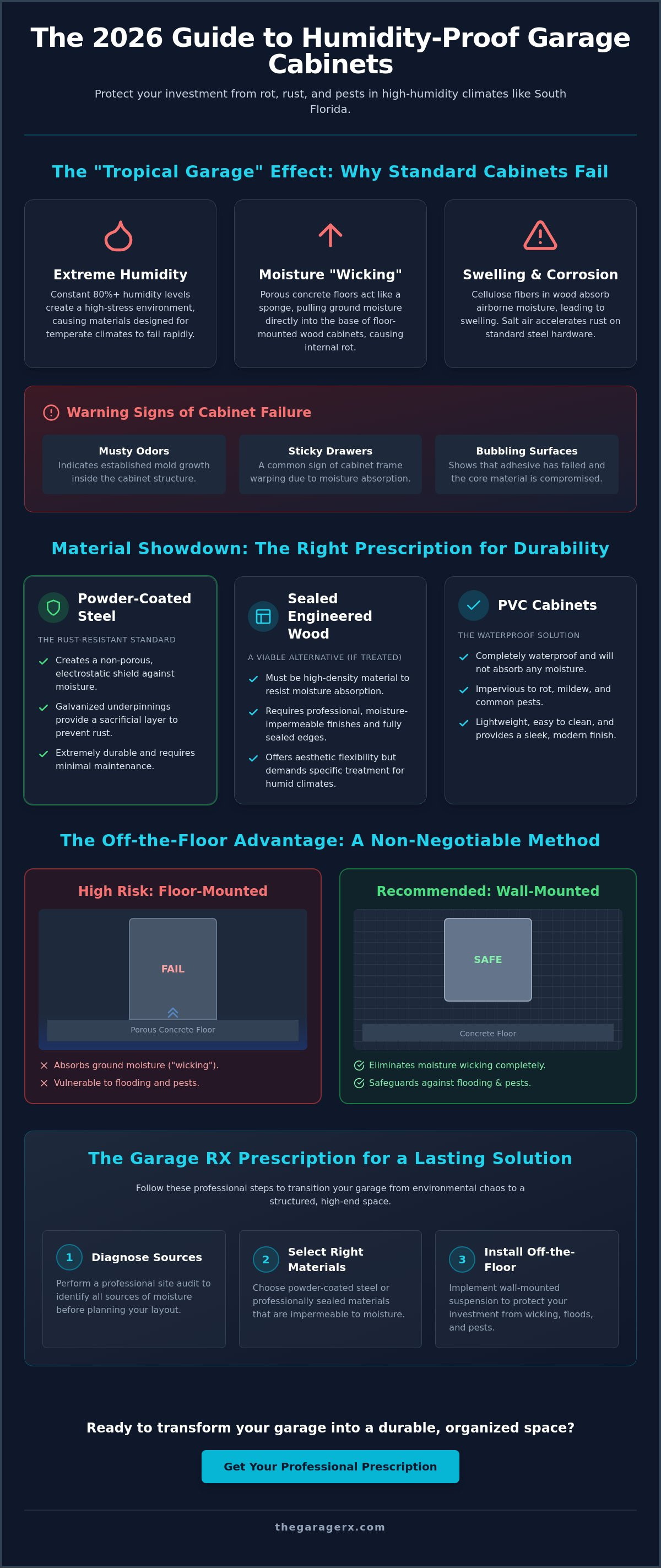
South Florida garages aren't just storage spaces; they're high-stress environments. The combination of intense heat and pervasive humidity creates a "Tropical Garage" effect that punishes standard materials. Most homeowners discover that off-the-shelf solutions are designed for temperate climates, not the 80% humidity levels common in Davie or Miami. When you invest in durable garage cabinets for humid climates, you're making a calculated decision to avoid the cycle of rot and replacement. Identifying these environmental stressors is the first step in a successful spatial recovery.
One of the most overlooked issues is the "wicking" phenomenon. Concrete floors are naturally porous. They act like a sponge, pulling moisture from the ground and trapping it beneath anything sitting on the surface. Standard wood-based cabinets with floor-mounted bases absorb this moisture directly. This leads to internal rot long before you see the damage on the outside. This isn't just a maintenance problem; it's a structural failure that requires a professional intervention rather than a temporary DIY patch. Without a specialized plan, even the most organized space will eventually succumb to the elements.
The Science of Swelling and Corrosion
Cheap wood cabinets rely on cellulose fibers held together by resins. These fibers have a natural tendency to absorb moisture from the surrounding air. In our coastal environment, salt air acts as a catalyst for oxidation. It turns standard steel hinges into rusted relics within months. Labels claiming "water-resistance" often fall short. They don't account for the constant, 24/7 vapor pressure found in South Florida. The technical requirements for durable garage cabinets for humid climates go beyond simple aesthetics; they must be engineered to resist these molecular-level changes and the corrosive nature of our salt-heavy breeze.
Identifying the 'Symptoms' of Failing Storage
A failing storage system often presents specific warning signs. Musty odors are the first indicator. They suggest mold growth is already established within the cabinet carcass. You might notice sticky drawers. This isn't just a hardware issue; it's often a sign of frame warping. Visible bubbling on melamine or particleboard exterior surfaces means the adhesive has failed. These symptoms indicate that the environment has compromised the integrity of your storage. Recovery starts with a proper diagnosis of these failure points to ensure the next installation remains as tidy and efficient as the day it was installed.
Choosing the Right Materials: Metal vs. Engineered Wood vs. PVC
Selecting the correct substrate is the most critical decision in your garage's treatment plan. Standard materials often fail because they lack the necessary barriers against South Florida's relentless vapor pressure. In environments where humidity consistently exceeds 80%, the choice between metal and engineered wood determines whether your storage lasts two years or twenty. Effective Moisture Control for New Residential Buildings in hot-humid climates relies on materials that don't promote mold growth or structural decay. You need a solution that acts as a fortress against salt air and internal rot.
The gold standard for durable garage cabinets for humid climates involves a specialized prescription of moisture-impermeable finishes and sealed edges. If you use your garage as a high-traffic workshop or a storage zone for heavy equipment, your material requirements will differ from a homeowner seeking a sleek, aesthetic organization system. Consulting with an expert for custom garage cabinets ensures your materials match your specific environmental needs and usage patterns.
Powder-Coated Steel: The Rust-Resistant Standard
Powder-coating isn't just paint. It's an electrostatic bond that creates a non-porous shield around the metal. This process is superior to standard liquid paint because it eliminates the microscopic pinholes where moisture enters. For coastal Davie homes, we recommend galvanized steel underpinnings. The zinc coating provides a sacrificial layer that prevents rust from reaching the structural core. Maintenance is minimal; a simple wipe-down with mild soap and water every few months keeps the protective barrier intact and looking pristine.
High-Grade Engineered Wood with Moisture Seals
High-density engineered wood can be an excellent choice if it's treated with a professional RX approach. This involves using high-density materials finished with Thermally Fused Laminate (TFL). TFL creates a surface that's essentially plastic, making it impervious to airborne moisture. However, the edge-banding is the most critical feature. Every exposed edge must be sealed with a thick PVC band to prevent the internal fibers from absorbing humidity. While plywood offers superior weight-bearing strength, high-density particleboard with TFL and sealed edges often provides better dimensional stability in fluctuating temperatures. This prevents the sagging and warping common in lower-grade cabinets.
The 'Off-the-Floor' Advantage for Humid Environments
Suspension isn't just a design choice; it's a strategic necessity in South Florida. While material selection provides the chemical resistance you need, the installation method provides the physical defense. Wall-mounted systems solve the primary vulnerability of ground-level storage. They eliminate the point of contact between your investment and the moisture-rich concrete floor. This design choice is fundamental when installing durable garage cabinets for humid climates. It ensures that even during the most intense afternoon thunderstorms, your belongings remain high and dry.
Airflow is the secret weapon against material degradation. When cabinets sit flush against the floor or on short legs, they create stagnant micro-environments. These pockets trap humidity and provide the perfect breeding ground for spores. Following the EPA's guide to moisture control, maintaining proper ventilation is essential to prevent mold growth. A floating system allows air to circulate freely beneath and behind the units. This constant movement helps regulate surface temperatures and reduces the risk of condensation forming on the cabinet carcass. It's a technical solution for a persistent environmental challenge.
Preventing Wicking and Water Damage
Adhering to the "6-inch rule" is a non-negotiable part of our professional prescription. By suspending cabinets at least six inches off the ground, you neutralize the wicking phenomenon. This clearance protects your storage from water that often gets pushed under garage doors during tropical storms. It also safeguards your investment during routine garage wash-downs or accidental spills. In Florida's Concrete Block Structure (CBS) homes, we utilize heavy-duty fasteners to secure these systems directly into the masonry. This creates a structural bond that supports hundreds of pounds without the need for floor contact, ensuring your storage remains stable and secure.
Ease of Cleaning and Pest Control
Standard floor-mounted cabinets often become a "pest hotel." The dark, undisturbed space behind a toe-kick is an ideal nesting ground for South Florida rodents and insects. Transitioning to a floating system removes this sanctuary. You gain full visibility of your floor, which acts as a natural deterrent for pests. Maintenance becomes a streamlined process. You can use a leaf blower or a damp mop to clear out dust and debris in seconds. This creates an orderly, clinical environment that looks as high-end as it functions. Investing in durable garage cabinets for humid climates that hang on the wall results in a serene space that stays clean with minimal effort.
Planning Your Layout: From Diagnostic to Installation
Successful restoration of your garage requires a disciplined plan of action. You can't simply install storage and expect it to survive the South Florida environment without a proper diagnostic approach. We begin with a comprehensive site audit to identify moisture ingress points and assess the structural integrity of your walls. In many Florida homes, this means verifying the load-bearing capacity of CBS (concrete block) substrates to ensure they can support heavy-duty wall-mounted systems. This initial assessment prevents the frustration of future structural failure and ensures you are investing in durable garage cabinets for humid climates that remain secure for decades.
Once we diagnose the environment, we focus on maximizing your vertical storage. Moving items off the floor and onto the walls is the most effective way to recover your space and improve functionality. This step involves more than just hanging shelves. It's a methodical process of determining your storage volume and weight requirements to ensure the layout remains orderly and efficient. A professional installation ensures that every unit is perfectly level and securely anchored, providing the serene, high-end environment you deserve. To start your spatial recovery, schedule a consultation for custom garage cabinets today.
Integrating Cabinets with Polyaspartic Flooring
Integrating your storage with a polyaspartic floor finish is the first step in creating a moisture-free garage. This high-performance coating acts as a non-porous seal that prevents concrete from wicking moisture into the room. When you combine a sealed floor with floating cabinets, you create a seamless transition that is both aesthetically pleasing and highly functional. This combination significantly reduces the amount of concrete dust and ambient humidity in the space. It's a technical intervention that protects both your floor and your storage investment from the ground up.
Measuring for Airflow and Ventilation
Precision in layout planning includes accounting for material expansion and contraction. We strategically space cabinets to allow for natural airflow and keep them away from localized moisture sources like water heaters or utility sinks. Vented cabinets are the optimal choice for storing tools in humid zones because they facilitate constant air exchange to prevent localized condensation. This detail-oriented approach ensures that your durable garage cabinets for humid climates don't just look organized but also maintain a healthy internal environment for your belongings. Proper spacing is the final technical requirement for a garage that stays tidy, dry, and professional.
The Garage RX Prescription for a Durable, Organized Space
Ending the cycle of garage dysfunction requires more than a weekend trip to a big-box store. Off-the-shelf kits are built for the average climate, but the average climate doesn't include 90-degree dew points and salt-laden air. In Davie and Miami, a generic storage solution is often a temporary patch rather than a permanent cure. Selecting durable garage cabinets for humid climates demands a professional prescription that accounts for local environmental stressors. We move beyond the surface-level clutter to address the structural health of your storage, turning environmental chaos into a functional, high-end clinic.
Our local expertise in Broward and Miami-Dade allows us to select materials that have been field-tested against Florida's unique humidity profiles. We understand that a garage in a coastal High-Velocity Hurricane Zone (HVHV) has different technical requirements than a standard interior closet. By focusing on professional-grade substrates and specialized installation techniques, we ensure your storage remains as resilient as it is beautiful. This disciplined approach is the only way to achieve a serene, orderly environment that lasts for a decade or more. It's time to stop managing the symptoms of a messy garage and start implementing a total spatial recovery.
Custom Design for Davie and Miami Homes
Every South Florida garage has a unique footprint that requires a tailored approach. We don't believe in one-size-fits-all solutions because your storage should mirror your specific lifestyle. Whether you need deep cabinets for bulky boating gear, specialized racks for golf clubs, or ventilated zones for beach equipment, the dimensions must be precise. You can find technical inspiration in our guide to custom garage cabinets. By tailoring the height and depth of every unit, we maximize your square footage while maintaining the airflow necessary for material longevity. This level of customization ensures that every item has a dedicated place, keeping your floor clear and your mind at ease.
Professional Installation vs. DIY Kits
The primary risk of DIY kits in Florida is improper anchoring. Most residential garages here utilize Concrete Block Structure (CBS) construction, which requires specialized fasteners and drilling techniques to ensure a permanent bond. A failure in anchoring doesn't just result in a crooked cabinet; it can lead to a catastrophic collapse under the weight of heavy tools. Professional-grade hardware is the secret to long-term cabinet health. We utilize heavy-duty suspension systems that distribute weight evenly across the masonry, preventing the sagging and pulling common in amateur installations. If you're ready for a permanent intervention, contact The Garage RX today for your garage transformation. Our team will provide the diagnostic expertise and precision installation needed to secure your investment against the elements.
Secure Your Permanent Spatial Recovery
Your garage doesn't have to be a casualty of the South Florida climate. By prioritizing moisture-impermeable materials and off-the-floor suspension, you effectively neutralize the environmental stressors that destroy standard cabinetry. This guide has detailed how technical precision in material selection and site-specific planning creates a storage system that lasts. Investing in durable garage cabinets for humid climates is a specialized plan of action that recovers your space from environmental chaos. We provide professional installation across Broward, Miami-Dade, and Palm Beach; this ensures every unit is securely anchored to handle the unique demands of our coastal environment. Our team utilizes specialized moisture-resistant material selection and custom-designed storage tailored to your boating, golf, and beach lifestyle. It's time to move from the frustration of a dysfunctional space to the serene satisfaction of a high-end environment. Schedule Your Professional Garage Diagnostic with The Garage RX and secure a permanent cure for your storage needs. You've earned a space that is as orderly and resilient as the rest of your home.
Frequently Asked Questions
Are metal cabinets better for humid garages?
Metal cabinets offer superior performance if they feature a powder-coated finish or aluminum construction. Standard liquid paint often fails in our humidity, but powder-coating creates an electrostatic shield against moisture. This prevents the oxidation that destroys generic steel units. If your garage lacks climate control, metal is the professional choice to ensure your storage remains structurally sound for over a decade.
How do I prevent my garage cabinets from molding in Florida?
Prevent mold by eliminating porous surfaces and ensuring constant airflow throughout the space. You should choose non-cellulosic materials or high-density substrates finished with thermally fused laminates. Suspending your units at least six inches off the floor prevents moisture wicking from the concrete. This combination is the standard prescription for maintaining a clean, healthy environment in a tropical climate.
What is the best material for garage cabinets in a coastal climate?
Powder-coated steel and high-density melamine with sealed PVC edges are the best materials for our environment. These substrates resist the 80% humidity levels common in South Florida. In coastal areas, aluminum is the gold standard because it is naturally immune to salt-air corrosion. Selecting durable garage cabinets for humid climates requires materials that act as a vapor barrier against the elements.
Should garage cabinets be mounted to the wall or sit on the floor?
Wall-mounted cabinets are the only professional recommendation for Florida garages. Suspending units off the floor protects them from moisture wicking and the occasional floodwater pushed under the door during storms. This design also eliminates "pest hotels" where rodents and insects nest. Floating cabinets allow for easy cleaning and better airflow, which are both vital for long-term durability.
Can I use MDF cabinets in a non-climate-controlled garage?
You should avoid standard MDF in non-climate-controlled garages. MDF is highly hygroscopic, meaning it absorbs airborne moisture and swells like a sponge. This leads to delamination and structural failure within months. If you prefer a wood-look finish, you must use high-density substrates with industrial-grade edge banding and thermally fused surfaces to create a moisture-proof seal.
How much does a professional garage cabinet installation cost in South Florida?
Professional installation costs vary based on the configuration and material grade selected. Factors such as wall substrate, cabinet volume, and integrated features like workbenches or slatwalls influence the final investment. Because every space requires a unique diagnostic approach, we recommend a formal consultation to determine the exact scope and all-inclusive costs for your specific spatial recovery project.
Will salt air rust my stainless steel garage cabinets?
Salt air can cause "tea staining" or surface pitting even on stainless steel if it is not the correct grade. Coastal homes require 316-grade stainless steel or, preferably, powder-coated aluminum to neutralize the corrosive effects of the breeze. Regular maintenance with a specialized cleaner helps maintain the protective layer. Without these precautions, the salt air will eventually compromise the aesthetic and structural integrity of the metal.
How do I clean my garage cabinets without causing water damage?
Clean your cabinets using a microfiber cloth dampened with a mild soap and water solution. You should never use a garden hose or pressure washer directly on the cabinet surfaces. Wipe the units dry immediately to prevent moisture from lingering on the edges or hardware. This disciplined maintenance routine preserves the finish and ensures your storage system continues to look and function like new.