

That standard epoxy kit from the big-box store isn't a solution for your garage; it's a pre-existing condition waiting to fail. Most homeowners in South Florida expect their garage floor to look like a showroom, yet they're often stuck staring at peeling gray paint, yellowed surfaces, and ugly hot tire marks. It's frustrating to invest time and money into a space only to have the humidity bubble the finish within a year.
In this guide, you'll discover why Florida's unique climate demands a specific flooring prescription and how to choose the coating that actually survives South Florida's relentless moisture. When it comes to high-performance polyaspartic flooring palm beach county residents need a solution that won't succumb to UV exposure or heavy vehicle heat. We'll break down the technical differences between epoxy and polyaspartic, showing you how to achieve a maintenance-free, high-gloss floor that increases your property value. From diamond-grinding preparation to industrial-grade application, we're providing the professional diagnosis for a clean, organized, and permanent garage transformation.
Key Takeaways
- Identify why South Florida's high humidity and water table act as the primary enemies of standard concrete coatings, leading to peeling and bubbling.
- Explore why polyaspartic flooring palm beach county provides the specific UV resistance and heat tolerance needed for open garage environments.
- Stop the frustration of hot tire pickup by learning how modern aliphatic polyurea prevents chemical fusion with your vehicle's tires.
- Avoid the "cheap floor trap" by calculating the true return on investment for professional diamond-grinding and industrial-grade applications.
- Transform your dysfunctional space into a high-end, maintenance-free environment with a specialized professional prescription for your concrete.
The South Florida Garage Environment: A Diagnostic Challenge
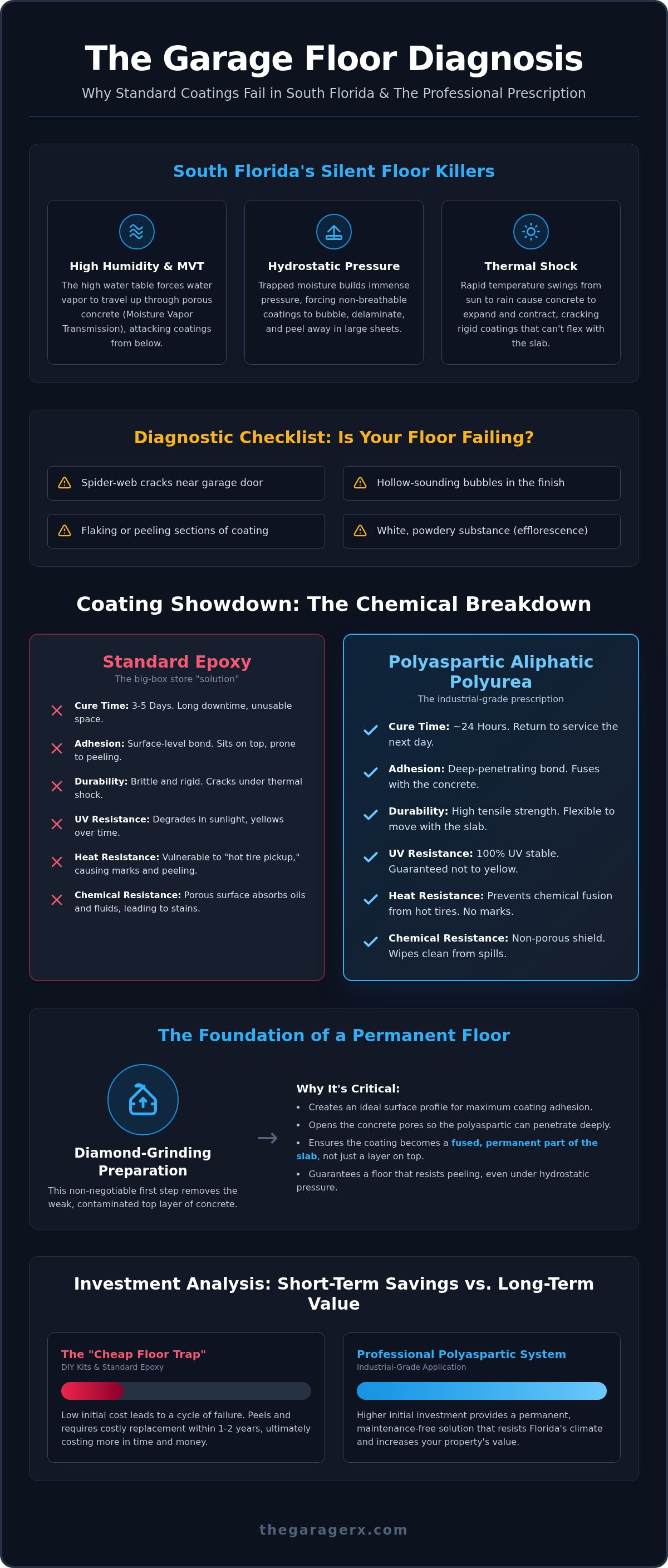
Your garage floor is under constant environmental assault. In South Florida, the primary enemy isn't just heavy traffic or oil spills; it's the invisible humidity trapped within the concrete itself. Because our region sits on a high water table, your concrete slab acts like a massive sponge. This creates a phenomenon known as Moisture Vapor Transmission (MVT). Water moves from the damp soil upward through the porous concrete, seeking to evaporate into the air. This isn't just a surface issue; it's a structural reality for every home from Davie to Jupiter.
Hydrostatic Pressure: The Silent Floor Killer
When you apply a standard epoxy coating, you're essentially placing a non-breathable plastic cap over the concrete. As hydrostatic pressure builds, that water vapor has nowhere to go. It collects at the bond line, creating "sweating slab syndrome." Eventually, the pressure forces the coating to bubble, delaminate, and peel away in large sheets. For high-performance polyaspartic flooring palm beach county homes require, the material must form a deep mechanical bond that resists this upward force. Unlike brittle epoxy that eventually snaps under stress, a professional-grade system is engineered to handle the constant moisture cycle of coastal Broward and Palm Beach counties.
Thermal Shock and Concrete Expansion
Florida weather follows a predictable, brutal pattern: 90-degree heat followed by sudden afternoon thunderstorms. This causes rapid "thermal shock." Your concrete expands in the heat and then quickly contracts as cool rain hits the slab. If your floor coating is too rigid, it can't move with the concrete. This leads to micro-cracking and delamination. We treat these environmental factors as symptoms of an underlying condition. Use this diagnostic check to see if your current floor is suffering from thermal stress:
- Spider-web cracks appearing near the garage door opening where sun exposure is highest.
- Small, hard bubbles that feel hollow when tapped, indicating trapped vapor pockets.
- Flaking sections where the coating has lost its grip on the "sweating" concrete.
- A white, powdery substance known as efflorescence appearing under the finish.
Salt air in coastal communities adds another layer of complexity. It accelerates the degradation of the concrete surface, making professional diamond-grinding preparation non-negotiable. Without removing that compromised top layer, even the best polyaspartic flooring palm beach county can offer won't achieve the deep "root" bond necessary for long-term health. Our installation process focuses on preparing the substrate to accept the coating, ensuring the prescription actually takes hold.
Epoxy vs Polyaspartic: The Chemical Breakdown
Choosing the right coating requires a clear diagnostic view of molecular structures. Epoxy is a thermosetting resin that has served as the industry standard for decades. It creates a hard, thick layer, but it's essentially a surface-level treatment. Polyaspartic is an aliphatic polyurea, representing a significant technological evolution. It doesn't just sit on top of the concrete; it penetrates the open pores created during the diamond-grinding process. This creates a fused system rather than a simple overlay.
Time is a critical factor in any professional intervention. Epoxy typically requires three to five days to fully cure before it can support vehicle traffic. In contrast, polyaspartic systems are ready for use in roughly 24 hours. This efficiency is vital for polyaspartic flooring palm beach county homeowners who need to restore their space to full functionality without a week of downtime. The adhesion mechanics are also superior. Polyaspartic "wets out" the concrete, biting deeper into the substrate to ensure the coating becomes a permanent part of the floor.
Tensile Strength and Shore Hardness
Shore hardness measures a material's resistance to indentation. While epoxy is undeniably hard, it lacks elongation properties. It's brittle. In the intense South Florida heat, your concrete slab is dynamic; it moves. If a coating is too rigid, it cracks when the slab expands. Polyaspartic maintains a high shore hardness while offering superior tensile strength. It's flexible enough to move with the slab without losing its bond. This prevents the micro-cracking often seen in older epoxy installations.
Chemical Resistance and Porosity
Density is your best defense against common garage hazards. Epoxy is naturally more porous than polyaspartic. If battery acid, brake fluid, or motor oil sits on an epoxy surface, it can eventually seep in and cause permanent staining. Polyaspartic creates a non-porous shield. It's an impermeable barrier that keeps fluids on the surface for easy cleanup. This is the professional Rx for a spill-proof environment. You can consult with our specialists to determine which high-performance system best suits your garage's specific requirements.
Combatting Hot Tire Pickup and UV Damage in Palm Beach
Palm Beach residents often open their garage doors to enjoy the coastal breeze, but this simple act exposes the floor to intense UV radiation. While standard epoxy is a common choice, it suffers from a fatal flaw in high-sunlight environments. It's chemically "aromatic," meaning its molecular structure reacts poorly to light exposure. This leads to a distinct yellowing effect that ruins the aesthetic of your home and makes a clean space look aged and neglected.
The Science of Ambering
UV rays act as a catalyst that breaks down the polymer chains within epoxy resins. This degradation, known as ambering, isn't just a cosmetic issue; it signals a loss of structural integrity. Even indirect sunlight reflecting off your driveway can trigger this reaction over time. For the high-performance polyaspartic flooring palm beach county homes require, we utilize aliphatic polyurea. This chemistry acts as a 100% UV-stable sunscreen for your concrete. It remains crystal clear for the life of the floor, regardless of how often you leave the garage door open to the Florida sun.
Eliminating Hot Tire Peel
Hot tire pickup is the number one cause of epoxy floor failure. This phenomenon occurs when your vehicle's tires reach high temperatures on South Florida asphalt, causing the rubber to soften and expand. When you park in the garage, the tires cool and contract, creating a vacuum-like seal against the floor coating. If you're using a standard DIY kit or low-grade epoxy, the tire will literally rip the coating off the concrete when you drive away.
When installing polyaspartic flooring palm beach county residents can trust, we focus on high cross-linking density. This molecular "web" is too tight for the softened rubber to penetrate or bond with. This prevents the vacuum seal from forming, ensuring your floor stays intact even after a long summer commute. By choosing a material engineered for these specific thermal stresses, you eliminate the cycle of constant patching and repair. Our diagnostic approach ensures your floor resists the most common environmental stressors in the region:
- Prevents unsightly yellowing and discoloration from UV exposure.
- Resists the chemical fusion of high-performance tires.
- Maintains high-gloss clarity in coastal environments.
- Protects against the softening of rubber during 90-degree days.
By addressing the chemical causes of floor failure, we provide a permanent resolution rather than a temporary fix. This transition from a failing epoxy surface to a resilient polyaspartic system is the primary step in recovering your garage's functional beauty.
Cost-Benefit Analysis: Short-Term Savings vs Long-Term Value
Many homeowners fall into the "cheap floor trap" by opting for big-box DIY epoxy kits. While the initial investment seems lower, these products are not engineered for South Florida's high water table or intense humidity. In Palm Beach County, a failing garage floor is more than an eyesore; it's a liability that eventually requires professional intervention. A professional polyaspartic installation offers a significant return on investment by eliminating the need for periodic re-coating. It transforms a dark, dysfunctional storage area into a high-end, organized extension of your home environment.
Property value is another critical factor for local homeowners. Florida buyers increasingly view the garage as a primary entryway and a reflection of the home's overall maintenance. A clean, high-gloss floor suggests a disciplined approach to property care and provides an immediate competitive edge in the luxury real estate market. Additionally, the cost of downtime is often overlooked in the decision-making process. Standard epoxy requires you to park your vehicles on the street for up to a week. Our high-performance systems allow you to return to full service and pull your cars back inside in just 24 hours.
The Hidden Costs of Epoxy Failure
The most expensive way to renovate is to do it twice. When a low-grade coating fails due to moisture or heat, the remediation process is intensive. We must perform a surgical removal of the old material using diamond grinders before the new treatment can begin. This often doubles the labor involved in the project. You can find more detailed information on long-term performance in our Polyaspartic Floor Coating Reviews.
Professional Prep: The Secret to Longevity
A permanent bond requires mechanical intervention rather than chemical washes. DIY kits suggest acid etching, which merely cleans the surface without creating the necessary "profile" for adhesion. We utilize industrial diamond grinding to open the pores of the concrete. This ensures the polyaspartic flooring palm beach county residents invest in actually fuses with the substrate. For a deeper look at material specifications and installation standards, see our guide on High-Performance Epoxy Coating for Garage Floor.
Investing in a specialized prescription for your concrete prevents environmental chaos and long-term frustration. Don't settle for a temporary bandage when you can secure a permanent resolution. Contact our team for a professional floor evaluation to ensure your garage transformation is handled with technical precision from day one.
The Garage RX Professional Prescription for Your Floor
At The Garage RX, we treat every garage as a unique case study. We don't believe in one-size-fits-all fixes. Instead, we apply a diagnostic mindset to identify the specific environmental stressors affecting your concrete. Our specialized polyaspartic flooring palm beach county residents trust is engineered specifically for the humidity and heat of the local climate. We provide a surgical intervention that transforms your floor from a source of frustration into a high-end, maintenance-free environment.
The Diagnostic Installation Process
Our team follows a methodical, three-step protocol to ensure a permanent bond. We don't take shortcuts because we value long-term durability over quick, superficial results. Our process includes:
- Industrial Diamond Grinding: We utilize specialized machinery to remove the top layer of compromised concrete. This achieves the perfect Concrete Surface Profile (CSP), allowing the coating to root deep into the slab.
- Substrate Repair: We identify and repair structural flaws. Using high-strength menders, we address cracks and pits to create a perfectly level and stable surface.
- Precision Application: We apply a high-solids base coat followed by a full flake broadcast. We finish with a chemical-resistant top coat that provides a high-gloss, non-porous shield.
Reclaiming Your Space in Palm Beach County
A professional floor is just the first step toward a total recovery of your space. To achieve a full cure for garage chaos, we recommend integrating custom garage cabinets. These systems provide the organization necessary to maintain your new high-gloss environment. For the high-performance polyaspartic flooring palm beach county homeowners deserve, the final result should feel like a usable room, not just a storage shed.
Maximize your vertical real estate by pairing your new floor with overhead garage storage racks miami. This removes clutter from the floor, highlighting the beauty and clarity of your new coating. Our one-day promise ensures that this entire transformation happens with professional efficiency. We respect your time and your property, delivering a clean and orderly installation process from start to finish.
Stop tolerating a dysfunctional garage. It's time for a professional intervention that increases your property value and restores your peace of mind. Contact The Garage RX for your free diagnostic consultation and let us prescribe the permanent solution your home needs.
Secure a Permanent Resolution for Your Garage Floor
Your garage floor shouldn't be a source of constant frustration. By choosing a professional polyaspartic system over standard epoxy, you're addressing the root cause of floor failure in South Florida. We've seen how hydrostatic pressure and UV exposure destroy inferior coatings; we're here to provide the long-term cure. Since 2018, The Garage RX has served Palm Beach, Davie, and Miami with a disciplined approach to concrete health and spatial organization.
We utilize industrial-grade materials and mandatory diamond-grinding preparation to ensure every installation is permanent. When you invest in the high-performance polyaspartic flooring palm beach county homes require, you're choosing durability that survives the humidity. It's time to reclaim your space and move from a dysfunctional environment to a clean, organized, and high-end garage. Our team is ready to help you envision the final result and execute the transformation with technical precision.
Book Your Free Garage Diagnostic Consultation
Take the first step toward a maintenance-free floor today and enjoy the relief of a professionally finished space.
Frequently Asked Questions
Is polyaspartic really better than epoxy for Florida garages?
Polyaspartic is the superior prescription for South Florida's specific environmental challenges. While epoxy is a traditional choice, it often fails under the intense UV exposure and high humidity common in Palm Beach. Polyaspartic offers four times the durability of standard epoxy and doesn't yellow over time. It creates a flexible, industrial-grade bond that moves with your concrete slab during rapid temperature shifts, preventing the cracking and peeling seen in inferior systems.
How long does a polyaspartic garage floor coating last in South Florida?
A professionally installed polyaspartic floor is engineered to last for several decades. Because we utilize industrial diamond-grinding preparation, the coating fuses deeply with the concrete substrate. This prevents the delamination issues that typically plague DIY applications. In the harsh coastal climate of Davie and surrounding areas, this longevity is a significant benefit. It provides a permanent resolution to floor degradation rather than a temporary surface-level bandage that requires frequent re-coating.
Can I install polyaspartic flooring myself with a kit?
Attempting a DIY installation with polyaspartic is highly discouraged due to the material's rapid cure time. Unlike epoxy, which remains workable for hours, polyaspartic sets quickly and requires a synchronized professional team to apply correctly. Additionally, achieving a permanent bond requires industrial diamond grinding to open the concrete's pores. Most consumer-grade kits rely on acid etching, which is an insufficient preparation method for Florida's high moisture levels and dense concrete slabs.
What happens if my garage floor has high moisture levels?
High moisture levels lead to Moisture Vapor Transmission (MVT), where water pushes up through the porous concrete. If your floor has a non-breathable coating like standard epoxy, this pressure causes unsightly bubbling and peeling. Our diagnostic approach involves testing for moisture before installation. We prescribe a high-performance system designed to handle these hydrostatic pressures. Choosing polyaspartic flooring palm beach county residents trust ensures the coating remains bonded even when the Florida water table rises.
Will hot tires peel up a polyaspartic floor coating?
Hot tires will not peel a professionally applied polyaspartic coating. This failure, known as hot tire pickup, occurs when heat from your vehicle's tires softens low-grade epoxy, causing it to bond to the rubber and pull away from the floor. Polyaspartic features a dense cross-linking molecular structure that is chemically resistant to this heat-induced fusion. Your floor remains intact and high-gloss, regardless of how hot the asphalt gets during a typical South Florida summer afternoon.
How soon can I drive on my new polyaspartic garage floor?
You can typically return your vehicles to the garage within 24 hours of the final application. This rapid return to service is one of the primary advantages of our polyaspartic systems. While epoxy requires you to park on the street for three to five days, our efficient process minimizes disruption to your daily routine. Foot traffic is often permissible in as little as four to six hours, allowing you to reclaim your organized space almost immediately.
Does polyaspartic flooring get slippery when wet?
Any high-gloss surface can become slippery when wet, but we integrate slip-resistant additives into our top coats to mitigate this risk. We broadcast decorative flakes and specialized traction agents that provide a textured finish without sacrificing the clean, high-end aesthetic. This is a vital safety feature for South Florida garages, which often deal with wind-blown rain and high humidity. It ensures your floor is both aesthetically pleasing and functionally safe for your family.
Why does my current epoxy garage floor look yellow?
Your epoxy floor looks yellow because it has undergone a chemical reaction called ambering. Standard epoxy resins are not UV-stable; they break down when exposed to the intense sunlight that streams through an open garage door. This degradation isn't just cosmetic; it indicates that the polymer chains are weakening. Our polyaspartic prescription utilizes aliphatic chemistry, which is 100% UV-stable. It remains crystal clear for the life of the floor, resisting the discoloration caused by the Florida sun.