

Is your garage floor suffering from a chronic case of "hot tire pickup" or unsightly yellowing? Many homeowners believe a standard epoxy kit is the universal cure for a dusty concrete floor, but in the volatile climate of South Florida, that's often a misdiagnosis that leads to total system failure within a single season. You deserve a space that reflects the high-end value of your home, not a peeling, stained surface that "sweats" every time the humidity spikes in Davie or Fort Lauderdale.
When evaluating epoxy vs polyaspartic for florida garage installations, it's vital to understand that our local environment demands a specialized prescription. You need a floor that won't flake under heat or fade under the intense tropical sun. This 2026 professional comparison breaks down the technical differences between these two popular coatings, proving why polyaspartic has become the essential treatment for a durable, maintenance-free environment. We will examine the science of moisture vapor transmission, UV stability, and the specialized diamond-grinding prep process required to transform your garage into a showroom-quality asset that increases your property value for years to come.
Key Takeaways
- Identify why South Florida’s high water table and intense humidity lead to the premature failure of standard DIY floor kits.
- Analyze the technical differences between epoxy vs polyaspartic for florida garage floors to determine which material offers the best UV protection and flexibility.
- Learn how to prevent "hot tire pickup" by choosing industrial-grade coatings designed for the extreme road temperatures found in Davie and Miami-Dade.
- Understand why professional diamond grinding is a non-negotiable step for creating a permanent bond between the coating and your concrete.
- Discover how a specialized floor treatment serves as the foundation for a complete garage transformation that increases your property's resale value.
The South Florida Garage Diagnosis: Why Standard Coatings Fail
Your garage floor is under constant environmental assault. In Davie and across Broward County, homeowners often report a recurring set of symptoms: unsightly peeling under tires, bubbling surfaces, and stubborn oil staining. These aren't just cosmetic flaws. They're signs of a systemic failure caused by the unique South Florida climate. When comparing epoxy vs polyaspartic for florida garage applications, you must first understand why standard "off-the-shelf" kits from big-box stores are merely temporary bandages. These retail products lack the industrial-grade chemistry required to withstand our specific regional stressors. They offer a cosmetic fix for a problem that requires a structural solution.
The Humidity Factor: Why Adhesion is Critical
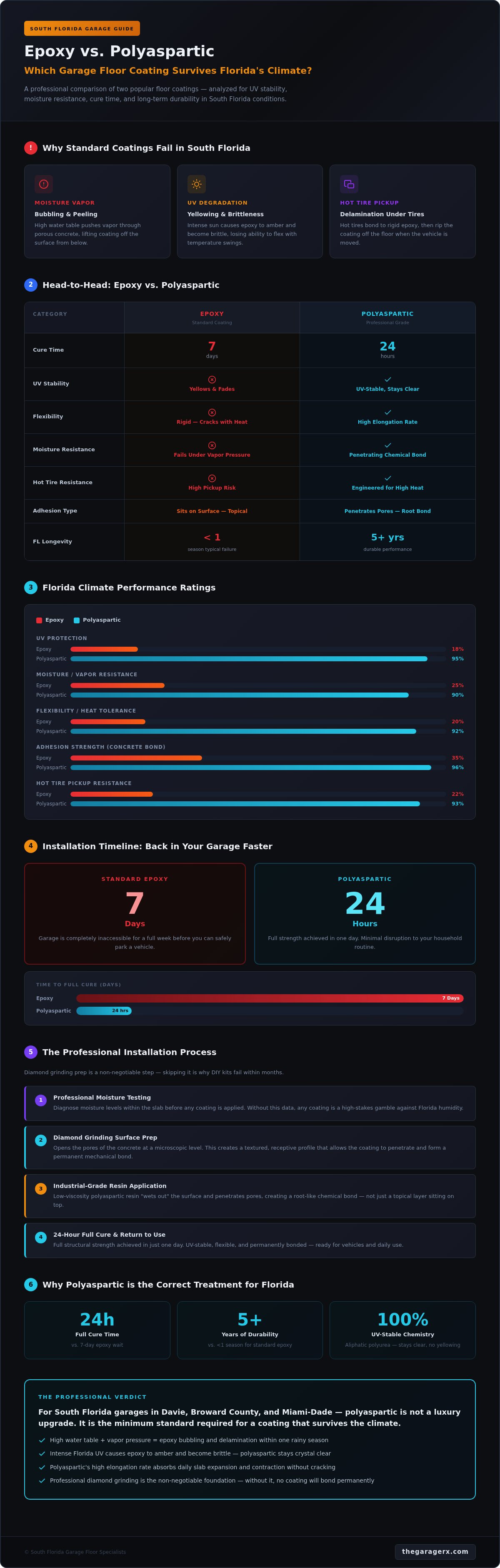
South Florida sits on a high water table. This means the soil beneath your garage slab is often saturated. Through a process called moisture vapor transmission, water moves upward through the porous concrete. If you apply a standard epoxy, this vapor pressure builds up until it literally pushes the coating off the floor. This results in the "bubbling" effect many residents see during the rainy season.
Adhesion is the most vital part of the treatment. A topical "paint" simply sits on the surface, waiting to be lifted by moisture. A high-performance coating must create a penetrating chemical bond that becomes part of the concrete itself. This is why professional moisture testing is the first step in a Garage RX consultation. We diagnose the moisture levels within your slab before recommending a plan of action. Without this data, any coating you apply is a high-stakes gamble against the Florida humidity.
UV Stability in the Sunshine State
The intense Florida sun acts as a catalyst for chemical breakdown in traditional epoxy. This "UV Fever" causes the material to amber, turning a crisp grey or white floor into a dingy, yellowish mess within months. Beyond the aesthetic cost, the sun makes epoxy brittle. It loses the ability to expand and contract with the heat, leading to cracks and chips.
Polyaspartic coatings are engineered as high-performance aliphatic polyureas. They are inherently UV-stable. They remain water-clear and flexible, even after years of direct exposure to South Florida’s rays. This flexibility is the permanent cure for a floor that needs to look as good in five years as it does on day one. Choosing a material that resists yellowing is a necessary intervention to protect your home's long-term property value.
Decoding the Chemistry: What is Polyaspartic vs. Epoxy?
Understanding the molecular makeup of your floor is the first step toward a permanent solution. When analyzing epoxy vs polyaspartic for florida garage floors, we see two fundamentally different chemical profiles. Epoxy is a thermosetting polymer. It's respected for its high-build capacity, creating a thick, glossy layer that initially looks impressive. However, epoxy is inherently rigid. This lack of flexibility becomes a liability in our climate, where concrete slabs are constantly shifting.
Polyaspartic technology represents the modern prescription for high-traffic environments. It's a high-performance aliphatic polyurea engineered for speed and resilience. The timeline for transformation is a major differentiator. A standard epoxy installation requires a 7-day cure period before you can safely park a vehicle. Polyaspartic accelerates this recovery, reaching full strength in just 24 hours. This efficiency minimizes the disruption to your household, allowing you to return to your routine without the week-long wait.
South Florida's temperature swings are more dramatic than they appear. Your concrete slab is a dynamic structure that expands in the midday heat and contracts at night. Polyaspartic provides the "flexibility cure" that epoxy lacks. It possesses a high elongation rate, which allows the coating to move with the concrete. This elasticity prevents the hairline fractures and spider-web cracking that often plague rigid epoxy systems after a single summer season.
Adhesion and Molecular Bonding
Polyaspartic resins are designed to "wet out" the concrete surface. This low-viscosity chemistry allows the material to penetrate the microscopic pores of the slab, creating a root-like mechanical bond. In contrast, thick epoxy often sits on the surface, increasing the risk of delamination. Professional-grade resins outperform hardware store alternatives because they create a permanent fusion rather than a superficial layer. If you're ready to upgrade your workspace, consider a professional floor consultation to determine the best bond for your specific slab.
Chemical and Abrasion Resistance
Consider the corrosive contaminants common in a Davie garage. Salt air from the coast, chlorine from pool supplies, and acidic motor oils create a destructive cocktail for unprotected concrete. Polyaspartic acts as a non-porous defensive shield. It balances extreme surface hardness with the ability to absorb impact. Industrial polyaspartic coatings typically achieve a Shore D hardness rating between 80 and 85, offering a surface that is significantly harder yet more flexible than the rigid, brittle structure of standard epoxy. This protection ensures your floor remains a high-end environment rather than a stained storage locker.
Performance Showdown: Which Coating Survives Florida’s "Hot Tire Pickup"?
Hot tire pickup is the most common diagnosis for a failed garage floor in Broward County. It occurs when your tires, heated by miles of sun-baked asphalt, come into contact with a standard floor coating. As the tires cool, they shrink and bond to the surface. When you next reverse out of your driveway, the adhesive force of the rubber pulls the coating right off the concrete slab. This leaves behind unsightly black patches and exposed concrete that is vulnerable to further damage. When analyzing epoxy vs polyaspartic for florida garage durability, this specific failure is the primary reason why standard epoxy eventually fails.
In South Florida, road temperatures frequently soar past 140 degrees. This creates a state of thermal shock when you transition your vehicle into a shaded garage. Your floor needs to handle this rapid temperature shift without softening or losing its bond. Standard epoxy kits often lose their structural integrity under these conditions. A professional polyaspartic system is engineered to resist this chemical bond, ensuring your floor remains intact regardless of how hot the Davie summer gets. It turns a vulnerable surface into a resilient foundation for your home.
Maintenance also becomes a streamlined process with the right treatment. Porous concrete acts like a sponge for motor oil, brake fluid, and road salt. Scrubbing these stains out of bare concrete is a losing battle that often results in permanent discoloration. A high-performance coating creates a non-porous barrier where spills bead up for easy removal. This transformation turns a grimy utility space into a showroom-quality environment that requires nothing more than a quick mop to maintain its professional appearance.
The Hot Tire Resistance Comparison
The secret to durability lies in the Glass Transition Temperature (Tg) of the material. This is the thermal point where a coating transitions from a hard, glassy state to a soft, rubbery one. Epoxy has a relatively low Tg, meaning it becomes vulnerable when South Florida heat peaks. Polyaspartic maintains its structural integrity at significantly higher temperatures. You can see how this technical advantage translates to real-world longevity by reading these polyaspartic floor coating reviews. Choosing a material with a high Tg is a necessary intervention for any Florida driver.
Impact and Scratch Protection
Beyond heat resistance, your floor must withstand daily physical trauma. Our multi-layer flake system provides a sacrificial wear layer that protects the underlying bond from damage. If you drop a heavy tool, the polyaspartic topcoat absorbs the impact without shattering like a brittle, rigid epoxy. While some homeowners explore a high-performance epoxy coating for garage floor alternatives as a base, the polyaspartic finish remains the essential prescription for the top layer to ensure maximum scratch protection and long-term aesthetic clarity.
The Professional Prescription: Prep and Installation Standards
Even the highest-grade resin will fail if the underlying concrete isn't properly prepared. In the context of epoxy vs polyaspartic for florida garage projects, the prep work is the most critical phase of the intervention. Many contractors use acid washing as a shortcut. This method uses a chemical solution to etch the surface, but it's often insufficient for Florida’s dense, power-troweled slabs. Acid washing also introduces more moisture into the concrete; this is the exact opposite of what a South Florida floor needs to achieve a permanent bond. A shortcut during prep is a guaranteed misdiagnosis that leads to future delamination.
We utilize industrial diamond grinding to achieve a specific Concrete Surface Profile (CSP). This mechanical process opens the pores of the concrete, creating a sandpaper-like texture that allows the coating to fuse with the slab. We manage this in residential Davie environments using high-efficiency particulate air (HEPA) vacuum systems. This ensures a "dustless" installation, protecting your home’s air quality and keeping your adjacent living spaces clean. Efficiency is a hallmark of a professional installation. While epoxy can take days to apply and a week to cure, our polyaspartic system is a streamlined one-day procedure. You can walk on the surface in hours and park your car within 24 hours.
The 5-Step Professional Installation Process
Our methodical approach ensures every floor receives the specialized care it requires to last a lifetime. The process follows a strict protocol:
- Step 1: Diagnostic surface preparation. We use heavy-duty diamond grinders to remove old sealers, contaminants, and weak top layers of concrete.
- Step 2: Crack and pit repair. We apply specialized menders to restore structural integrity to the slab, ensuring a smooth foundation.
- Step 3: Basecoat application and full flake broadcast. We lay a high-bond resin and saturate it with decorative flakes for added texture and strength.
- Step 4: Scraping and smoothing. We remove excess flakes to ensure a uniform, comfortable walking surface that isn't overly abrasive.
- Step 5: High-solids polyaspartic topcoat. We seal the system with a UV-resistant shield that prevents the ambering issues discussed in previous sections.
Why DIY Kits are a High-Risk Gamble
DIY kits are a high-stakes gamble with your home's foundation. Local rental shops don't provide the industrial-grade moisture testing or the heavy diamond grinders needed to do the job correctly. The hidden cost of a failed DIY attempt is staggering. You'll eventually pay for the professional removal of the failed epoxy plus the cost of a professional re-installation. A professional installation in 2026 comes with a comprehensive warranty, providing the peace of mind that your floor is a permanent asset. If you're ready to secure your space, you can schedule a professional diagnostic consultation today.
Investing in Your Home: Why Polyaspartic is the Correct Treatment
Investing in your property requires a long-term perspective. When weighing epoxy vs polyaspartic for florida garage upgrades, consider the direct impact on your home's equity. A professional floor treatment is often one of the highest ROI projects in a South Florida renovation. Potential buyers in Davie and Fort Lauderdale see a polyaspartic floor as a premium, maintenance-free feature rather than a looming repair project. It signals that the entire property has been maintained with specialized care. You aren't just buying a floor; you're securing a structural asset that protects your concrete slab for decades.
There is a powerful psychological relief that happens when you eliminate environmental chaos. Your garage stops being a neglected storage locker and becomes a finished, functional room. This transformation is most effective when you integrate the high-performance floor with custom garage cabinets. This combination provides a complete organizational cure. It turns a dysfunctional, cluttered space into a high-end extension of your living area where every tool and bin has a dedicated home.
The Total Garage Transformation
A cohesive design strategy is essential for a professional result. We help you select floor colors and flake patterns that complement your garage organization systems south florida. Beyond the aesthetics, a sealed, non-porous floor significantly reduces the volume of concrete dust tracked into your main house. This keeps your indoor air cleaner and reduces your weekly cleaning burden. You gain a versatile environment suitable for a climate-controlled home gym, a detailed workshop, or a high-end hobby room.
Next Steps with The Garage RX
The final verdict for the Davie climate is clear. While epoxy serves well in milder regions, the South Florida environment demands a more resilient material. Polyaspartic is the only logical choice for homeowners who value long-term durability and aesthetic clarity. It's the permanent cure for the peeling, yellowing, and moisture damage discussed throughout this guide. It offers the flexibility to move with your slab and the strength to resist the most aggressive South Florida heat.
Our process begins with a professional "Garage Diagnosis." During your on-site estimate, we analyze your concrete's condition and moisture levels to ensure a successful intervention. We provide transparent communication regarding the project scope and costs so you can proceed with confidence. Schedule your professional garage floor consultation today! and take the first step toward a total space recovery. Let us help you transform your garage from a source of frustration into a serene, organized masterpiece.
Secure Your Garage with the Correct Professional Treatment
Your garage floor is more than just a place to park; it's the foundation of your home's utility and value. We've diagnosed why the debate of epoxy vs polyaspartic for florida garage floors consistently favors polyaspartic technology. Between the relentless humidity of Davie and the intense UV exposure across Miami and the Palm Beaches, standard coatings simply don't have the flexibility to survive without failing. Standard epoxy is a temporary patch, but a high-performance system is a permanent cure for environmental chaos.
Achieving a showroom finish requires a methodical approach and technical precision. Our industrial-grade polyaspartic systems, paired with specialized dustless diamond grinding preparation, ensure a permanent bond that resists hot tire pickup and chemical staining. It's time to transition from a dysfunctional, dusty space to an organized, high-end environment that increases your property value. Book Your Professional Floor Diagnosis with The Garage RX today to start your total garage transformation. We're ready to provide the specialized care and disciplined craftsmanship your home deserves. Your durable, beautiful floor is just one consultation away.
Frequently Asked Questions
Is polyaspartic really better than epoxy for Florida garages?
Polyaspartic is the superior choice for South Florida because it resists the yellowing and brittleness caused by intense UV exposure. While standard epoxy is rigid, polyaspartic chemistry allows for significant elongation. This flexibility is essential for concrete slabs that expand and contract in the Davie heat. It provides a permanent cure where epoxy often acts as a temporary patch that fails under tropical stressors.
How long does a polyaspartic garage floor coating last in South Florida?
A professionally installed polyaspartic floor is designed to last for the lifetime of your home. Unlike DIY kits that fail within a few seasons, industrial-grade materials maintain their bond despite high humidity and heavy vehicle traffic. The durability of epoxy vs polyaspartic for florida garage installations depends on the quality of the resin and the mechanical prep involved during the initial transformation. It's an investment in long-term property value.
Can I apply polyaspartic over an existing epoxy floor?
Applying polyaspartic over existing epoxy is a common misdiagnosis that leads to system failure. The new coating is only as strong as the layer beneath it. If the old epoxy delaminates, the new floor will peel away with it. We always recommend industrial diamond grinding to remove old coatings and reach the bare concrete for a successful, permanent bond that prevents future spatial disorder.
How much does a professional polyaspartic garage floor cost in Davie?
Project costs depend on the square footage of your space and the current condition of your concrete slab. Factors like crack repair, moisture levels, and the complexity of the installation influence the final investment. We provide transparent, all-inclusive communication during our on-site diagnostic consultations to ensure there are no surprise expenses. This clarity signals to the homeowner that we value honesty throughout the entire installation process.
What is the "One-Day" installation process for garage floors?
The "One-Day" process utilizes the rapid cure times of polyaspartic resins to complete the transformation in a single session. We perform diamond grinding, repair cracks, apply the basecoat with flakes, and finish with a high-solids topcoat within hours. You can safely walk on the new surface the same evening and return your vehicle to the garage within 24 hours, minimizing the disruption to your routine.
Does polyaspartic flooring get slippery when wet?
Polyaspartic floors include a full broadcast of decorative flakes that create a textured, slip-resistant surface. This texture is vital in South Florida, where high humidity can cause concrete to sweat or track in rainwater. We can also add specialized anti-slip agents to the final topcoat for enhanced safety in high-traffic areas or workshops. This ensures the execution of your floor is as functional as it is beautiful.
Can polyaspartic handle the salt air in coastal Florida areas?
Polyaspartic coatings are highly resistant to the corrosive effects of salt air common in coastal Broward and Miami-Dade counties. The material creates a non-porous defensive shield that prevents salt and moisture from penetrating the concrete. This protection is a necessary intervention for homeowners near the coast who want to prevent the structural degradation of their garage slab and maintain a high-end, organized environment.
Why do tires leave black marks or peel up cheap epoxy floors?
Black marks and peeling are symptoms of hot tire pickup, which occurs when sun-heated tires bond to a low-quality coating. When comparing epoxy vs polyaspartic for florida garage outcomes, cheap epoxy often has a low glass transition temperature. It softens under the heat of your tires, causing the coating to pull away from the concrete as you drive. Polyaspartic remains stable at much higher temperatures, preventing this common failure.