

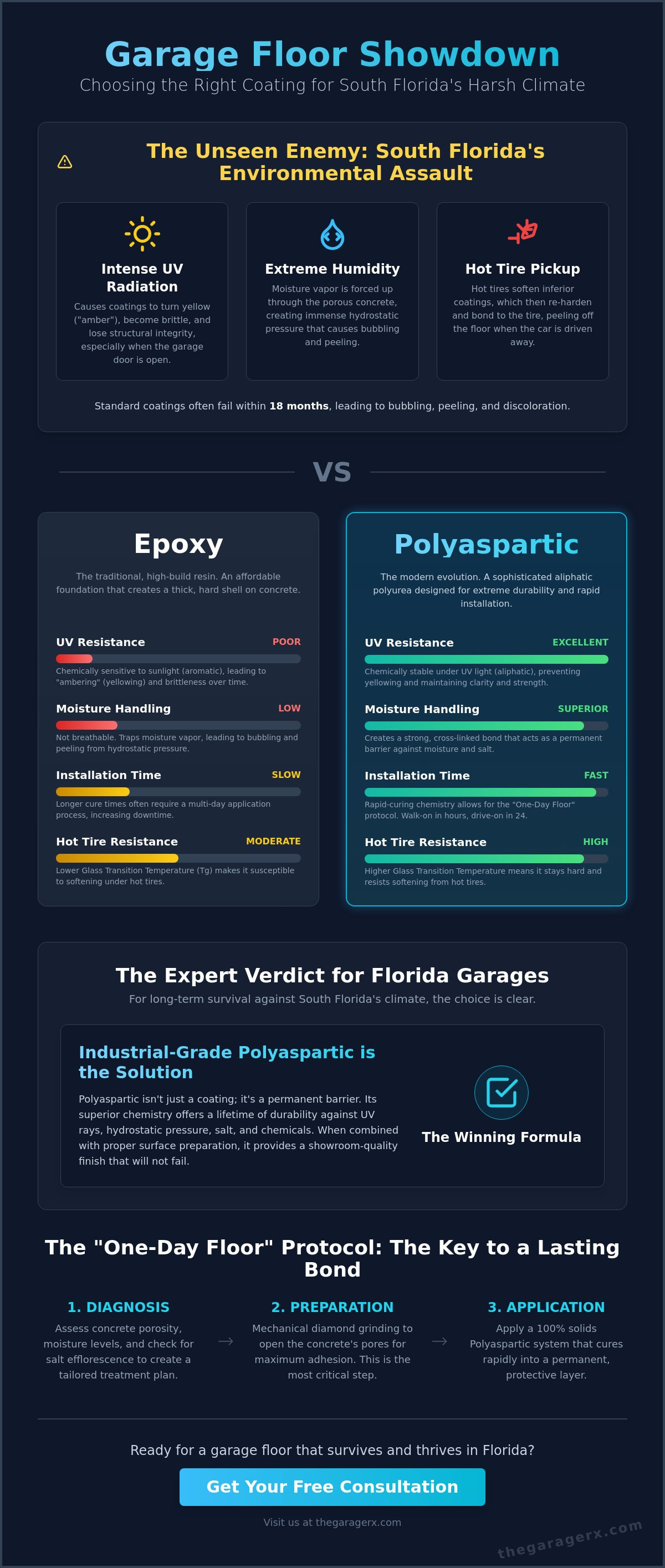
Your garage floor is currently fighting a losing battle against South Florida’s relentless environmental stressors. Most homeowners believe a standard coating is enough, but the reality of high humidity and intense UV rays often results in bubbling, peeling, and unsightly yellowing within just 18 months. When comparing epoxy vs polyaspartic for florida garage installations, the choice is less about color and more about the chemical diagnosis of your concrete. It is a necessary intervention for a space that faces extreme hydrostatic pressure and heat every day.
You likely want a showroom-quality finish that doesn't surrender to hot tire pickup the moment you pull in from a humid summer drive. It is frustrating to invest in a home improvement only to watch it amber and crack under the sun. This guide provides the expert relief you need to choose a surface that survives our tropical climate for the long term. We will examine the technical precision of polyaspartic versus traditional epoxy, highlighting how the right chemistry offers a one-day installation and a lifetime of durability against salt, moisture, and chemicals.
Key Takeaways
- Identify the underlying causes of floor failure by diagnosing concrete porosity and salt efflorescence common in South Florida.
- Evaluate the chemical performance of epoxy vs polyaspartic for florida garage spaces to ensure your investment survives UV exposure without ambering.
- Understand how Glass Transition Temperature (Tg) prevents hot tire pickup, a leading cause of coating delamination in tropical climates.
- Adopt the "One-Day Floor" protocol that prioritizes mechanical diamond grinding for a bond that outlasts traditional multi-day applications.
- Discover how industrial-grade polyaspartic solutions provide a permanent barrier against the harsh salt and chemicals unique to our region.
Diagnosing the South Florida Garage Floor: Why Concrete Fails in Davie
Your garage floor is a living part of your home’s structure. In Davie, it faces a constant barrage of environmental stressors that most homeowners ignore until the damage is visible. Concrete is not the impenetrable barrier it appears to be. It is actually a porous, sponge-like material that actively absorbs moisture and minerals from the ground beneath it. This capillary action means your floor is never truly dry, especially with South Florida's high water table just inches below the surface.
When we perform a site diagnosis, we look for specific symptoms of failure. Dusting is a common sign that the top layer of concrete is breaking down. Small cracks often signal thermal expansion or settling. You might also notice white, powdery stains known as salt efflorescence. This occurs when moisture moves through the slab and brings minerals to the surface, leaving behind a crusty residue. These aren't just aesthetic issues; they are the early warning signs of structural decay. An expert floor intervention is necessary to stop this cycle and prevent the eventual crumbling of your slab.
Choosing the right treatment requires a deep understanding of epoxy vs polyaspartic for florida garage environments. Without a proper diagnosis of your floor's moisture levels, any coating you apply is destined to fail. We treat these installations as a specialized professional practice, ensuring the material matches the specific needs of your concrete.
The Hydrostatic Pressure Problem
South Florida’s geography creates a phenomenon called Moisture Vapor Transmission (MVT). Because the ground is often saturated, water vapor is forced upward through the concrete’s pores. This creates immense pressure at the surface. Hydrostatic pressure is the #1 killer of Florida garage floors. Standard epoxy resins often fail here because they can't breathe or flex. This pressure causes cheap epoxies and DIY paints to bubble and peel away from the substrate, leaving your floor vulnerable to further damage.
UV Radiation: The Invisible Enemy
Our local UV levels are among the highest in the country. This radiation constantly attacks the chemical bonds of your floor coating. It leads to a process called "ambering," where clear coats turn a sickly yellow and become brittle. If you leave your garage door open for projects or ventilation, you're accelerating this degradation. UV rays don't just change the color; they weaken the structural integrity of the coating. What started as a high-end finish quickly becomes a flaky, discolored mess that no longer protects your home.
The Chemistry of Protection: Epoxy vs. Polyaspartic Decoded
Choosing between epoxy vs polyaspartic for florida garage flooring is like deciding between a basic bandage and advanced regenerative medicine. One hides the problem temporarily. The other fundamentally changes the surface's health. Epoxy has served as the industry's traditional high-build resin for decades. It creates a thick, hard shell that looks impressive initially. However, polyaspartic represents the modern evolution of polyurethane technology. It's a sophisticated aliphatic polyurea designed to withstand stressors that traditional resins simply can't handle.
We focus on "solids content" during our diagnostic consultations. A 100% solids coating means the thickness you see during application is exactly what remains after the cure. Low-grade DIY kits often contain solvents that evaporate, leaving a thin, brittle film behind. Professional-grade materials ensure a dense molecular structure that resists the daily friction of heavy vehicles and Florida's relentless heat. If you're ready for a professional assessment, scheduling a consultation is the first step toward a permanent resolution.
Molecular bonding styles also differ significantly between these two treatments. Epoxy forms a strong mechanical bond by seeping into the pores of the concrete. It's a reliable, old-school solution for many environments. Polyaspartic, however, creates a cross-linked bond that is both stronger and more resilient. This next-gen chemistry allows the coating to act as a protective skin rather than just a brittle shell.
Epoxy: The High-Build Foundation
Epoxy resins excel at creating a dense foundation on diamond-ground concrete. They're affordable and provide a smooth, high-gloss finish. Unfortunately, they're also aromatic, which is a technical way of saying they're chemically sensitive to sunlight. This lack of UV resistance leads to the ambering mentioned in our previous diagnosis. Because epoxy is rigid, it doesn't move with your home's foundation. It's still a viable base layer in hybrid systems where a polyaspartic topcoat provides the necessary UV shield.
Polyaspartic: The Rapid-Cure Specialist
Polyaspartic coatings utilize specific 1:1 or 2:1 mix ratios to achieve industrial strength. Their standout feature is elongation. This property allows the coating to flex and stretch slightly as your garage floor expands and contracts during Davie’s extreme temperature shifts. This flexibility prevents the micro-cracking common in older systems. These coatings are also chemically inert. They resist damage from battery acid, motor oil, and the corrosive salt air that drifts in from the coast. It's the specialized intervention required for long-term durability.
The Florida Gauntlet: Performance in Heat and Humidity
South Florida garages are high-stress environments. Heat acts as a chemical catalyst that accelerates material failure. When evaluating epoxy vs polyaspartic for florida garage performance, we prioritize the Glass Transition Temperature (Tg). This technical metric defines the point where a coating shifts from a hard, protective surface to a soft, rubbery state. Most standard epoxies have a relatively low Tg. As the ambient temperature rises, the coating loses its structural rigidity and becomes vulnerable to damage.
Flexibility is a mandatory requirement for coastal durability. While epoxy becomes brittle and prone to cracking as it ages in the heat, polyaspartic remains resilient. This is vital for homes in Broward County. The constant presence of salt spray creates a corrosive environment that penetrates porous or cracked surfaces. A specialized polyaspartic intervention provides a non-porous barrier that salt cannot breach. It ensures your floor remains as tidy and functional as the day it was installed.
Surviving the 100-Degree Tire Test
Tires traveling on I-95 often reach temperatures exceeding 130 degrees. When you park in your garage, the hot rubber begins to cool and contract. This creates a powerful vacuum-like bond between the tire and the floor. If the coating has softened due to the Florida heat, the tire will literally rip the finish off the concrete when you pull away. This phenomenon, known as "Hot Tire Pickup," destroys 90% of DIY garage floors. Polyaspartic’s advanced cross-linking prevents this softening, maintaining a permanent bond that survives the most extreme thermal loads.
Humidity and the Curing Process
High humidity levels introduce significant risks during the installation phase. Traditional epoxy is notoriously sensitive to moisture in the air. If the humidity is too high, a reaction called "blushing" occurs. This creates a cloudy, waxy film on the surface that ruins the aesthetic and weakens the bond. Polyaspartic technology is fundamentally different. It is moisture-cured, meaning it actually utilizes the humidity in the air to complete its chemical reaction. This makes it the superior choice for our tropical climate. It eliminates the risk of delamination and ensures a clear, showroom-quality finish every time.
Treatment Plans: Choosing Your Installation Strategy
Successful spatial transformation requires more than just a bucket of resin. It demands a rigorous installation protocol tailored to our unique climate. When comparing epoxy vs polyaspartic for florida garage projects, the timeline is often the first thing homeowners notice. Traditional epoxy systems typically require a three-day cycle to account for slow curing times and multi-stage bonding. In contrast, our polyaspartic treatment plan utilizes a "One-Day Floor" protocol. This efficiency doesn't sacrifice quality; it reflects the advanced chemistry of the material. You can park your vehicle on the new surface within 24 hours, moving you from a cluttered state of renovation to a serene, finished environment almost overnight.
The success of any floor intervention depends entirely on the preparation phase. We operate under a simple rule: the cure is in the prep. Many failed floors are the result of cutting corners during the initial diagnostic stage. To ensure a lifetime of durability, schedule your floor diagnostic with a team that understands the technical requirements of Florida concrete.
The Professional Installation Sequence
We follow a disciplined four-step process to ensure a high-end result that lasts decades. Every step is a necessary intervention for the long-term health of your slab.
- Step 1: Mechanical Diamond Grinding. We use industrial grinders to open the concrete pores. We never use acid washing, as it introduces unnecessary moisture into a slab already struggling with high humidity.
- Step 2: Crack Repair and Moisture Barrier. We identify and resolve structural imperfections. A specialized moisture barrier is applied to mitigate the hydrostatic pressure we diagnosed earlier.
- Step 3: Base Coat and Decorative Flake. We apply the industrial-grade base and perform a "Full Flake" broadcast. This isn't just for aesthetics; the flakes provide essential slip resistance and a uniform, high-end texture.
- Step 4: The Polyaspartic Top-Coat. This final layer provides the "Seal of Approval." It creates the UV-resistant, chemically inert barrier that protects your investment from the Florida sun and salt.
DIY vs. Professional Intervention
Big-box store kits are often the primary cause of homeowner frustration. These retail products are typically water-based with low solids content, meaning they lack the density to bond permanently. Statistics show that 90% of these DIY applications fail within 12 months, usually due to the hot tire pickup and moisture issues we've discussed. Industrial-grade solids used in professional installations are a one-time investment. While a retail kit might seem cheaper today, the cost of grinding off a failed coating and reapplying a professional system is significantly higher over time. A professional installation provides the relief of knowing the job is done right the first time.
The Garage RX: Premium Polyaspartic Solutions in Davie
We treat each project as a specialized plan of action. Our team brings deep local expertise to every home in Broward, Miami-Dade, and Palm Beach counties, ensuring that your specific environmental stressors are identified and resolved. The debate over epoxy vs polyaspartic for florida garage surfaces ends with a commitment to industrial-grade aliphatic chemistry. This material provides the maximum UV protection required for our intense sun exposure. It isn't just a coating; it's a permanent barrier against the elements. By choosing a solution-oriented professional, you're investing in a space that remains as clean and disciplined as the rest of your home.
Our installations reflect a sense of pride in craftsmanship that general labor simply cannot match. We utilize industrial-grade polyaspartic to ensure that your floor survives the South Florida heat without the ambering or peeling common in lesser systems. This specialized intervention is designed for long-term durability and functional beauty. We move your garage from a state of dysfunction to a high-end environment that adds genuine value to your property.
Why Davie Homeowners Trust The Garage RX
Residents in Davie choose us because our process starts with a diagnostic-led consultation. We don't just provide a quote; we examine the health of your concrete to identify moisture levels and structural integrity. Our "No Hidden Issues" transparency policy ensures you understand the project scope and costs from the very beginning. This methodical approach provides the relief of knowing your spatial recovery is in the hands of detail-oriented experts. We focus on transforming environmental chaos into organized, serene spaces through a predictable and reassuring installation journey.
Completing the Transformation
A resilient, showroom-quality floor is the foundation of a truly functional space. Once the polyaspartic cure is complete, you can begin the next phase of your spatial recovery. High-end floors pair perfectly with custom garage cabinets to hide clutter and protect your seasonal belongings. We also utilize vertical space with slatwall systems that keep tools and equipment organized and off the ground. This holistic approach ensures every square inch of your garage serves a specific purpose. It's time to reclaim your space and enjoy the satisfaction of a disciplined, high-end environment. Schedule your garage floor diagnosis today to begin your transformation.
Secure Your Long-Term Spatial Recovery
The choice between epoxy vs polyaspartic for florida garage flooring is a critical decision for the long-term health of your home. You now understand that our unique climate demands more than a superficial coating. It requires a chemical intervention capable of withstanding extreme hydrostatic pressure and relentless UV radiation. While traditional resins often fail under the weight of South Florida’s humidity, industrial-grade polyaspartic offers the technical precision needed to prevent yellowing and hot tire pickup permanently.
Our one-day professional installation process is a specialized protocol designed for efficiency and durability. We utilize industrial-grade materials and mechanical diamond grinding to ensure a bond that outlasts the house itself. This methodical approach transforms your garage from a state of environmental chaos into a serene, high-end environment. You deserve the relief of a space that is as organized and disciplined as the rest of your home. It's time to stop managing floor failure and start enjoying a permanent solution.
Get Your Free Garage Floor Diagnosis & Quote
Reclaim your garage today and experience the satisfaction of a showroom-quality finish built to survive the Florida gauntlet.
Frequently Asked Questions
Is polyaspartic really better than epoxy for Florida garages?
Polyaspartic is the superior intervention for our tropical climate because it is an aliphatic compound. Unlike aromatic epoxy, it doesn't degrade or turn yellow under South Florida's intense UV radiation. It also handles the high water table better by allowing for moisture vapor transmission without delaminating. This chemistry makes it the ideal choice for long-term durability in Davie and surrounding areas.
How long does it take to install a polyaspartic floor coating?
A professional installation follows a "One-Day Floor" protocol. We complete the mechanical grinding, crack repairs, base coat, and topcoat within a single shift. You can walk on the surface in just a few hours and park your vehicle 24 hours later. Traditional epoxy requires a multi-day curing cycle that keeps your garage out of commission for much longer.
Will my garage floor be slippery when wet?
Your floor won't be slippery if you choose a full-flake broadcast system. The decorative flakes create a textured, high-traction surface that remains safe even during heavy rain or high humidity. This texture provides a necessary safety barrier compared to smooth, liquid-applied coatings that become hazardous when wet. It's a professional-grade solution for keeping your space safe and functional.
Can I apply a polyaspartic coating over an existing epoxy floor?
We don't recommend applying new material over an existing, failing coating. A successful floor intervention requires mechanical diamond grinding to remove the old epoxy and open the concrete's pores. This ensures the new polyaspartic layer forms a permanent bond with the substrate. Applying a new layer over a compromised surface only leads to future delamination and hidden issues.
What is hot tire pickup and how do I prevent it?
Hot tire pickup occurs when tires reach high temperatures on the highway and bond to a softened floor coating as they cool. You prevent this by using materials with a high Glass Transition Temperature (Tg). When comparing epoxy vs polyaspartic for florida garage use, polyaspartic’s cross-linked chemistry maintains its rigidity. It won't pull up when you pull out of the garage on a hot afternoon.
How do I clean and maintain my new polyaspartic garage floor?
Maintenance is simple and requires minimal effort to keep your space in a serene state. Sweep away debris regularly and use a squeegee with a mild, pH-neutral cleaner for deeper cleaning. Because the surface is non-porous and chemically resistant, salt, oil, and chemicals won't penetrate the finish. This specialized coating is designed to stay tidy and organized with very little upkeep.
Why did my previous DIY garage floor coating peel?
Most DIY failures stem from inadequate surface preparation and low-solids retail products. Acid washing doesn't open concrete pores as effectively as mechanical diamond grinding, leaving the coating with nothing to grip. Additionally, water-based kits lack the density to resist Florida’s hydrostatic pressure. These factors lead to peeling within 12 months as moisture pushes the thin film away from the slab.
Is a polyaspartic coating worth the higher price point?
It is a specialized investment that provides a higher return on value over the life of your home. While the upfront cost is greater than epoxy, polyaspartic eliminates the need for expensive recoating every few years. It's a one-time intervention that protects your home's foundation and creates a high-end environment. You save money long-term by avoiding the cycle of failure and repair common with cheaper materials.