

In South Florida, your garage cabinets often have an expiration date the moment they leave the climate-controlled showroom. If you've watched expensive units succumb to mold or seen "heavy-duty" hinges turn to flakes of orange rust, you know that the local environment is a relentless adversary. Selecting garage cabinet materials that resist moisture isn't just a design choice; it's a necessary intervention for a space that regularly faces humidity levels above 70%. We understand the frustration of investing in organization only to have the humid air warp your doors until they no longer close properly.
You deserve a storage system that doesn't just look good on day one but survives the long-term reality of our coastal climate. This article provides the professional prescription for your garage's health, identifying the most durable materials that refuse to rot, rust, or peel. We'll examine why high-grade powder-coated steel and marine-grade polymers are the gold standard for homes in Davie and the surrounding areas. You'll also learn why a successful installation requires more than just the right surface, emphasizing the "off-the-floor" strategy that keeps your gear safe from moisture intrusion and potential flooding.
Key Takeaways
- Identify the specific garage cabinet materials that resist moisture to protect your investment from South Florida's relentless humidity.
- Learn why standard MDF and particle board act as sponges for salt air, which leads to inevitable structural failure and mold growth.
- Understand why it's vital to use off-the-floor suspension to prevent ground-level moisture from wicking into your storage units.
- Discover the professional Hardware Test to verify that your cabinets are equipped with rust-proof hinges and fully wrapped seams.
- Evaluate how a custom diagnostic design provides a long-term cure for garage chaos where generic retail solutions often fail.
The South Florida Humidity Diagnostic: Why Standard Cabinets Fail
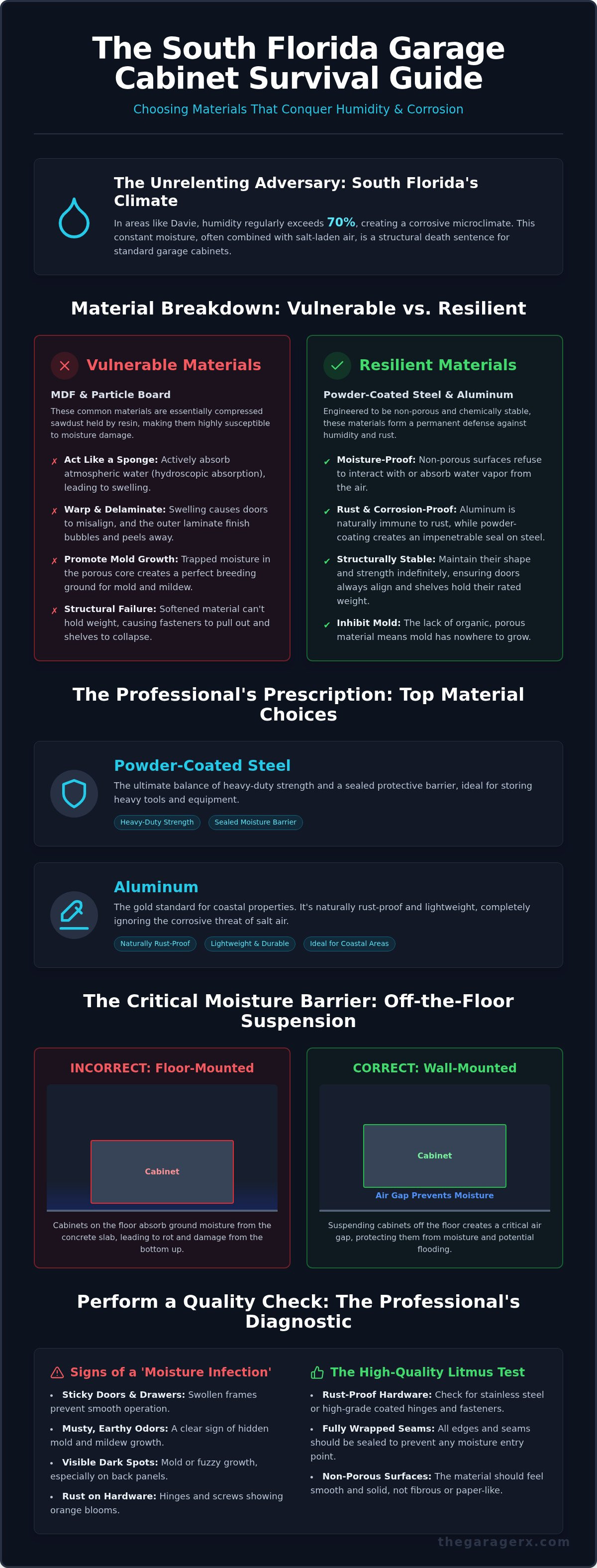
Your garage isn't just a room; it's an unconditioned microclimate where the air is often thick enough to drink. In Davie and throughout Broward County, humidity levels regularly exceed 70%. This isn't just uncomfortable for you; it's a structural death sentence for low-grade cabinetry. Most "big box" storage solutions rely on materials that simply aren't engineered for 90-degree heat flux and salt-laden air. When you choose garage cabinet materials that resist moisture, you're choosing to fight back against this environmental decay.
Many homeowners mistakenly believe that "heavy-duty" labels equate to moisture-proof performance. Most retail cabinets are constructed from Engineered wood products like particle board or MDF. These materials are held together by resins that lose their grip when the air gets heavy. While the surface might mimic the look of real wood, the core is essentially compressed sawdust. In our climate, this core acts as a wick, drawing in atmospheric water until the entire unit swells beyond repair. This swelling isn't just an eyesore. It compromises the cabinet's ability to hold weight safely.
There is a critical distinction between water-resistant and moisture-proof. Water-resistant materials might survive a splash from a hose. However, in a Davie garage, only moisture-proof materials survive the invisible, constant pressure of high-vapor environments. Stagnant air trapped between a cabinet back and a concrete wall creates a perfect incubator for mold. Without proper airflow and non-porous surfaces, your storage becomes a breeding ground for spores within months. It's a standard home improvement failure that requires a professional intervention.
The Science of Hydroscopic Materials
Hydroscopic absorption in the context of garage storage is the physical process where porous materials actively pull water vapor from the surrounding air into their internal structure. This leads to the "delamination" effect. You'll see the decorative laminate or wood grain finish begin to bubble and peel away from the core. Once the finish separates, the structural integrity is gone. The cabinet is no longer a storage unit; it's a sponge. It will continue to expand and contract with the weather until the fasteners pull right through the softened material.
Signs Your Current Cabinets Have a 'Moisture Infection'
You don't need a lab test to see when your cabinets are failing. The symptoms are physical and progressive. If you notice these signs, the "infection" has likely reached the core of your system:
- Sticky drawers and doors that no longer align because the frames have swollen.
- Musty, earthy odors that linger even when the garage door is open.
- Visible dark spots or fuzzy growth on the back panels and interior corners.
- Rust bloom on hinges and hardware, often appearing within just 12 months of installation.
Identifying these issues early is the first step in a successful transformation. Using garage cabinet materials that resist moisture ensures that your storage survives the Florida stress test for years to come.
Top Moisture-Resistant Materials: Prescribing the Right Cure
Selecting the correct garage cabinet materials that resist moisture is the curative step in any high-end renovation. You aren't just buying shelves; you're investing in an environmental defense system. In South Florida, we prioritize non-porous surfaces that refuse to interact with the heavy, humid air. This proactive approach ensures your storage remains structurally sound while generic alternatives fail around you. We prescribe materials based on their chemical stability and resistance to oxidation.
Aluminum vs. Powder-Coated Steel
Aluminum is the gold standard for coastal properties in Broward and Miami-Dade. It's naturally rust-proof and remarkably lightweight. If your home is near the coast, salt air is a constant corrosive threat that aluminum simply ignores. It doesn't require a protective coating to remain stable, though finishes are often added for aesthetics. For many homeowners, custom garage cabinets built with these high-grade metals offer the ultimate relief from the cycle of replacement.
Powder-coated steel offers a different advantage, balancing heavy-duty strength with a protective moisture barrier. This material is ideal for storing heavy gear, floor jacks, or power tools. The powder coating acts as a vaccine for the steel. This electrostatically applied finish creates a hard, non-permeable shell that prevents oxygen and water from reaching the metal core. It's a robust solution, provided the finish remains intact to maintain its protective seal.
Modern Synthetic Options
Modern synthetic options have revolutionized luxury garage design. High-density polyethylene (HDPE) and PVC-based systems are 100% waterproof. They eliminate the risk of rot and termite damage entirely. Scientific research into the Durability of Wood-Plastic Composites shows how these synthetic bonds prevent the internal swelling common in traditional wood products. While metal provides a sleek industrial look, synthetics offer a warmer aesthetic that mimics wood without the hygroscopic liability.
Specialized thermofoil is another precision option for those who prefer the look of traditional cabinetry. This process involves heat-sealing a vinyl film over a core material under high pressure. It creates a seamless finish on the doors and panels. Because there are no exposed seams, moisture can't find a way to penetrate the core. It's an excellent choice for homeowners who want a clean, high-end look that stands up to the Davie humidity. Consider these factors when choosing your material:
- Exposure level: High-humidity garages benefit most from aluminum or PVC.
- Weight requirements: Heavy tool storage often requires the rigidity of powder-coated steel.
- Maintenance: Synthetics and aluminum offer the lowest maintenance requirements over a 15 to 20-year lifespan.
Off-the-Floor Suspension: The Critical Moisture Barrier
Concrete slabs are essentially hard sponges. They hold and release water vapor constantly through a process called moisture vapor transmission. If your cabinets sit directly on the floor, they are in the direct line of fire for "bottom-up" moisture. This ground-level humidity creates a wicking effect. Even high-quality garage cabinet materials that resist moisture can struggle if they are perpetually sitting in a micro-puddle of vapor. Breaking this physical connection is vital for long-term durability.
We prescribe wall-mounted, floating systems as the standard for every South Florida installation. By suspending the units six to twelve inches off the ground, we break the capillary contact with the slab. This gap is your primary defense against moisture-triggered rot and swelling. It also facilitates a cleaner environment. You can wash down your floors with a hose or a power washer without ever worrying about water pooling against the base of your cabinetry. Suspension turns a potential trap for dampness into a ventilated storage zone.
Wall-Mounted vs. Leg-Supported Systems
Some systems rely on adjustable legs to provide elevation. While legs offer some height, they often act as half-measures. Legs create debris traps for dust, dead insects, and moisture. They also concentrate significant weight onto small points on your floor, which can lead to cracking over time. True wall-mounted systems utilize the structural studs of your garage to distribute the load evenly. This "floating" design allows for maximum airflow behind and beneath the unit. Air circulation is the natural enemy of mold. By keeping the air moving, we prevent the stagnant conditions where "moisture infections" thrive.
Protecting the Slab First
A complete cure for garage moisture involves treating the floor before the cabinets arrive. High-performance polyaspartic floor coatings create a primary vapor barrier that seals the porous concrete. This prevents moisture from migrating up through the slab and into the air around your storage. A professionally coated floor serves as the first line of defense, ensuring that your garage cabinet materials that resist moisture aren't working overtime to combat ground-level vapor. When you combine a sealed floor with suspended cabinetry, you create a synergistic barrier that the Florida climate cannot easily penetrate. This methodical approach ensures your transformation remains as clean and dry as the day it was installed.
Actionable Guidance: Evaluating Cabinet Quality
Selecting garage cabinet materials that resist moisture is only half the battle. To ensure a permanent cure for garage chaos, you must perform a detailed diagnostic on the construction quality of the units. High-end materials can still fail if the assembly methods leave the core vulnerable to the elements. You need to look past the aesthetic finish and examine the "connective tissues" of the system. This level of scrutiny separates professional-grade installations from temporary retail fixes.
Hardware and Fasteners
Cheap zinc-plated screws and fasteners are a primary cause of cabinet failure in Davie. In our humid environment, zinc undergoes a rapid oxidation process, leading to "rust bloom" that can seize drawers and weaken structural joints. We prescribe 304-grade stainless steel for all hinges, handles, and screws. Stainless steel is non-negotiable for coastal homes where salt air accelerates corrosion. Additionally, verify that your system uses high-quality, soft-close hinges. These premium components are often better sealed against atmospheric moisture, preventing the internal springs from snapping due to rust.
Don't overlook the drawer slides. Ball-bearing slides made from inferior metals will eventually seize in 70% humidity. Look for slides with a high load rating and a corrosion-resistant finish. If the hardware feels "gritty" or sticks during a showroom test, it won't survive a single Florida summer. If you want a system that remains functional for decades, schedule a professional consultation to review heavy-duty hardware options.
The 'Full-Wrap' Advantage
The most common point of entry for moisture is an exposed seam. Many manufacturers use edge-banding, which is a thin strip of material glued to the raw edge of a panel. Over time, the glue fails, the strip peels, and the "wound" allows humidity to enter the core. We recommend fully encapsulated panels. This "full-wrap" finish ensures that every square inch of the material is sealed under high pressure, leaving no gaps for vapor to penetrate. It turns the entire cabinet into a monolithic, moisture-proof barrier.
Your location in South Florida also dictates specific material needs. If you live closer to the Everglades, you face higher consistent humidity and potential pest issues. If you're nearer the Atlantic coast, salt-air corrosion is your primary threat. Always check the warranty fine print to see what "moisture resistance" actually covers. A professional warranty should protect against delamination and structural swelling caused by atmospheric humidity, not just direct contact with water. Finally, ensure your chosen finishes include UV-stabilizers. The intense Florida sun can degrade the chemical bonds of low-grade plastics and resins, leading to brittleness and fading over time.
- The Seam Test: Run your finger along the edges of the cabinet doors; you should feel a smooth, continuous surface.
- The Magnet Test: High-quality stainless steel is generally non-magnetic or weakly magnetic; if a magnet sticks firmly to a hinge, it's likely a lower-grade, rust-prone alloy.
- The Finish Check: Ask for documentation on UV-resistance ratings to prevent yellowing or chalking in open-garage environments.
The Garage RX Prescription: Custom Cabinets Built for Davie
Standard retail storage units are designed for generic, climate-controlled environments. They fail the Florida stress test because they treat moisture resistance as an optional feature rather than a fundamental requirement. When you rely on "off-the-shelf" solutions, you're essentially applying a temporary bandage to a chronic environmental issue. At The Garage RX, we view your storage needs through a diagnostic lens. We ensure that the garage cabinet materials that resist moisture in your home are specifically selected for the unique heat and humidity of Davie. Our goal is to move you from the frustration of a failing space to the relief of a permanent storage solution.
Our process begins with a comprehensive assessment of your garage's specific exposure. We evaluate air circulation patterns and proximity to moisture sources to determine the ideal material composition for your cabinets. By integrating custom garage cabinets with our heavy-duty slatwall systems and polyaspartic floor coatings, we create a unified, moisture-proof environment. This holistic approach ensures that every component works in synergy to prevent the structural swelling and mold growth discussed earlier. We don't just install cabinets; we perform a necessary intervention for your home's most neglected space.
The Professional Installation Difference
Professional installation is the final, critical step in your garage's recovery. DIY mounting often leads to significant wall damage because homeowners struggle to locate structural support within complex garage framing. Our technicians use precision tools to ensure your system is perfectly level, even on sloped garage floors designed for water drainage. This accuracy isn't just about aesthetics. It ensures that doors and drawers remain perfectly aligned, preventing the mechanical stress that leads to material fatigue. A professionally designed system offers a superior long-term ROI by protecting your property value and eliminating the need for frequent replacements. We take pride in craftsmanship that stands up to the South Florida sun and salt air.
Your Next Steps to a Dry Garage
Transitioning from a dysfunctional, damp space to a serene, organized environment starts with a professional "Garage Check-Up." Our consultants visit your home in Davie or the surrounding Miami area to perform a thorough site analysis. We use advanced 3D design consultations to help you visualize the transformation before a single cabinet is mounted. This allows you to see exactly how your new storage system will reclaim your space and protect your gear. Stop wasting money on temporary solutions that rot and rust in the humidity. Contact The Garage RX for your custom cabinet prescription and secure a storage system built to survive South Florida's extreme climate.
Reclaim Your Space from the Florida Elements
South Florida's humidity is a constant threat to your home's organization, but it doesn't have to dictate the lifespan of your storage. By prioritizing garage cabinet materials that resist moisture like powder-coated steel and aluminum, you move beyond temporary fixes. Remember that a successful transformation requires more than just the right surface. It demands a professional installation strategy that includes off-the-floor suspension and high-grade stainless steel hardware to prevent the wicking and rusting common in our coastal climate.
Since 2018, we've specialized in high-durability garage transformations across Broward, Miami-Dade, and Palm Beach. Our expert installation of heavy-duty, off-the-floor systems provides the necessary intervention your space requires. Don't settle for "big box" solutions that are destined to warp and mold. You deserve a disciplined, detail-oriented approach that turns your garage into a clean, high-end environment. Schedule Your Professional Garage Diagnostic and Cabinet Consultation Today. It's time to experience the relief of a perfectly organized, Florida-proof garage.
Frequently Asked Questions
Is aluminum or steel better for a humid garage in Florida?
Aluminum is the superior choice for coastal Florida garages because it is naturally rust-proof. While steel is exceptionally strong, it relies entirely on its finish to prevent oxidation. In Davie, where salt air is a constant factor, aluminum provides a higher level of long-term security. If you store heavy automotive equipment, powder-coated steel is a viable alternative, provided you select a high-grade finish to act as a moisture barrier.
Can I use kitchen cabinets in my garage if they are painted?
You should avoid using standard kitchen cabinets in a garage environment because they typically consist of porous MDF or particle board. Even multiple layers of high-quality paint cannot fully encapsulate the core against South Florida's high vapor pressure. Moisture will eventually penetrate the seams, causing the wood fibers to swell and the structure to fail. Investing in garage cabinet materials that resist moisture is the only permanent solution for our local climate.
What is the best way to prevent mold behind garage cabinets?
Promoting consistent airflow is the most effective way to prevent mold growth behind your storage units. We prescribe wall-mounted systems that create a gap between the cabinet back and the concrete wall. This design prevents stagnant, humid air from becoming trapped. Additionally, using non-porous materials like aluminum or PVC ensures that spores have no organic matter to feed on. A professionally sealed floor coating further reduces the ambient humidity in the space.
Do I really need to mount my cabinets off the floor?
Yes, mounting cabinets off the floor is a critical requirement for any Florida garage renovation. Concrete slabs act like sponges, wicking ground moisture directly into any material in contact with the surface. By suspending your units six to twelve inches high, you break this capillary bond and protect your gear from ground-level moisture. This floating configuration also allows you to wash your garage floor without risking water damage to your cabinetry.
Will powder coating completely prevent rust on steel cabinets?
Powder coating provides an excellent moisture barrier, but its effectiveness depends on the integrity of the seal. This finish acts as a protective shell that prevents oxygen and water from reaching the steel core. However, deep scratches or chips can expose the metal, leading to localized oxidation. For maximum durability in Davie, we recommend combining powder-coated surfaces with stainless steel hardware, which remains resistant to rust even in high-humidity conditions.
How much does professional moisture-resistant cabinet installation cost in Davie?
The cost of a professional installation depends on the total linear footage, the specific materials selected, and the complexity of your garage's layout. Factors such as whether you choose aluminum, powder-coated steel, or synthetic polymers will influence the final investment. Because every garage in South Florida has unique structural needs, we provide custom quotes based on a detailed site diagnostic. This ensures your storage system is perfectly tailored to your space and your budget.
What is the difference between water-resistant and waterproof garage cabinets?
Water-resistant cabinets can withstand occasional splashes, but waterproof cabinets are engineered to survive constant high humidity and vapor pressure. In our climate, garage cabinet materials that resist moisture must be non-porous to prevent atmospheric water from being absorbed into the core. While water-resistant wood products might survive a dry climate, they often fail in Davie. Truly waterproof materials like PVC or aluminum offer the permanent cure required for South Florida garages.
How do I clean moisture-resistant cabinets without damaging the finish?
You should use a mild, non-abrasive soap and warm water to maintain the finish of your cabinets. Avoid using harsh chemical solvents or scouring pads, as these can create microscopic scratches that compromise the moisture seal. For powder-coated steel or aluminum, a soft microfiber cloth is usually sufficient to remove dust and salt residue. Regular cleaning prevents the buildup of corrosive elements, ensuring your high-end storage system remains in peak condition for decades.