

Why does a standard DIY garage floor kit often fail so spectacularly just eighteen months after installation? Most homeowners believe the secret to a high-end garage lies in the topcoat, but the truth is far more clinical. In the high-stakes environment of South Florida, your floor's survival depends entirely on the mechanical "surgery" performed before the first drop of resin touches the concrete.
You've likely dealt with the frustration of hot tire pickup or the bubbling caused by our state's high water table. It's a common struggle, and it's exactly why a superficial cleaning isn't enough. Discover why professional surface preparation is the single most important factor in preventing garage floor failure and how our diagnostic approach ensures a permanent bond. This guide examines the specialized garage floor coating preparation process that eliminates dust, manages moisture, and creates an industrial-grade foundation. Learn how a disciplined, detail-oriented installation can turn your dysfunctional garage into a pristine, durable space that finally stands up to the Florida heat.
Key Takeaways
- Understand why mechanical diamond grinding is the clinical standard for opening concrete pores and achieving the precise texture required for industrial-grade adhesion.
- Compare the environmental and structural risks of chemical acid etching against the superior results of a professional garage floor coating preparation process.
- Learn how to diagnose and treat South Florida moisture issues, like high water tables and vapor transmission, before they cause your new coating to blister or peel.
- Discover the essential steps of a professional preparation protocol designed to eliminate surface toxins and create a permanent, lifetime bond.
What is Professional Garage Floor Preparation?
Think of your garage floor as a patient in need of specialized care. Professional garage floor preparation is much more than a simple sweep or a power wash. It's the intensive mechanical process of removing deep-seated contaminants and opening the concrete's pores to create a receptive surface. In our practice at The Garage RX, we view this stage as the diagnostic surgery. The subsequent coating is merely the recovery phase. Without a successful surgery, the patient, your floor, will eventually fail.
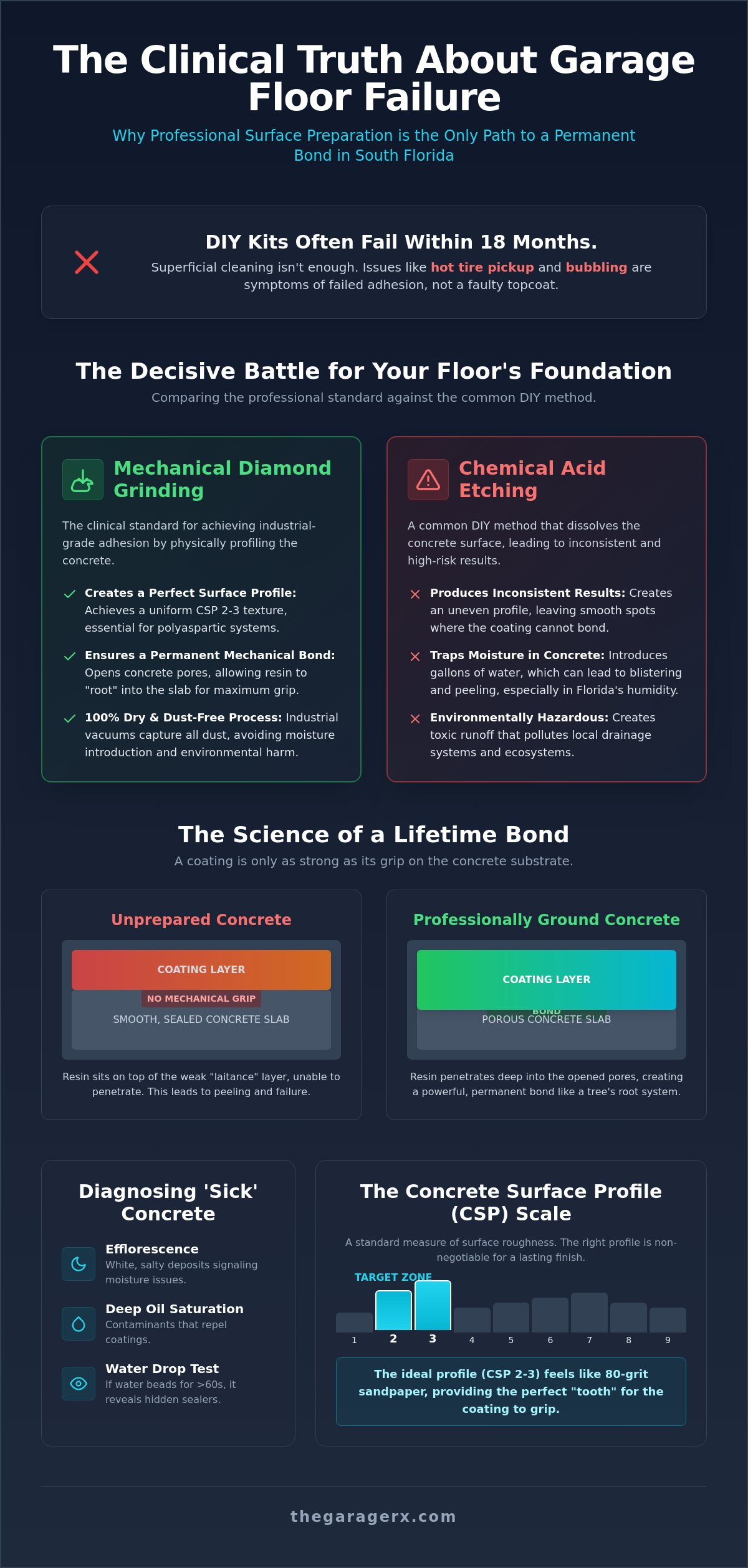
Professionals use the Concrete Surface Profile (CSP) standard to measure the texture of a slab. This scale, ranging from 1 to 9, determines how "rough" the surface is after treatment. For most high-performance polyaspartic systems, we aim for a CSP of 2 or 3. This texture feels like 80-grit sandpaper and provides the necessary "tooth" for the coating to bite into the substrate. If the profile is too smooth, the coating has nothing to hold onto. If it's too rough, you'll see unevenness in the final finish.
It's vital to understand that cleaning is not the same as preparing. Cleaning removes surface-level dust and debris. Preparing removes the "laitance," which is the weak, brittle top layer of the concrete. If you only clean, you're sticking your expensive coating to loose particles rather than the structural slab. Our garage floor coating preparation process ensures we reach the healthy, porous concrete beneath the surface grime.
The Science of Industrial Adhesion
To achieve a lifetime bond, polyaspartic and epoxy resins must "root" themselves into the concrete capillaries. Think of it like a tree's root system. If the concrete is too smooth, such as a power-troweled floor in a new home, the resin can't penetrate. It simply sits on top. Surface tension is the enemy here. If liquids bead up on your floor, a coating will too. We ensure the concrete is mechanically ground, honed and polished to a state where it hungrily absorbs the resin. This creates a mechanical bond that prevents the peeling often seen in DIY attempts.
Identifying 'Sick' Concrete Symptoms
Before any treatment begins, we perform a thorough diagnosis of your floor's health. We look for symptoms of "sick" concrete, such as efflorescence, which are white, salty deposits that signal moisture movement. We also look for previous coating failures or deep oil saturation. One simple diagnostic tool we use is the water drop test. We place droplets on various areas of the floor. If the water doesn't soak in within 60 seconds, it's a clear sign of a hidden sealer or "toxins" like brake fluid that block adhesion. We don't guess; we test. This diagnostic approach allows us to tailor the garage floor coating preparation process to your floor's specific needs, ensuring a successful outcome.
Diamond Grinding vs. Acid Etching: The Professional Verdict
Many homeowners are tempted by the low cost of DIY kits that rely on muriatic acid etching. This chemical approach is a blunt instrument. It attempts to "eat" away the top layer of concrete to create texture. However, this method is fundamentally flawed for high-performance installations. Mechanical diamond grinding is the precision alternative. It uses industrial-grade diamonds to physically shave the concrete. This creates a uniform "velcro" surface specifically designed for polyaspartic floor coatings to bite into.
The environmental cost of acid etching is often overlooked in South Florida. When you wash that acid off your floor, the toxic runoff enters our local drainage systems. This is particularly problematic in areas like Davie or Weston, where the ecosystem is delicate. Beyond the environment, acid etching introduces a massive amount of water into your slab. In our humid climate, a wet slab is a liability. It can take days for the concrete to dry enough for a coating to bond. If you apply resin too soon, you're trapping moisture that will eventually cause the floor to blister.
Diamond grinding avoids these risks entirely. It's a dry process that reveals the healthy aggregate of the slab without altering its chemistry. This mechanical garage floor coating preparation process ensures your floor is ready for treatment immediately. If you want to ensure your investment survives the local climate, you can schedule a professional floor consultation to see the difference mechanical prep makes.
The Dangers of DIY Acid Etching
Acid etching yields inconsistent results. Concrete isn't a uniform material; some spots are denser than others. This means the acid might etch one area perfectly while leaving another completely sealed. These "slick" spots are where your coating will eventually peel. There's also the physical risk. Muriatic acid is highly corrosive. It can easily damage your garage drywall, driveway pavers, or the landscaping surrounding your home. It's a high-risk gamble for a low-quality bond.
Why Industrial Diamond Grinding Wins
Precision is the hallmark of a professional installation. Diamond grinding allows us to achieve a consistent CSP 2 or 3 across every square inch of your floor. This process effectively removes the "laitance," which is the weak, milky top layer of concrete. Laitance is the primary culprit behind hot tire pickup. When your tires get warm, they pull on the coating; if that coating is only attached to weak laitance, it peels right off. Our garage floor coating preparation process utilizes HEPA-filtered dust extraction. This keeps your home clean and your family safe from silica dust during the concrete surgery. We leave behind a pristine, open-pored surface ready for a lifetime finish.
South Florida Challenges: Humidity and Vapor Barriers
Davie’s high water table creates a unique environmental stressor for every concrete slab in the region. Your garage floor isn't a solid, impenetrable block. It's a porous membrane that breathes. Because our local soil is often saturated, moisture is constantly looking for a way out. This movement is known as Moisture Vapor Transmission (MVT). If you apply a finish without accounting for this pressure, the vapor gets trapped. The result is a series of unsightly blisters and bubbles that eventually lead to total coating failure. It's a common complication that we see in many failed DIY projects.
South Florida humidity also dictates how we approach the curing process. High ambient moisture can interfere with the chemical reaction of standard epoxy coatings for garage floors, leading to a finish that remains tacky or develops a cloudy "blush." We don't leave this to chance. The Garage RX utilizes a diagnostic moisture test as a non-negotiable part of our garage floor coating preparation process. We measure the pounds of moisture emitting from your slab per 1,000 square feet. This data allows us to determine if your floor is a candidate for a standard installation or if it requires a more intensive moisture-mitigation protocol.
The 'Sweaty Slab' Syndrome
Concrete in Broward County often suffers from what we call 'Sweaty Slab' syndrome. Even if the surface looks bone-dry, the core of the slab is often saturated. Capillary action pulls water and dissolved salts from the ground up to the surface. When the water evaporates, it leaves behind white, powdery deposits called efflorescence. These salts act as a bond-breaker. If you coat over them, you're essentially painting over dust. Our professional preparation mitigates this risk by mechanically removing these salts and addressing the hydrostatic pressure that causes delamination. We ensure the "respiratory system" of your concrete is managed before we seal it.
Moisture Remediation Strategies
When a slab tests positive for high moisture levels, we pivot to a specialized moisture-blocking primer. This isn't a standard "one-size-fits-all" basecoat. It's a medical-grade barrier designed to withstand up to 20 pounds of vapor pressure. This high-moisture protocol is vital for coastal homes or properties in low-lying areas of Davie. Our local expertise allows us to predict seasonal slab behavior, ensuring your floor remains stable during our heavy summer rains. By integrating these remediation steps into the garage floor coating preparation process, we provide a permanent solution that generic contractors simply can't match. We treat the underlying cause of the failure, not just the surface symptoms.
The 5-Step Professional Prep Protocol at The Garage RX
Success in concrete restoration isn't accidental. It's the result of a disciplined, five-step protocol designed to transform a compromised slab into a high-performance foundation. Our garage floor coating preparation process follows a clinical sequence that ensures every square inch of your floor is ready for a lifetime bond. We don't take shortcuts because we know that a single overlooked "toxin" or untreated crack can compromise the entire installation.
- Step 1: Industrial Degreasing. We begin by neutralizing the slab. We remove deep-seated oils, brake fluid, and road salts that act as bond-breakers.
- Step 2: Precision Diamond Grinding. Our team performs the mechanical "surgery." We use industrial grinders to shave away the weak laitance and open the concrete's capillaries.
- Step 3: Crack and Spall Repair. We identify every structural imperfection. We stitch these "wounds" using high-strength polymers that restore the floor's integrity.
- Step 4: Edge Work. Detail matters. We use hand grinders to ensure a 100% mechanical profile along the walls and corners where large machines can't reach.
- Step 5: HEPA Vacuuming. We perform a final sterile sweep. Our industrial extraction systems remove every trace of dust before the first layer of resin is applied.
Deep Cleaning and Degreasing
Standard pressure washing is often the first mistake made in DIY attempts. High-pressure water actually pushes automotive fluids deeper into the concrete's pores. It also introduces excessive moisture into the slab, a complication we discussed regarding South Florida's humidity. We use specialized, non-corrosive cleaners to lift oils to the surface for extraction. This prepares the concrete for a clean, surgical bond that won't delaminate when your tires get hot. If your floor has seen years of heavy use, you should request a professional floor assessment to identify hidden contaminants.
Repairing Cracks and Pits
We don't just "fill" cracks; we treat them. Our team uses the "chasing" method, which involves opening the crack with a diamond blade to create a clean channel. We then inject polyurea menders that cure harder than the concrete itself. These rapid-set materials allow us to sand the repair flush within minutes. This ensures a seamless, monolithic floor surface that eliminates the visual eyesores of a settling slab. The result is a perfectly level substrate ready for the final aesthetic coat.
Dust Mitigation and HEPA Extraction
Concrete grinding is notoriously messy without the right equipment. Our garage floor coating preparation process utilizes industrial vacuums that capture 99.9% of concrete dust at the source. This protects your home's air quality and prevents fine silica dust from settling on your custom garage cabinets or stored items. We maintain a clean-room standard throughout the installation, ensuring that your high-end professional garage transformation is as tidy as it is durable.
Why The Garage RX is Your Floor’s Best Specialist
The Garage RX doesn't just install floors; we provide a specialized intervention for your home's most neglected space. Our team has served Broward, Miami-Dade, and Palm Beach counties since 2018. We operate with a strict "prep-first" philosophy. This means we never rely on ineffective chemical etching or shortcuts that lead to peeling. By focusing on a rigorous garage floor coating preparation process, we ensure that every installation is built for long-term durability. We view your garage as a cohesive system. A high-performance floor is the foundation, but we also integrate total organization solutions like overhead racks to reclaim your space from floor to ceiling. You gain the peace of mind that comes with a professionally prescribed and installed floor system.
The Value of a Professional Installation
Choosing a professional specialist over a DIY kit is a matter of longevity. A typical store-bought kit might look acceptable for two or three years before it begins to flake under hot tires. A professional RX installation is designed to last 15 years or more. This durability translates directly into property value for your Davie home. Prospective buyers recognize the difference between a peeling DIY mess and an industrial-grade finish. Our efficiency matches our precision. We offer a one-day transformation that minimizes disruption to your household routine while maintaining a surgical standard of care. We deliver a result that survives the South Florida climate and the daily demands of your vehicles.
Schedule Your Floor Consultation
Your journey toward a high-end garage begins with a thorough on-site diagnostic visit. We don't provide "guesstimates" over the phone. Instead, our specialists perform the moisture testing and substrate analysis required to build a custom plan for your concrete. You'll receive a transparent project estimate that covers the entire garage floor coating preparation process with no hidden fees or surprises. We believe in clarity and honesty from the initial consultation to the final walkthrough. Stop settling for a dusty, dysfunctional garage. Book your free garage diagnostic today! and let us prescribe the permanent solution your home deserves.
Invest in a Permanent Foundation for Your Space
A high-end garage transformation is only as stable as the concrete beneath it. You've seen why mechanical diamond grinding is the surgical standard and how identifying "sick" concrete symptoms prevents future delamination. By prioritizing a rigorous garage floor coating preparation process, you eliminate the risk of peeling under hot tires and ensure your floor survives the unique humidity of Broward and Palm Beach counties. We don't just apply a finish; we treat the underlying substrate to meet 15+ year durability standards. Our HEPA-filtered dustless grinding and expertise as South Florida moisture specialists guarantee a clean, professional intervention for your home.
It's time to move past the frustration of failed DIY attempts and embrace the satisfaction of an orderly, high-end environment. Take the first step toward a lifetime of durability and effortless maintenance. Schedule Your Professional Garage Floor Diagnostic today and reclaim your space with total confidence. Your garage deserves a foundation that is as hardworking and resilient as the rest of your home.
Frequently Asked Questions
Is professional garage floor preparation really necessary for a brand-new home?
Yes, professional preparation is vital even for brand-new concrete slabs. New homes often have power-troweled floors that are finished to a smooth, non-porous shine. This surface is too slick for resins to penetrate. We must remove the "laitance," which is the weak top layer of concrete, to reveal the open pores needed for a permanent mechanical bond.
How long does the diamond grinding process take for a standard 2-car garage?
Diamond grinding for a standard 2-car garage typically takes three to five hours to complete. This timeframe depends on the hardness of the concrete and the amount of detail work required around the perimeter. We focus on achieving a consistent texture across the entire slab before moving to the repair and cleaning phases of the garage floor coating preparation process.
Will there be a lot of dust in my house after the grinding is finished?
No, your home's interior will remain clean and free of concrete dust. We utilize industrial-grade HEPA vacuum systems that are connected directly to our grinding equipment. These systems capture 99.9% of silica dust at the source. This surgical level of cleanliness ensures that your garage and adjacent living spaces stay pristine throughout the transformation.
Can you fix deep oil stains that have been there for years?
Yes, we can successfully treat and remove deep-seated oil, grease, and brake fluid stains. We apply industrial-strength degreasers that lift these "toxins" to the surface for extraction. Once the contaminants are removed, our diamond grinding process shaves away the affected concrete to ensure the new coating bonds to a healthy, clean substrate.
What happens if you coat over a floor that has not been properly prepared?
The coating will inevitably fail, often within the first year of use. Without a mechanical profile, the resin simply sits on top of the concrete rather than rooting into it. This leads to bubbling, flaking, and "hot tire pickup," where the heat from your tires pulls the finish right off the floor. Proper preparation is the only way to avoid these expensive complications.
Can I rent a grinder and do the preparation myself?
You can rent equipment, but retail rental grinders often lack the weight and diamond quality required for industrial-grade results. These machines frequently leave uneven profiles or fail to remove tough sealers. Our professional-grade equipment ensures a specific Concrete Surface Profile (CSP) that DIY rentals simply cannot replicate, providing the foundation for a lifetime finish.
How do you handle cracks that keep coming back in the concrete?
We address recurring cracks by "chasing" them with a diamond blade to create a clean, deep channel. We then fill the void with high-strength polyurea menders that cure harder than the surrounding concrete. These materials are designed to bridge the gap and prevent the crack from telegraphing through your new aesthetic coating as the slab naturally shifts.
What is the best temperature and humidity for preparing a floor in Davie?
The ideal conditions involve moderate temperatures and low humidity, but our garage floor coating preparation process is adapted for South Florida's climate. In Davie, the high water table is a bigger factor than air temperature. We perform diagnostic moisture tests on every slab and use specialized moisture-mitigating primers to ensure a successful bond regardless of the local humidity levels.