

Did you know that 60% of basic epoxy installations in Southwest Florida are plagued by unsightly tire marks? It's a frustrating reality for homeowners who invested time and money into DIY kits only to see the coating peel away like a bad sunburn. You're likely tired of scrubbing at stubborn black marks and worrying that any professional upgrade will just be another expensive failure. You deserve hot tire pickup resistant flooring that functions as a permanent solution rather than a temporary patch.
In this guide, we'll debunk the common myths about garage coatings and reveal the scientific truth behind why most floors fail. You'll learn exactly how to achieve a professional, durable finish that adds significant value to your home. We'll examine why polyaspartic systems have become the gold standard for heat resistance and why expert surface preparation is responsible for 90% of a coating's longevity. It's time to move from the chaos of a peeling floor to the serenity of a high-end, organized environment.
Key Takeaways
- Identify the root cause of floor delamination by understanding how plasticizer migration from hot tires chemically compromises standard coatings.
- Debunk common myths about DIY epoxy kits and temporary mats that fail to address the underlying bond issues in your garage.
- Explore the molecular cross-linking of polyaspartic systems that creates a permanent, hot tire pickup resistant flooring solution.
- Learn how to protect your investment from South Florida's high humidity and the hidden dangers of "sweaty slab syndrome."
- Discover why a professional diagnostic approach, including diamond grinding to a CSP 2-3 profile, is required for a lasting transformation.
Understanding Hot Tire Pickup: The "Diagnosis" of a Peeling Garage Floor
Hot tire pickup is more than an aesthetic nuisance; it's a clinical failure of the bond between your garage floor and its coating. This phenomenon occurs when heat and chemical migration work together to physically pull the floor finish away from the concrete substrate. While many homeowners mistake this for simple staining, it's actually a form of delamination. Achieving a truly hot tire pickup resistant flooring system requires understanding why this separation happens at a molecular level. It is a diagnostic issue where the coating's chemical integrity is compromised by the very vehicles it was meant to support.
The symptoms of this failure are unmistakable and progressive. It usually begins with black carbon transfer where the tires rest. You might notice small bubbles forming under the surface or a slight tackiness when you touch the area. Eventually, the coating peels away in jagged chunks, leaving the raw concrete exposed. Unlike a surface stain that you can scrub away, this is a structural breakdown. The bond has been completely severed, rendering the coating useless in those high-traffic zones.
The Science of Plasticizer Migration
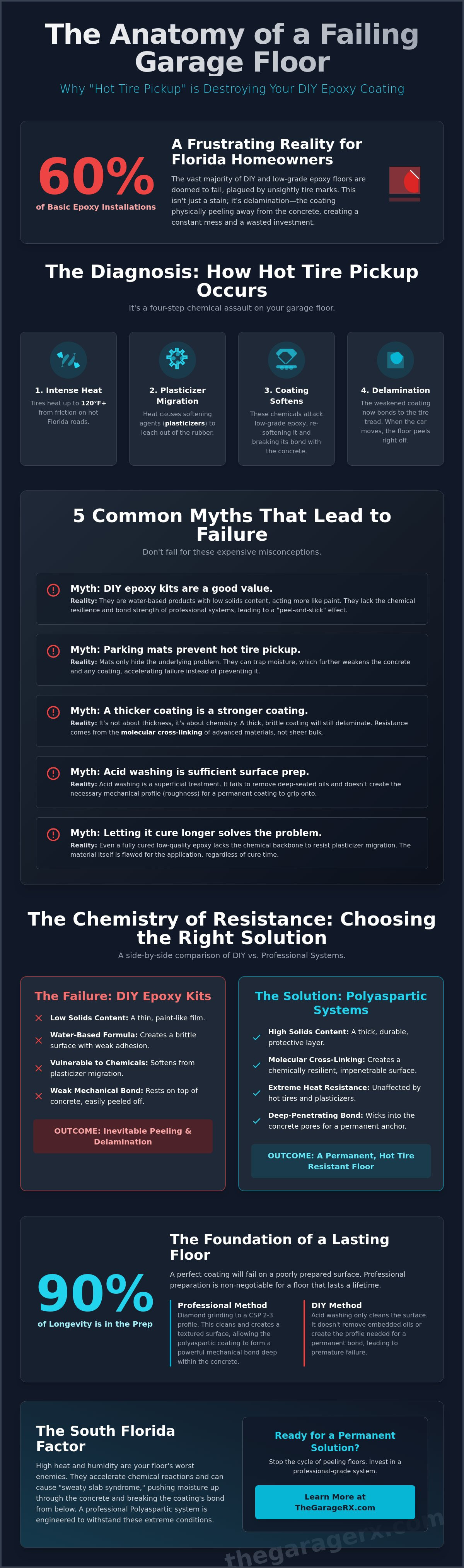
Tires are complex chemical compounds designed for flexibility and grip. As you drive through Davie, friction and South Florida road heat can cause tire temperatures to soar to 120°F or higher. This intense heat causes plasticizers, which are specialized softening agents, to leach out of the rubber. When you park, these chemicals migrate directly into the floor surface. If your floor is coated with low-grade or water-based traditional epoxy, a destructive chemical reaction occurs. These plasticizers effectively re-soften the epoxy, causing it to bond to the tire tread rather than the floor. When you pull the car out the next morning, the tire takes the floor with it.
Why Standard Concrete is Vulnerable
Untreated concrete is fundamentally a sponge. Its porous structure is filled with microscopic voids that easily absorb motor oils, brake fluid, and road contaminants. These substances act as bond-breakers, preventing any topical coating from achieving a deep mechanical anchor. Even if the surface looks clean, deep-seated oils can rise to the surface over time and push the coating away. Additionally, the difference in thermal expansion rates between the concrete and a rigid coating causes surface-level bond breakage as temperatures fluctuate throughout the day. Without professional intervention, your concrete is essentially working against the longevity of your floor.
5 Common Myths About Hot Tire Pickup Resistant Flooring
Misinformation often leads to expensive mistakes in garage renovation. Many homeowners attempt to solve peeling issues with quick fixes that ignore the underlying chemical diagnosis. True hot tire pickup resistant flooring isn't found in a box at a big-box retailer. It requires a specialized approach that addresses the bond between the coating and the concrete. Let's look at the most common misconceptions that keep your garage floor in a state of dysfunction.
- Myth 1: Store-bought epoxy kits are just as good as professional systems. These kits lack the solids content and chemical resilience of industrial-grade materials.
- Myth 2: Parking mats are a permanent solution for hot tire pickup. They merely hide the damage while potentially creating new moisture issues.
- Myth 3: A thicker coating always means better heat resistance. Bulk doesn't prevent chemical migration; molecular structure does.
- Myth 4: Acid washing is enough to prepare the floor for a coating. Acid often fails to remove deep-seated oils and doesn't provide the mechanical profile needed for a permanent bond.
- Myth 5: Curing time is the only factor in preventing pickup. Even a fully cured low-quality epoxy will soften under the heat of South Florida tires.
Achieving a hot tire pickup resistant flooring finish requires moving past these surface-level assumptions. You need a solution that treats the root cause of the failure rather than just the symptoms.
The Failure of DIY Epoxy Kits
Most DIY kits are water-based products with low solids content. They behave more like paint than a structural coating. As the water evaporates, it leaves behind a thin, brittle film that lacks the "bite" into the concrete. This creates a "peel-and-stick" effect where the coating rests on the surface rather than becoming part of it. Without industrial-grade diamond grinding, these coatings have no mechanical anchor. They're destined to fail as soon as heat is applied.
Why Parking Mats Often Hide the Problem
Heavy rubber mats are a temporary band-aid. They trap moisture vapor rising from the concrete, a process known as "sweaty slab syndrome." This trapped moisture can actually accelerate the failure of any existing coating underneath. Mats also tend to slide, bunch up, and collect dirt, detracting from the clean, high-end aesthetic you want. If you're looking for a lasting transformation, skip the mats and invest in a professional floor system designed for durability. Polyaspartic technology offers the cross-linking required to resist chemical migration without the need for bulky accessories.
The Chemistry of Resistance: Why Polyaspartic Outperforms Traditional Epoxy
Polyaspartic coatings are the industrial standard for environments that demand extreme durability and chemical resilience. While many homeowners are familiar with standard epoxy, polyaspartic technology represents a significant leap forward in material science. It is the diagnostic cure for a failing garage. Achieving a hot tire pickup resistant flooring finish depends entirely on the coating's ability to resist the molecular infiltration of tire plasticizers. Polyaspartic systems accomplish this through a dense, cross-linking molecular structure that traditional products simply cannot match.
This cross-linking creates a surface that is virtually impenetrable. When hot tires rest on a polyaspartic surface, the softening agents in the rubber find no path to enter the coating. The bond remains intact because the material is engineered to maintain its integrity under localized heat and pressure. Additionally, polyaspartic systems offer superior elongation properties. Concrete is not a static material; it expands and contracts with temperature changes. A flexible coating moves with the slab, whereas a brittle finish will eventually crack and delaminate. This flexibility, combined with rapid cure times, allows for efficient installations without sacrificing long-term performance.
Epoxy vs. Polyaspartic: A Technical Breakdown
Traditional epoxy systems are often the victim of their own chemistry. They are naturally brittle and prone to ambering or yellowing when exposed to the intense South Florida sun. Understanding the common causes of coating failure is essential for selecting a system that lasts. Unlike epoxy, polyaspartic is inherently UV-stable. It won't degrade or lose its luster under UV radiation. Furthermore, polyaspartic creates a deep mechanical bond with the concrete. It "wets out" the surface more effectively during the application process, anchoring itself into the pores created during diamond grinding. This creates a unified structure rather than a superficial layer that can be easily pulled away.
Thermal Stability and Heat Dissipation
Heat dissipation is a critical factor in preventing surface damage. High-performance polyaspartic coatings are designed to spread and dissipate the thermal energy from your tires more efficiently than standard finishes. This prevents the "hot spots" that lead to localized softening. We evaluate these coatings based on their Shore D hardness rating, which measures the material's resistance to permanent indentation. A higher rating ensures the floor can withstand the immense pressure of heavy vehicles without deforming. A 100% solids system is mandatory for true hot tire pickup resistant flooring because it contains no solvents or fillers that evaporate during the curing process. This leaves a solid, non-porous barrier that stays bonded to your garage floor for decades.
The South Florida Factor: How Humidity and Heat Accelerate Floor Failure
Davie homeowners face a specific set of environmental stressors that most generic flooring guides ignore. While we've discussed how tires pull coatings from the top, the South Florida climate often works to push them off from the bottom. High humidity and a low water table create a constant state of moisture vapor transmission. This is the diagnostic root of "sweaty slab syndrome." Without a specialized approach, even a high-quality finish can fail due to these external pressures. True hot tire pickup resistant flooring must be able to withstand both the heat from your commute and the moisture rising from the ground.
The combination of heat and salt air adds another layer of complexity. Salt crystals can settle into the pores of unprotected concrete, leading to surface spalling and structural weakness. A high-solids polyaspartic system seals these pores completely. It creates a protective barrier that resists salt, moisture, and heat simultaneously. This comprehensive protection is what transforms a dysfunctional garage into a high-end, durable environment.
Moisture Vapor Transmission (MVT) in Davie
High water tables in Broward County affect every garage slab. Moisture moves through the concrete and exerts upward pressure on the floor finish. In many cases, this leads to osmotic blistering in non-breathable coatings. We use professional-grade testing to measure these levels before any installation begins. Addressing MVT is the only way to ensure your floor doesn't delaminate from the bottom up.
UV Degradation and Gloss Retention
Constant UV exposure is another major factor in South Florida floor failure. Standard epoxy coatings are notoriously sensitive to sunlight. They often yellow, chalk, and lose their structural integrity near garage aprons and entry points. Polyaspartic systems are inherently UV-stable. They maintain their clarity and gloss even under the punishing Florida sun. For a deeper look at protecting your floor from the sun, check out our UV resistant flooring guide.
Protecting your investment requires a solution that accounts for these local conditions. If you're ready to resolve these environmental issues once and for all, contact us for a professional floor evaluation to find the permanent cure for your garage.
The Garage RX Solution: Professional Grade Protection for Davie Homeowners
At The Garage RX, we treat a peeling floor as a symptom of a deeper structural issue rather than a simple cosmetic flaw. Our diagnostic approach identifies the specific environmental stressors affecting your Davie home before we ever open a container of coating. We don't just cover up the mess; we provide a permanent cure. By utilizing industrial-grade polyaspartic materials and precise mechanical preparation, we deliver a hot tire pickup resistant flooring system that stands up to the heaviest vehicles and the harshest South Florida heat. Our goal is to move you from the frustration of a failing space to the relief of a pristine, high-end environment.
Proper surface preparation accounts for 90% of a coating's longevity. We don't rely on weak acid washes or hand-sanding. Instead, our team uses heavy-duty diamond grinders to achieve a Concrete Surface Profile (CSP) of 2-3. This process opens the pores of the concrete, allowing our polyaspartic base coat to penetrate deep into the slab. This creates a mechanical anchor that makes it physically impossible for hot tires to pull the coating away. It's the difference between a superficial layer and a structural bond.
Our Multi-Step "Treatment" Plan
Our installation process is methodical and disciplined. We start with HEPA-filtered diamond grinding to ensure your home remains clean and dust-free throughout the transformation. Once the surface is prepped, we apply a high-solids polyaspartic base coat, followed by a full broadcast of decorative flakes for texture and strength. We finish with a UV-stable top coat that seals the entire system. This multi-layered approach provides the durability required for hot tire pickup resistant flooring while offering custom color options to match your personal aesthetic. Best of all, our efficient workflow allows for a one-day installation, meaning your garage is back in service with minimal disruption.
Beyond the Floor: A Total Garage Transformation
A professional floor is the foundation of an organized home, but the transformation doesn't have to stop there. High-end flooring pairs perfectly with custom cabinets to create a fully functional, high-value space. This holistic approach significantly increases your home's curb appeal and overall market value. You're not just fixing a floor; you're investing in a long-term storage solution that eliminates environmental chaos. Stop settling for a dysfunctional garage and start envisioning a space that works as hard as you do. Schedule your free garage floor diagnosis in Davie today and take the first step toward a permanent, professional finish.
Secure a Permanent Cure for Your Garage Floor
A peeling garage floor is a diagnostic signal that your current coating isn't equipped for the demands of South Florida. We've explored how plasticizer migration and Davie’s high humidity create a cycle of failure for standard epoxy systems. By choosing a solution rooted in industrial-grade polyaspartic materials and professional diamond-grind preparation, you eliminate the root cause of delamination. You deserve hot tire pickup resistant flooring that offers long-term durability and a high-end aesthetic without the constant fear of another renovation failure.
Our local Davie expertise ensures that every installation accounts for specific environmental stressors like moisture vapor transmission and intense UV exposure. It is time to stop applying temporary band-aids to a structural issue. Transform your garage into a clean, organized, and high-value space that functions as intended. Get a Free Diagnostic Consultation for Your Davie Garage Floor and experience the relief of a "set it and forget it" finish. Your home deserves the specialized care and technical precision that only a professional intervention can provide.
Frequently Asked Questions
Is hot tire pickup permanent or can it be cleaned?
Hot tire pickup is a permanent structural failure that cannot be cleaned or scrubbed away. It represents the physical delamination of the coating from the concrete substrate. Because the chemical bond has been severed, the only effective resolution is to remove the compromised material and install a professional system. Attempting to wash the area will not restore the missing finish or repair the underlying damage.
Does polyaspartic flooring really prevent hot tire pickup?
Polyaspartic systems are specifically engineered to provide hot tire pickup resistant flooring by utilizing a dense molecular cross-linking. This chemistry prevents the softening agents in your tires from penetrating the surface. It maintains its structural integrity even when tires reach temperatures exceeding 120°F during standard driving. This makes it a superior alternative to traditional epoxy in high-traffic South Florida environments.
How long do I have to wait to park on my new garage floor?
You should wait four to seven days before subjecting your new floor to vehicle traffic or heavy loads. While the surface may feel dry to the touch within a few hours, the chemical curing process requires this full window to reach its maximum Shore D hardness. Parking too early can compromise the bond and lead to premature wear. Always follow the specific timeline provided during your professional installation consultation.
Why did my DIY epoxy floor start peeling after only six months?
DIY epoxy floors typically fail quickly because they lack the industrial-grade preparation and high-solids chemistry of professional systems. Most retail kits rely on acid etching, which fails to create the deep mechanical profile needed for a lasting bond. Additionally, water-based DIY products are often too brittle to withstand the thermal expansion and chemical migration that occurs in a typical garage environment.
Can you repair a garage floor that already has hot tire pickup?
Repairing isolated areas of pickup is possible, but it often results in a visible patchwork aesthetic that detracts from your home's value. For a seamless and durable result, we recommend a full resurfacing that includes professional diamond grinding. This diagnostic approach ensures that the new coating achieves a uniform bond across the entire slab. It is the most reliable way to prevent future delamination issues.
Does the color of the flooring affect its heat resistance?
The color or flake pattern of the floor does not influence its ability to resist heat from your tires. Resistance is a property of the polyaspartic resin and its molecular structure rather than the aesthetic pigments used for styling. You can choose any color profile that fits your aesthetic preferences without worrying about compromising the floor's technical performance or durability.
Is hot tire pickup covered under professional flooring warranties?
Warranty coverage for hot tire pickup depends on the specific materials used and the quality of the installation. Professional-grade polyaspartic systems are often protected against delamination when applied by experts who utilize diamond-grind preparation. You should always review the specific terms of your project scope to understand the protections provided. Specialized care and transparent communication regarding durability are hallmarks of a professional installation.
How do I maintain a hot tire pickup resistant floor in Florida?
Maintaining hot tire pickup resistant flooring in Florida requires minimal effort but consistent attention to environmental debris. Sweep the floor regularly to remove abrasive sand and salt air deposits that can dull the finish. Periodically mop the surface with a pH-neutral cleaner and water to keep the high-end aesthetic intact. This simple routine preserves the gloss and protects your investment from the unique stressors of the South Florida climate.