

What if the very tires designed to keep you safe on the road are the primary suspects in your garage floor's slow destruction? In the intense South Florida heat, your tires act like high-temperature adhesive strips, literally pulling standard coatings right off the concrete. If you’ve noticed those ugly, peeling tracks under your car, you’re witnessing a chemical failure that most big-box kits simply can't handle. Finding a truly durable, chemical resistant garage floor coating South Florida homeowners can trust requires more than a weekend DIY project. It requires a professional-grade intervention that addresses the unique humidity and thermal stress of our local climate.
You’ve likely felt the frustration of watching a "guaranteed" floor flake away after just one summer, leaving you with a wasted investment and a bigger mess. We understand the fear of the "buy it twice" mistake. This guide provides the definitive prescription for a permanent, showroom-ready finish. You’ll discover the science behind hot tire pickup and why polyaspartic systems are the superior choice for long-term durability. We'll outline the exact steps to achieve a one-and-done floor that stands up to the Davie sun and stays easy to clean for the long haul.
Key Takeaways
- Identify the root cause of floor peeling by understanding the chemical "tug-of-war" caused by cooling tires and plasticizer migration.
- Discover why a professional chemical resistant garage floor coating South Florida homeowners choose must achieve a deep mechanical bond to survive high humidity.
- Compare the durability of polyaspartic versus epoxy to see why industrial-grade materials are 4x stronger and offer superior UV stability.
- Learn the critical "prescription" for installation success, including industrial diamond grinding and mandatory substrate moisture testing.
- Gain confidence in a "one-and-done" showroom finish by leveraging local expertise tailored to the specific climate challenges of Davie and Broward County.
Understanding the Symptoms: What is Hot Tire Pickup?
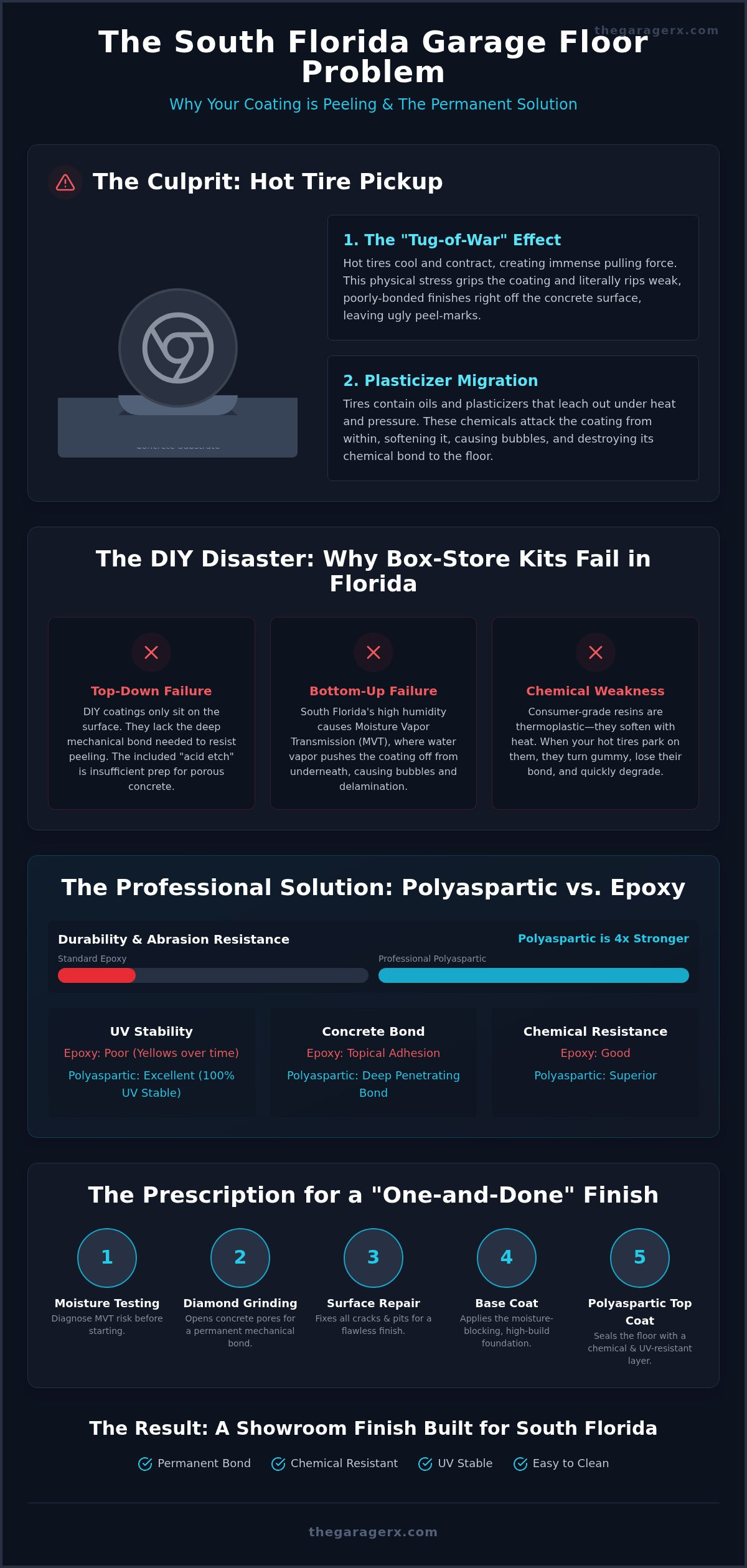
Your garage floor isn't just dirty; it's likely suffering from a specific mechanical failure. In South Florida, road temperatures frequently soar past 140 degrees. Your tires act as heat sinks, absorbing this thermal energy during your commute. When you pull into your garage, that heat is trapped between the rubber and the floor. This creates a "tug-of-war" effect. As the tires cool, they naturally contract and grip the surface. If your floor lacks a high-performance chemical resistant garage floor coating South Florida heat can't break down, the tire's grip will exceed the coating's bond to the concrete. The result is an ugly, peeling track where your car parks.
Plasticizer migration adds a chemical layer to this destruction. Tires contain oils and plasticizers to remain flexible. Under the intense pressure and heat of a parked vehicle, these chemicals leach out of the rubber and into the resin. This hidden reaction softens consumer-grade coatings, making them susceptible to blistering and "bald spots." Identifying the damage early is key. Look for areas where the coating appears bubbled or where the concrete is exposed in the exact shape of your tire tread.
The 140-Degree Threshold
Standard water-based epoxies often lose their structural integrity when temperatures spike. In a typical unconditioned Davie garage, the ambient heat combined with high tropical humidity creates a hostile environment for floor resins. This moisture prevents proper curing in DIY kits, leading to a "top-down" failure where the surface remains soft. Florida’s environment accelerates this delamination process, turning a minor cosmetic issue into a full-scale floor failure within a single summer season.
Diagnostic Check: Is Your Floor at Risk?
You can conduct a simple "exam" to determine the health of your current floor. If your coating feels thin or shows signs of yellowing, it's likely a 1-part DIY product. Perform a "Tape Test" by applying a strip of heavy-duty duct tape to the floor and pulling it up sharply. If any part of the coating lifts, your floor's adhesion is compromised. Even homeowners with brand-new concrete slabs shouldn't assume safety. New concrete often contains a weak surface layer called laitance that requires a professional diagnostic review and industrial grinding to ensure any future treatment actually fuses with the substrate.
Why Standard Epoxy and DIY Kits Fail in Florida
South Florida's environment is a relentless testing ground for floor coatings. Many homeowners fall into the trap of purchasing "epoxy-fortified" paint from big-box stores, believing it offers industrial protection. It doesn't. Most DIY kits fail because they only sit on the surface of the concrete. This is a "top-down" failure. Without industrial diamond grinding to open the concrete's pores, the coating has nothing to grab onto. The "acid etch" included in these kits is often a recipe for disaster. It adds more moisture to the slab without deep-cleaning the substrate, leading to immediate delamination.
The curing process itself is also compromised by our local weather. South Florida's high humidity levels interfere with the evaporation of solvents in water-based kits. When the air is saturated with moisture, the coating can't dry or cross-link properly. This leaves the finish perpetually soft and prone to damage from chemicals or vehicle weight. You're left with a floor that looks decent for a month but fails the moment the tropical rainy season begins.
The Humidity Factor in South Florida
In coastal areas near Miami and Davie, the high water table creates a phenomenon called Moisture Vapor Transmission (MVT). Water vapor rises through the porous concrete slab and exerts hydrostatic pressure against the underside of the coating. This is a "bottom-up" failure. If you haven't applied a high-solids, chemical resistant garage floor coating South Florida humidity can actually push the floor right off the concrete. Standard DIY kits are too thin and porous to resist this pressure. They lack the density to withstand the tropical dew point, resulting in unsightly bubbles and eventual peeling.
The Problem with 'Box Store' Chemistry
Consumer-grade products typically have much lower resin-to-filler ratios than industrial systems. These "box store" products are often thermoplastic, meaning they soften whenever they get hot. When your tires bring in road heat, the coating turns gummy and loses its bond. This cycle of softening and hardening eventually destroys the material's structural integrity. It's a chemical weakness that no amount of careful DIY application can fix.
The long-term cost of these "cheap" solutions is high. You'll eventually face the expense of stripping, grinding, and re-coating the entire space. If you're tired of seeing your floor flake away, it's time to consider a professional-grade treatment that fuses with your concrete for a permanent solution. Choosing a high-solids polyaspartic or industrial epoxy ensures that the chemical structure remains stable regardless of the outdoor temperature or the humidity levels inside your garage.
Polyaspartic vs. Epoxy: The Chemical Resistance Comparison
Choosing the right material is a diagnostic decision that determines the longevity of your garage transformation. While traditional epoxy has been the industry standard for decades, modern polyaspartic technology offers a superior "prescription" for the harsh conditions in Broward County. The primary difference lies in how these materials interact with your concrete. Epoxy typically sits on the surface, creating a rigid cap. In contrast, polyaspartic systems penetrate deep into the concrete pores to create a mechanical bond. This chemical fusion is so powerful that the bond strength often exceeds the internal strength of the concrete itself.
Durability in the Florida sun is another critical factor. Epoxy is naturally sensitive to UV radiation, which causes "ambering" or yellowing over time. This isn't just a cosmetic issue; UV damage makes the resin brittle and prone to cracking. Polyaspartic is 100% UV stable, meaning it stays crystal clear and maintains its aesthetic appeal for years. For homeowners seeking a truly chemical resistant garage floor coating South Florida weather won't degrade, the choice is clear. Polyaspartic also offers a significantly faster return to service. Most installations are completed in a single day, allowing you to park your car back in the garage within 24 hours, whereas epoxy often requires three to five days of curing.
Resistance to Plasticizer Migration
Polyaspartic is a high-performance variant of polyurea with superior pot life. This material is chemically inert to the aggressive compounds found in modern tires. The dense cross-linking of polyaspartic molecules creates a surface that is truly impermeable. This high density prevents automotive fluids, salts, and tire plasticizers from leaching into the coating. It effectively stops the chemical "tug-of-war" that causes standard resins to soften and peel away under your vehicle's weight.
Heat Tolerance for Performance Vehicles
The softening point of a floor coating is its Achilles' heel. Epoxy is a thermoplastic material, which means it begins to lose structural integrity as it gets hot. When a performance vehicle pulls in with tires heated from the asphalt, the epoxy can reach its glass transition temperature and become gummy. Polyaspartic has a much higher heat threshold, making it the preferred standard for airplane hangars and fire stations where heavy equipment and high temperatures are constant. You can read more about these real-world results in our Polyaspartic Floor Coating Reviews. By choosing a material with industrial-grade heat resistance, you ensure your floor remains a high-end environment rather than a maintenance headache.
Preventing the Peel: The Professional Installation Process
A permanent floor installation requires more than just high-quality materials; it demands a rigorous, multi-step surgical approach. To achieve a chemical resistant garage floor coating South Florida homeowners can rely on, the preparation must be flawless. We follow a specific professional protocol to ensure the system never delaminates or fails under pressure. This isn't a cosmetic cover-up. It's a structural intervention that bonds the new surface to your home's foundation.
- Step 1: Industrial Diamond Grinding. We use heavy machinery to remove the weak surface layer of concrete, exposing the "pores" for maximum mechanical grip.
- Step 2: Substrate moisture testing. Given the high water table in Broward County, we must verify that moisture vapor levels are safe for application.
- Step 3: Crack and pit repair. We utilize high-strength polyurea fillers that fuse with the concrete, creating a seamless and level surface.
- Step 4: Multi-layer application. This tiered process includes a deep-penetrating base coat, a full broadcast of vinyl flakes, and a clear, industrial-strength topcoat.
Mechanical Grinding vs. Acid Etching
Acid etching is a common DIY mistake that simply cannot provide the necessary profile for hot tire pickup resistance. While a chemical rinse might clean the surface, it doesn't create the Concrete Surface Profile (CSP) of 2 or 3 required for industrial adhesion. Mechanical grinding is the only way to ensure the resin roots into the slab. You can learn more about these professional standards in our High-Performance Epoxy Coating for Garage Floor guide. Grinding removes contaminants that acid simply can't touch, ensuring your investment stays put.
The Multi-Layer Defense System
The installation is a tiered defense against environmental stress. The base coat acts as the anchor, "rooting" the entire system into the concrete slab. Following this, we apply a dense layer of vinyl flakes. These aren't just for aesthetics; they provide vital impact resistance and a non-slip texture that's essential for Florida's rainy days. Finally, the clear polyaspartic topcoat serves as the ultimate shield. It's the component that resists chemicals, UV rays, and the intense heat from your vehicle's tires. This multi-layer approach ensures your garage remains a high-end, organized environment regardless of the weather.
If you're ready to stop the cycle of peeling and repairs, schedule your professional floor exam today to start your transformation.
The Garage RX Prescription for South Florida Floors
Every garage floor in South Florida faces a unique set of environmental stressors. From the high water table in Miami to the intense UV exposure in Davie, a one-size-fits-all retail kit is never the answer. At The Garage RX, we treat your floor with a diagnostic lens. We don't just apply a coating; we provide a specific prescription based on your concrete's condition and your lifestyle needs. This professional expertise ensures that your chemical resistant garage floor coating South Florida installation survives the test of time and tropical heat.
No two concrete slabs are identical. Factors like the age of the home, previous treatments, and hydrostatic pressure levels vary significantly between a property in Palm Beach and one in Broward County. We begin every project with a thorough exam to identify hidden issues before they become failures. By choosing industrial-grade materials over consumer-grade resins, we provide a finish that is 4x stronger than standard epoxy. This commitment to quality transforms a chaotic, dusty space into a high-performance environment that mirrors the cleanliness of a professional showroom.
A Lifetime Solution for Your Home
Investing in a professional floor is a one-and-done decision for your property. A durable, polyaspartic surface doesn't just prevent hot tire pickup; it serves as the foundation for a total garage transformation. Once the floor is stabilized, you can integrate other high-end systems like Custom Garage Cabinets to fully recover your space. This comprehensive approach cures the garage chaos that plagues so many South Florida households. It adds measurable value and functionality to your home while ensuring you never have to worry about peeling tracks again.
Ready for Your Consultation?
Your path to a permanent floor starts with a professional site visit. We serve homeowners throughout Davie, Miami, and Palm Beach with a focus on disciplined craftsmanship and transparent communication. During your consultation, we'll perform a moisture test and a substrate evaluation to determine the ideal treatment for your specific slab. There are no hidden issues or surprise expenses at the end of the project. You receive a clear plan for a high-end, organized environment. Book your The Garage RX consultation today! and let our detail-oriented experts restore order to your garage.
Secure Your Showroom Finish Today
Your garage floor shouldn't be a source of frustration or wasted money. By understanding the science of hot tire pickup and the limitations of consumer-grade kits, you're now equipped to make a disciplined decision for your home. A truly chemical resistant garage floor coating South Florida requires industrial-grade materials that fuse with the concrete rather than just sitting on top of it. This transformation moves you from the irritation of peeling tracks to the satisfaction of a high-end, organized environment.
As a locally owned and operated expert in Davie, FL, we specialize in polyaspartic systems that are 4x stronger than standard epoxy. Our streamlined one-day professional installation process ensures your space is back in service quickly without compromising on durability. Don't risk the "buy it twice" mistake with a temporary fix. It's time to apply the right treatment to your slab and enjoy a permanent, easy-to-clean finish that stands up to the Florida sun.
Get a Professional Prescription for Your Garage Floor and take the first step toward reclaiming your space. We're ready to help you achieve the clean, orderly garage you deserve.
Frequently Asked Questions
Can I fix hot tire pickup by painting over the peeled area?
Painting over the damage is a cosmetic band-aid that fails to address the root cause of delamination. Because the original coating has already lost its mechanical bond with the concrete, any new layer applied on top will simply peel away along with the old material. A permanent cure requires a full professional exam of the slab followed by industrial diamond grinding. This removes the compromised resin and prepares the surface for a fresh, high-performance treatment.
How long does a hot tire pickup resistant floor last in Florida?
A professionally installed polyaspartic system is designed to last between 15 and 20 years in the South Florida climate. Unlike standard epoxy, which may show visible wear or yellowing within 5 to 7 years, polyaspartic remains UV stable and chemically inert. Its superior resistance to thermal shock and moisture vapor transmission ensures that the bond remains intact despite the intense tropical heat. This makes it a disciplined, long-term investment for your home's foundation.
What is the best garage floor for Florida humidity?
Polyaspartic coatings are the gold standard for high-humidity environments like Davie and Miami. This material is specifically formulated to tolerate the moisture levels common during application in our tropical climate. It provides a chemical resistant garage floor coating South Florida homeowners need to prevent "bottom-up" failure caused by hydrostatic pressure. While water-based DIY kits struggle to cure in high humidity, industrial polyaspartic sets reliably, creating a dense, impermeable shield that moisture cannot penetrate.
Is polyaspartic really better than epoxy for hot tires?
Yes, polyaspartic is significantly more effective than epoxy at resisting hot tire pickup. It is 4x stronger than standard epoxy and possesses a much higher glass transition temperature. This means it doesn't soften when performance tires bring 140-degree road heat into your garage. While epoxy is a thermoplastic that becomes gummy under thermal stress, polyaspartic maintains its structural integrity. It effectively ends the chemical "tug-of-war" that causes standard garage floors to peel and bubble.
Does a professional garage floor coating help with home resale value?
A professional floor coating acts as a value-added intervention that transforms a utility space into a high-end environment. Potential buyers often view a clean, showroom-quality garage as an extension of the home's living square footage. By eliminating the eyesore of peeling tire tracks and oil stains, you project an image of a well-maintained property. This detail-oriented upgrade provides a competitive edge in the South Florida real estate market, offering both aesthetic appeal and functional durability.
How soon can I park my car on a new polyaspartic floor?
You can typically return your vehicle to the garage just 24 hours after a polyaspartic installation is complete. This rapid "return to service" window is a major advantage for busy families who cannot leave their cars in the driveway for days. While traditional epoxy systems require 72 hours or more to reach full chemical cure, polyaspartic’s unique cross-linking technology allows for a one-day installation process. It’s an efficient solution that minimizes disruption to your daily routine.
What happens if I don’t grind the concrete before coating?
Skipping the mechanical grinding step is the primary cause of premature floor failure. Concrete naturally has a weak surface layer called laitance and may contain trapped oils or sealers that prevent a chemical resistant garage floor coating South Florida resins from bonding. Without grinding to achieve a specific Concrete Surface Profile, the coating merely sits on top of the slab. This leads to immediate peeling the moment your tires apply heat and traction to the surface.
Can hot tire pickup happen on a new concrete floor without a coating?
While bare concrete won't "peel" in the traditional sense, it is highly susceptible to permanent staining and "dusting" from hot tires. Unprotected concrete is porous, allowing tire plasticizers and road oils to leach deep into the slab. Over time, this creates dark, unsightly tracks that are impossible to clean. Applying a professional polyaspartic treatment acts as a preventative prescription, sealing those pores and creating an easy-to-clean surface that protects the structural integrity of your new concrete foundations.