

Why does every garage floor coating in Florida eventually peel, bubble, or surrender to the sun? You have likely seen the recurring symptoms: unsightly moisture blisters under the surface; gray dust tracking into your clean kitchen; and the frustration of "hot tire pickup" where your tires literally peel the finish off the concrete. It is an environmental battle that most standard retail kits simply aren't equipped to win. The "sweating slab syndrome" common in our climate requires more than a coat of paint; it requires a specialized intervention. This guide provides the expert-recommended prescription for how to protect concrete garage floor in Florida, moving you from a state of frustration to the satisfaction of a high-end environment.
We understand that a dysfunctional garage floor is more than an eyesore; it is a barrier to a productive home. Discover the professional strategy for shielding your space against high humidity and UV damage while adhering to the 9th Edition of the Florida Building Code. You will learn why moisture mitigation is the foundation of any successful installation and how modern polyaspartic systems offer 15 plus years of durability. We will outline the exact steps to achieve a showroom-quality finish that increases your property value and provides a clean, functional workspace for years to come.
Key Takeaways
- Identify why "Florida Garage Syndrome" causes bare concrete to fail and how hydrostatic pressure from the high water table affects your slab.
- Perform a simple 24-hour diagnostic "Plastic Sheet Test" to evaluate your floor’s moisture levels before applying any finish.
- Discover the professional prescription for how to protect concrete garage floor in Florida by choosing industrial-grade polyaspartic systems over temporary DIY bandages.
- Understand why diamond grinding is the only acceptable prep method for creating a mechanical bond, rendering traditional acid washing obsolete.
- Master the maintenance protocols necessary to shield your showroom-quality finish from corrosive coastal salt air and frequent afternoon downpours.
Understanding "Florida Garage Syndrome": Why Bare Concrete Fails
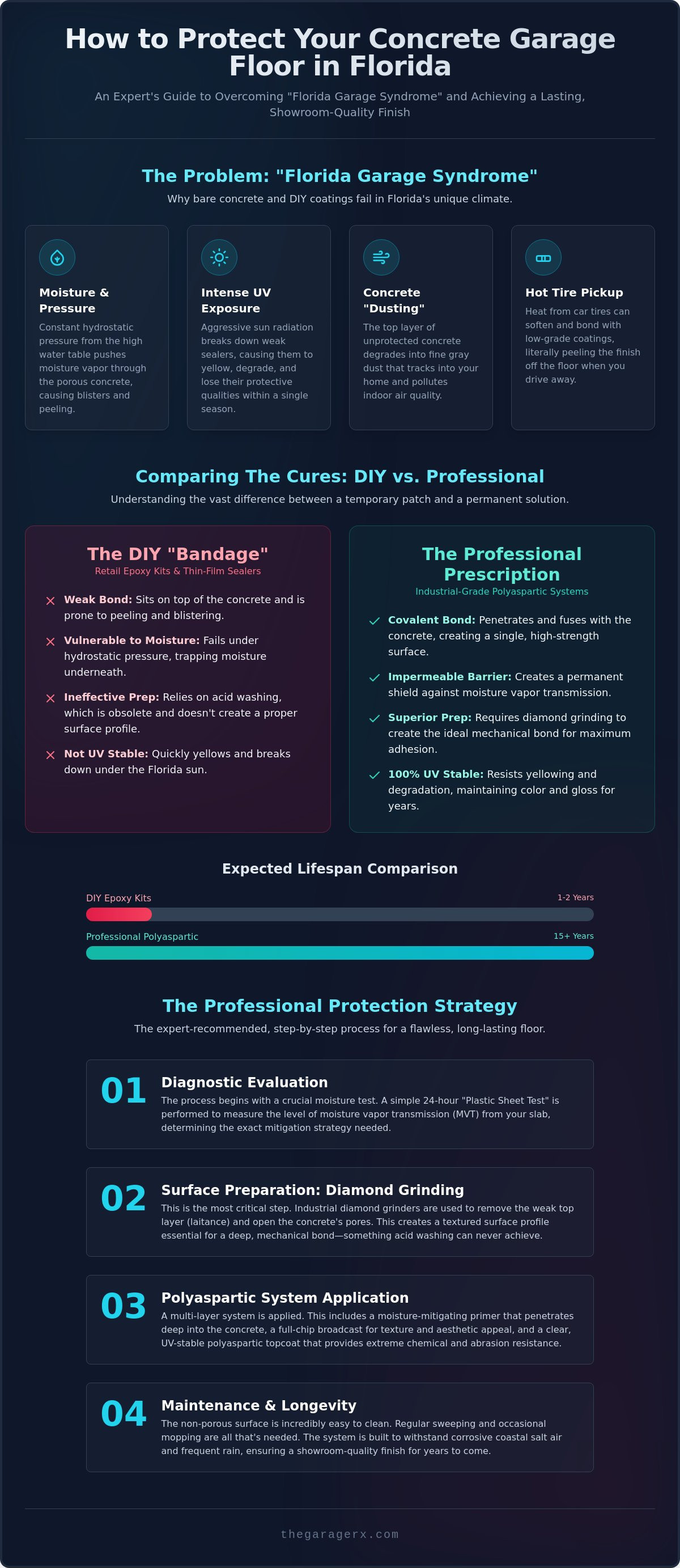
Most homeowners view their garage floor as a solid, impenetrable surface. In reality, concrete is a porous, breathable material that functions much like a hard sponge. In our subtropical climate, this porosity leads to a chronic condition we call "Florida Garage Syndrome." This isn't just a cosmetic annoyance. It is a structural breakdown caused by the relentless penetration of humidity and corrosive salt air. Understanding these mechanisms of concrete degradation is the first step in determining how to protect concrete garage floor in Florida.
The Impact of High Humidity and Hydrostatic Pressure
Concrete is filled with microscopic capillaries that allow for moisture vapor transmission (MVT). Because Florida has an exceptionally high water table, hydrostatic pressure is a constant environmental factor. This occurs when water vapor rises from the damp earth and pushes upward against the bottom of your slab. Without a professional-grade barrier, this moisture migrates through the concrete and eventually reaches the surface. You'll notice clear diagnostic signs of this failure: persistent damp spots and efflorescence, which is the white, chalky powder left behind when mineral-rich water evaporates. This internal pressure is the primary reason why thin, retail-grade coatings eventually blister and detach from the substrate.
UV Exposure and the Dusting Phenomenon
The South Florida sun is notoriously aggressive, and its impact on bare concrete is significant. Unprotected slabs suffer from "dusting," a process where the top layer of the concrete, or laitance, breaks down into fine, abrasive particulates. This dust doesn't stay confined to your garage. It tracks into your living spaces and gets pulled into your home HVAC system. This can lead to premature wear on mechanical components and increased indoor allergens. While many homeowners try to fix this with standard "wet look" sealers, these products often lack UV stability. Within a single season, the intense radiation causes these basic sealers to yellow and peel, leaving the concrete vulnerable to further decay.
To secure your floor for the long term, you must address both the moisture rising from the ground and the radiation hitting from above. A simple topical treatment is rarely enough when considering how to protect concrete garage floor in Florida for more than a few seasons. You need a solution that creates a permanent, structural bond with the slab.
Comparing Protection Methods: Sealers vs. Professional Coatings
Choosing the right intervention for your garage floor requires a clear understanding of the protection hierarchy. Most homeowners start with topical sealers, which act as a temporary barrier against water and dust. While these are inexpensive, they offer zero protection against the structural stressors of the Florida climate. Moving up the scale, "Big Box" DIY epoxy kits are often marketed as a permanent solution. In reality, these are merely a temporary bandage. These water-based products lack the solids content necessary to withstand hydrostatic pressure or intense heat. For a true long-term cure, industrial-grade polyaspartic systems are the only expert-recommended prescription for how to protect concrete garage floor in Florida.
The Federal Highway Administration highlights the link between concrete durability and environment, confirming that external stressors dictate the lifespan of a slab. Professional polyaspartic coatings address these stressors through a covalent bond. Unlike epoxy, which simply sits on top of the concrete, polyaspartic resins penetrate deep into the pores and fuse with the material. This creates a unified, high-strength surface that won't delaminate when the Florida water table rises. If you are tired of looking at a peeling, dysfunctional floor, a formal consultation with the specialists at The Garage RX can help you determine the exact specifications needed for your space.
DIY Epoxy vs. Industrial-Grade Polyaspartic
Efficiency is the primary differentiator between professional and amateur systems. A DIY epoxy project is a week-long ordeal. It requires days of drying and a lengthy cure time before you can park your vehicle. Polyaspartic systems are ready for foot traffic in just a few hours and full vehicle traffic within 24 hours. Beyond speed, flexibility is vital. Florida’s sandy soil often leads to minor slab shifts. Epoxy is inherently brittle and will crack under these conditions. Polyaspartic remains flexible, moving with the concrete to maintain a seamless finish. It also provides superior resistance against battery acid, motor oil, and the corrosive salt air found in coastal regions.
The Truth About Hot Tire Pickup in South Florida
Hot tire pickup is a specific failure where tires "melt" into a coating. After a long drive on sun-baked asphalt, your tires can reach temperatures exceeding 140 degrees. When you park, that heat transfers to the garage floor. Inferior coatings soften under this thermal load, causing the tire to fuse with the finish. When you pull out of the garage the next morning, the tire literally rips the coating off the concrete. Davie homeowners frequently see this peeling specifically where they park their heavy SUVs. Polyaspartic systems have a significantly higher heat tolerance, ensuring that tires never adhere to the floor, regardless of the afternoon temperature. This is a critical component of how to protect concrete garage floor in Florida for the long haul.
The Diagnostic Process: How to Evaluate Your Floor’s Health
Every successful intervention begins with a thorough examination. You can't simply apply a coating and hope for the best; you must understand the unique "medical history" of your slab. This diagnostic phase is the most overlooked step in how to protect concrete garage floor in Florida. Skipping this part of the process is why many DIY projects fail within the first year. Before you invest in materials, you need to identify the invisible stressors that could compromise your floor’s future bond.
The Moisture Test: Is Your Slab Breathing?
High humidity is a given in South Florida, but subsurface moisture is the silent killer of garage floor finishes. The Building Science Corporation explains concrete floor problems by highlighting how vapor pressure can detach coatings from the substrate. To perform a 24-hour DIY diagnostic, tape a 16x16 inch square of clear plastic sheeting to a clean section of your garage floor. Ensure all four edges are completely sealed with duct tape. After one full day, peel it back and inspect the area.
If the concrete appears darker or you see condensation on the plastic, your slab is "breathing" significant moisture through its capillaries. This is a sign that a standard sealer will fail. Professional installers go deeper than this visual test. They use calcium chloride tests to quantify the exact pounds of moisture vapor emitting per 1,000 square feet. This data determines if your floor requires a specialized moisture vapor barrier before the final polyaspartic layer can be applied safely.
Identifying Cracks and Surface Contaminants
Not all cracks are created equal. Hairline settling cracks are common in Davie homes and usually require minor "surgery" with a polyurea filler to prevent them from telegraphing through the new finish. However, wide structural cracks or vertical displacement suggest a more serious foundation issue that must be addressed before any protection is applied. You must also check for surface hardness and previous treatments. Perform a "scratch test" using a metal pick or a screwdriver. If the concrete gouges easily, the surface is soft and requires extra mechanical preparation to reach a solid substrate.
Pour water on various areas of the floor to check for old "mystery" sealers. If the water beads up instead of soaking in, a previous coating is present. New protection won't stick to these old layers. Finally, look for oil saturation. After 10 plus years of automotive trauma, oil can soak deep into the concrete. Cleaning alone won't suffice for these spots; they need aggressive degreasing or heavy diamond grinding to ensure a clean, mechanical bond. This thorough evaluation is essential for anyone learning how to protect concrete garage floor in Florida effectively.
The Professional Prescription: Step-by-Step Protection Strategy
Once the diagnostic phase is complete, it's time to move from evaluation to intervention. Protecting a slab in our environment requires a methodical, multi-step strategy that addresses the specific stressors identified in previous sections. You cannot simply roll on a product and expect it to hold. Real durability is achieved through mechanical preparation and a chemically engineered multi-layer system. This is the definitive standard for how to protect concrete garage floor in Florida for a lifetime.
Diamond Grinding vs. Acid Washing
In the world of professional concrete restoration, acid washing is a myth. While many DIY kits suggest a simple muriatic acid bath, this method is fundamentally flawed for Florida homes. Acid washing relies on a chemical reaction that often fails to remove deep-seated contaminants like motor oil or old sealers. More importantly, it introduces significant amounts of water into a slab that is already struggling with high humidity. This trapped moisture is a primary cause of premature coating failure.
Professional installers utilize industrial diamond grinding to prepare the surface. These heavy-duty machines use diamond-infused segments to mechanically remove the "laitance," or the weak top layer of the concrete. This process creates a specific "mechanical profile" similar to a medium-grit sandpaper. This texture is vital because it allows the coating to fuse with the concrete rather than just sitting on top. To ensure your home remains clean, these grinders are connected to high-efficiency particulate air (HEPA) vacuum systems that contain 99.9 percent of the dust at the source.
Multi-Layer Application for Long-Term Durability
A single coat of paint is never enough. A professional-grade system consists of three distinct layers, each serving a specific protective function. The first layer is a high-wicking base coat. This resin is designed to penetrate deep into the capillaries opened by the diamond grinding, creating a permanent covalent bond. While the base coat is still wet, a full broadcast of decorative flakes is applied. These flakes do more than just look good. They provide essential impact resistance and a slip-resistant texture that is vital for wet Florida afternoons.
The final layer is the polyaspartic top coat. This is the high-solids shield that protects your investment from UV radiation, corrosive salt air, and chemical spills. This top coat is what prevents the "hot tire pickup" mentioned earlier. For a total seal, this treatment should extend up the stem walls. Creating vertical mitered edges ensures that moisture cannot penetrate the seams where the floor meets the wall. If you are ready to implement this high-end environment in your own home, you can schedule a professional consultation to begin your transformation. This comprehensive approach is the only way to ensure success when considering how to protect concrete garage floor in Florida.
Maintaining Your Protected Floor in South Florida
Your floor has been transformed from a dusty, porous slab into a high-performance environment. However, the intervention doesn't end with the final top coat. To ensure your investment lasts 15 plus years, you must follow a specialized maintenance rhythm. South Florida's unique stressors, especially the corrosive salt air and frequent tropical downpours, require a specific cleaning protocol. This is the final step in how to protect concrete garage floor in Florida while maintaining a showroom-quality aesthetic.
Cleaning Protocols for Salt Air and Rain
Coastal homeowners deal with salt deposits that can act as an abrasive if left unmanaged. You don't need harsh degreasers or industrial chemicals for this. Stick to pH-neutral cleaners and warm water. These soaps effectively break down road grime and salt without compromising the chemical integrity of the polyaspartic shield. If you notice rubber residue from your tires, a simple microfiber mop and a neutral cleaner will lift the marks without the need for aggressive scrubbing. This non-porous surface ensures that contaminants stay on the surface where they can be easily neutralized.
A high-quality squeegee is your most valuable tool after a typical afternoon thunderstorm. When you pull a wet vehicle into the garage, water can pool and leave behind mineral deposits as it evaporates. A quick pass with a squeegee removes standing water and prevents the humid air from fueling mold growth in the corners of your space. Because the professional coating is non-porous, mold and mildew have no substrate to take root in. This provides a significant health and cleanliness advantage over bare or poorly sealed concrete slabs.
Professional Installation as Preventative Care
The long-term value of a professional system goes beyond the physical floor. One of the greatest benefits is the "No-Wax" advantage. Unlike commercial tile or cheaper epoxy, polyaspartic coatings never require buffing, waxing, or polishing to maintain their luster. This durable foundation sets the stage for a complete spatial recovery. A clean, protected floor integrates seamlessly with custom garage cabinets. This allows you to mount storage off the ground without worrying about moisture wicking up from the slab into your cabinetry.
When you consider the ROI, professional protection is the only logical choice. The cost of a "redo" for a failed DIY epoxy kit often exceeds the price of the initial professional installation. By choosing the right materials from the start, you create a functional workspace that increases property value. This finished environment is the perfect anchor for comprehensive garage organization systems. If you are ready to stop fighting the environmental chaos of your garage, a formal consultation is your first step. This professional prescription is the definitive answer for how to protect concrete garage floor in Florida and reclaim your home.
Secure Your Floor for the Future
Reclaiming your garage from the relentless Florida humidity requires more than a simple weekend project. You now understand that shielding your slab involves a precise diagnostic process and the mechanical bond only achieved through professional diamond grinding. By choosing industrial-grade polyaspartic technology over temporary DIY bandages, you effectively neutralize "Florida Garage Syndrome" and eliminate the frustration of peeling, dusting, and hot tire pickup. This guide has outlined the essential steps for how to protect concrete garage floor in Florida while ensuring a showroom-quality finish that lasts for decades.
Serving homeowners throughout Broward, Miami-Dade, and Palm Beach Counties, our team provides the technical precision needed for a high-end spatial transformation. Don't let environmental chaos dictate the condition of your home’s most versatile workspace. It is time to move from a dysfunctional floor to a serene, organized environment. Get Your Professional Garage Floor Diagnosis from The Garage RX today. You deserve a workspace that is as resilient as it is beautiful.
Frequently Asked Questions
Is polyaspartic better than epoxy for Florida garages?
Polyaspartic systems are significantly better for Florida's environment because they offer superior UV stability and flexibility. Unlike traditional epoxy, which often yellows and becomes brittle under the intense South Florida sun, polyaspartic remains clear and moves with the concrete. This prevents the cracking and delamination issues that plague many older, standard installations in our region.
How long does it take to professionally coat a garage floor in Davie?
A professional installation in Davie typically takes just one full day to complete. Our efficient process ensures your garage isn't out of commission for an entire week. You can generally walk on the new surface within four to six hours after the final top coat is applied. This rapid turnaround is a key part of our solution-oriented approach to spatial recovery.
Can I protect my garage floor if it already has cracks?
You can certainly protect a floor that already has cracks. During the preparation phase, we perform slab surgery by filling hairline and settling cracks with high-strength polyurea fillers. This creates a seamless, level surface before the protective layers are applied. Addressing these structural imperfections is essential for anyone learning how to protect concrete garage floor in Florida effectively.
Will a garage floor coating make my floor slippery when it rains?
Your floor will not be slippery if it is installed with a full broadcast of decorative flakes. These flakes provide a distinct mechanical texture that offers excellent slip resistance even during a heavy afternoon downpour. We can also include additional anti-skid additives in the top coat for areas that receive frequent water exposure or for homeowners prioritizing maximum safety.
How much does professional garage floor protection cost in South Florida?
Professional floor protection costs in South Florida are determined by the specific condition of your slab and the level of moisture mitigation required. Factors such as current slab damage, the presence of old coatings, and the total square footage all influence the project scope. We provide a transparent, all-inclusive consultation to ensure there are no surprise expenses at the end of the project.
Do I need to stay off the floor after it is coated?
You will need to stay off the floor for a very short period. Foot traffic is typically safe within four to six hours of the final application. However, you should wait a full 24 hours before parking vehicles or moving heavy equipment back into the space. This short window ensures the covalent bond has reached full strength before facing the stress of hot tire pickup.
Can I apply a coating over a floor that was previously painted?
You cannot apply a professional coating directly over old paint or retail-grade sealers. These previous treatments must be removed using industrial diamond grinding to expose the raw concrete capillaries. This mechanical preparation is the only way to ensure how to protect concrete garage floor in Florida with a bond that lasts for 15 plus years without peeling or bubbling.
Does the Florida humidity affect the installation process?
Florida’s high humidity definitely impacts the installation process by affecting cure times and moisture vapor transmission. Professional installers use diagnostic tools to monitor ambient moisture and slab temperature throughout the day. We adjust our chemical prescription based on these environmental readings to ensure a perfect application that withstands the state’s unique hydrostatic pressure challenges.