

Your garage floor isn't a storage unit; it's a high-traffic zone currently suffering from a chronic case of congestion. Tripping over seasonal bins and navigating a maze of clutter shouldn't be your daily reality. If you've been wondering how to use overhead garage storage to reclaim your square footage, you're looking for more than just a quick fix. You need a specialized intervention that treats the ceiling as a primary asset rather than an afterthought.
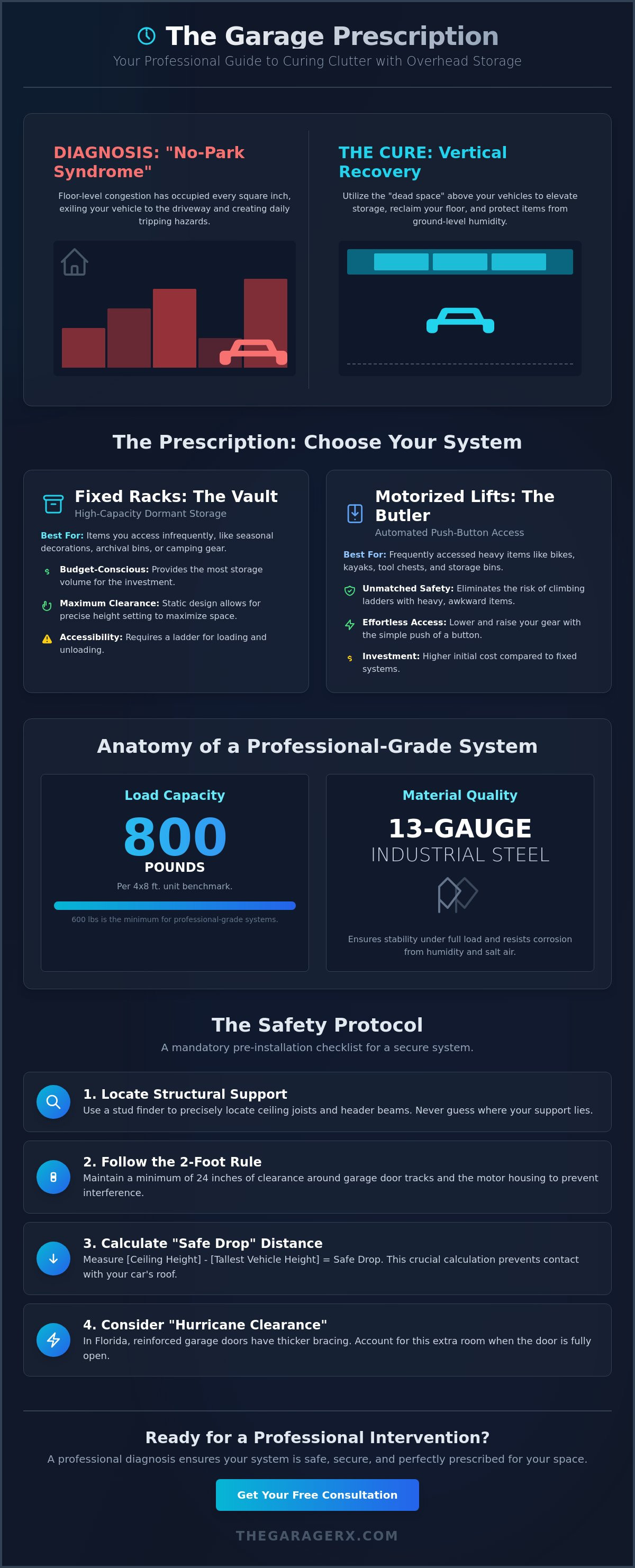
It's natural to feel uneasy about hanging heavy equipment over your car or struggling to reach items tucked away in high corners. We understand that South Florida's floor-level humidity adds another layer of urgency to getting your valuables off the concrete. This guide provides a professional prescription for your space. We'll show you how to diagnose your storage needs and implement high-capacity systems, including motorized overhead storage that brings your gear to you. You'll learn how to select 13-gauge industrial steel racks capable of holding up to 800 pounds. This methodical approach ensures your floor stays clear and your property remains secure.
Key Takeaways
- Identify underutilized vertical "dead space" above your vehicles to recover floor area currently congested by seasonal bins.
- Master how to use overhead garage storage by prescribing fixed racks for dormant items and motorized lifts for frequently used gear.
- Apply a clinical loading protocol that prioritizes a stable center of gravity and a triage system for easy accessibility.
- Schedule an annual physical exam of your storage system to monitor mounting hardware and ensure ceiling joists remain in peak condition.
- Learn why professional intervention is the cure for environmental chaos by integrating overhead racks with custom cabinets and slatwall systems.
Diagnosing Your Garage: Identifying Underused Vertical Space
"No-park syndrome" is the most common symptom of a dysfunctional garage. It occurs when your vehicles are relegated to the driveway because floor-level clutter has occupied every available square inch. To solve this, you must look up. We define the ceiling as the "recovery room" for your home's organization. By learning how to use overhead garage storage, you transition from managing chaos to optimizing a high-capacity asset. Most garages contain significant "dead space" between the vehicle roof and the ceiling joists. This void is the ideal location for bulky, seasonal items that currently obstruct your walking paths.
For homeowners in Davie, this strategy offers a clinical advantage beyond simple organization. Elevating your storage protects sensitive items from the relentless ground-level humidity common in South Florida. While the residential multifunction duty as workshops often leads to items piling up on the concrete, lifting them into the rafters prevents mold and moisture damage. It's a necessary intervention for long-term property preservation. If you can't see your floor, your garage is currently in a state of spatial crisis.
The Anatomy of a Garage Ceiling
Your ceiling joists serve as the skeletal support for any overhead system. Before installation, you must identify whether you have a finished drywall ceiling or an unfinished open-rafter layout. Finished ceilings require a stud finder to locate the center of each joist for secure lag bolt placement. For heavy-duty systems, locating the main header beam is critical. This structural powerhouse provides the maximum load-bearing capacity required for high-density storage. Don't guess where your support lies; a precise diagnosis of your ceiling's structure is the only way to ensure safety.
Measuring Your Clearance Zones
Precision is vital when calculating how to use overhead garage storage safely. Follow the 2-foot rule. Always maintain at least 24 inches of clearance around garage door tracks and the motor housing. This prevents mechanical interference during operation. Next, calculate your "Safe Drop" distance. Measure the height of your tallest vehicle and subtract that from the total ceiling height. This ensures your racks never make contact with your car's roof. Finally, account for "Hurricane Clearance." In Florida, reinforced garage doors often feature thicker bracing that requires extra room when the door is in the open position. Accurate measurements prevent costly collisions and mechanical failures.
The Prescription: Choosing the Right Overhead Storage System
Selecting the correct hardware is the most critical phase of your spatial recovery. Just as a physician tailors a treatment to a specific ailment, you must match your storage system to the frequency and weight of your gear. If you are researching how to use overhead garage storage for items you only touch once a year, fixed ceiling racks are your primary solution. These systems act as a dormant storage vault for holiday decorations or seasonal equipment. However, if you need to access heavy bins, bikes, or kayaks regularly, a motorized lift serves as the perfect rehabilitation tool. These automated systems eliminate the need for ladders, allowing you to lower your gear with the push of a button.
Don't fall into the weight capacity trap. Many retail-grade systems offer flimsy supports that bow under pressure. A professional-grade installation requires a 600-pound minimum capacity per 4x8 unit. For those with significant storage needs, heavy-duty systems now reach an 800-pound benchmark using 13-gauge industrial steel. This ensures your system remains stable even when fully loaded with dense containers. If you're unsure which capacity fits your home, a professional garage consultation can provide a precise diagnosis of your structural needs.
Fixed Racks vs. Motorized Lifts
Fixed racks offer high-volume storage at a lower price point. They are ideal for budget-conscious homeowners who need to clear massive amounts of floor clutter quickly. Motorized lifts, while a higher investment, provide unmatched safety and accessibility. If physical mobility is a concern or if you want to store heavy items like power tools and outdoor gear, the motorized option is the superior choice. It removes the physical strain of lifting heavy bins over your head, making the storage process significantly safer for the average homeowner.
Material Quality and Durability
In South Florida, the environment is a constant threat to your storage. High humidity and salt air act as corrosive agents on cheap metal. Industrial-grade steel is the only reliable medication for this issue. You should look for powder-coated finishes that resist rust and withstand the extreme heat of an unconditioned garage. Standard paint will peel or bubble, but powder coating bonds to the metal for long-term protection. Additionally, ensure your mounting hardware consists of heavy-duty lag bolts. These won't shear under the stress of a full load or the vibrations of a high-cycle garage door.
Clinical Loading Protocol: How to Organize Your Racks
Effective storage requires more than just lifting bins into the air. It demands a clinical loading protocol to ensure both safety and long-term accessibility. When you master how to use overhead garage storage, you must apply the "center-of-gravity" rule. This means placing your heaviest items directly over the joist-mounted brackets. By concentrating weight at the strongest points of the system's skeletal structure, you prevent structural fatigue and ensure the rack remains level. Never stack items haphazardly. A balanced rack is a safe rack.
Visual health is a vital component of a high-end garage environment. We recommend using clear, uniform bins to maintain a clean aesthetic and improve visibility. This allows you to identify contents from the floor without the need for a ladder. This transparency reduces the time spent searching for specific gear. Always perform a perimeter safety check after loading. Ensure no items hang over the edge of the rack decking. Overhanging equipment creates a snag hazard for garage doors and a significant safety risk for vehicles and pedestrians below.
Step-by-Step Loading Strategy
Follow this methodical process to optimize your ceiling-based recovery system:
- Step 1: Triage your inventory. Sort items into "Active" (used monthly), "Seasonal" (used once a year), and "Archival" (kept for long-term records).
- Step 2: Position the heavyweights. Place the densest bins directly over the primary mounting brackets to leverage the ceiling's maximum weight-bearing strength.
- Step 3: Distribute the load. Spread remaining items evenly across the wire decking. This prevents bowing and localized stress on the frame.
- Step 4: Secure the perimeter. Use specialized hooks to hang loose items like ladders or folding chairs from the rack's exterior frame for instant access.
Labeling for Instant Retrieval
Organization fails if you can't find what you need when you need it. Implement the "Three-Side Rule" by labeling every bin on the front, bottom, and side. This ensures the label is visible whether you're looking up from the floor or standing on a step stool. Use color-coded tape for an immediate visual diagnosis. For example, use red for holiday decor and green for gardening supplies. For high-volume systems, maintaining a digital "Garage Map" on your smartphone allows for instant retrieval. You'll never have to guess which bin holds your hurricane supplies again.
Maintenance and Safety: Keeping Your System in Peak Condition
Preventative care is the cornerstone of any long-term organizational plan. Just as you wouldn't ignore a clinical check-up, you shouldn't neglect the hardware supporting hundreds of pounds above your family's vehicles. Understanding how to use overhead garage storage effectively includes recognizing when the system requires adjustment. A high-performance storage system is a dynamic asset that interacts with your home's structure. Regular monitoring ensures that the initial transformation from chaos to order remains permanent and safe.
Warning signs of system fatigue are often subtle but critical to identify. Look for any visible sagging in the wire decking or gaps appearing between the mounting brackets and the ceiling. If you notice the rack swaying more than usual during loading, it's a symptom of loose hardware. Overloaded joists may also show signs of stress, such as cracking in the drywall or popping nails. Addressing these issues early prevents a catastrophic failure. If you suspect your current setup is compromised, schedule a professional structural assessment today to ensure your system meets industrial safety standards.
Annual Safety Inspection
Establish a routine for an annual physical exam of your racks. In South Florida, the vibrations from hurricane-season winds and heavy garage door usage can gradually loosen lag bolts. Use a socket wrench to verify that every mounting point remains flush against the ceiling. Inspect the wire decking for signs of rust or localized stress fractures. For those with motorized overhead storage, examine the lifting cables for fraying or kinking. Test the motor's responsiveness and listen for any grinding sounds that might indicate mechanical resistance or the need for lubrication.
Managing Heat and Humidity Up High
The "Attic Effect" is a unique challenge for local homeowners. Heat rises, and the air near your garage ceiling can reach temperatures significantly higher than at floor level. This extreme environment is why you should never store pressurized cans, aerosols, or sensitive electronics in overhead bins. These items are susceptible to heat-induced failure or leakage. To combat the persistent Florida humidity, place moisture-absorbent packets inside every bin before sealing the lid. This creates a controlled environment for your valuables. While the ceiling protects your property from the immediate threat of South Florida flooding events, proper bin preparation protects them from the invisible threat of airborne moisture.
Professional Intervention: Why The Garage RX is the Cure
Attempting a DIY installation for heavy-duty ceiling systems is often a risky form of self-medication for a cluttered home. While retail kits are available, they lack the structural precision required for high-capacity storage. Professional intervention ensures that your "no-park syndrome" is cured without compromising the skeletal integrity of your ceiling joists. We provide a specialized plan of action that moves you from the frustration of a dysfunctional space to the serenity of a high-end, organized environment. Our team handles the heavy lifting, ensuring your transformation is both safe and permanent.
Homeowners in Davie and Miami shouldn't have to wait weeks for relief. We offer a one-day transformation process that clears your floor and organizes your gear in a single session. This clinical efficiency is why local residents trust us to handle the complexities of vertical organization. We don't just hang equipment; we prescribe a long-term solution for your household's spatial health. By the time our team leaves, your garage will be a walkable, functional asset once again.
Precision Installation in South Florida
Our expert team possesses a deep understanding of Broward and Miami-Dade building codes. This local expertise is vital when calculating load-bearing capacities for heavy-duty racks. We use high-grade materials specifically tested to withstand the intense South Florida climate, preventing the rust and fatigue that plague cheaper alternatives. Every layout is customized to account for your specific garage door tracks, motor placement, and lighting fixtures. This level of technical precision ensures your system operates flawlessly without interfering with your home's existing mechanics.
Beyond Racks: The Complete Garage Treatment
A truly healthy garage requires a holistic approach to organization. While learning how to use overhead garage storage is a major step toward recovery, it's most effective when integrated into a complete system. We create seamless environments by pairing our overhead racks with Polyaspartic Floor Coatings to eliminate dust and moisture issues. For items that require eye-level access, we integrate Custom Garage Cabinets and slatwall systems. This multi-layered treatment ensures that every bin, tool, and piece of sporting equipment has a designated, secure location.
Don't settle for a temporary fix for your environmental chaos. Reclaim your square footage and protect your investment with a professional installation that lasts. Schedule your professional garage diagnostic today at The Garage RX.
Recover Your Floor with a Permanent Storage Solution
Your garage floor wasn't meant to be a warehouse for seasonal clutter. By identifying underused vertical dead space and implementing a clinical loading protocol, you can finally eliminate "no-park syndrome." Mastering how to use overhead garage storage involves more than just hanging racks; it requires a specialized approach to weight distribution and environmental protection. Whether you choose fixed racks for dormant items or motorized lifts for frequently used gear, this transformation provides immediate relief from household congestion.
The Garage RX has provided professional installation in Davie, FL, and across Broward, Miami-Dade, and Palm Beach since 2018. We utilize heavy-duty 600lb+ capacity systems that are specifically engineered to withstand the unique South Florida climate. Our disciplined approach ensures your property remains safe, accessible, and elevated above the humidity. It's time to stop navigating a maze and start enjoying a high-end, organized environment. Prescribe a cure for your cluttered garage—Get a Free Quote and experience the satisfaction of a clean, walkable garage floor today.
Frequently Asked Questions
How much weight can overhead garage storage racks actually hold?
Most professional-grade 4x8 foot racks are rated to hold between 250 and 600 pounds. The 2026 benchmark for heavy-duty systems is a weight capacity of 600 to 800 pounds. This high capacity depends on using 13-gauge industrial steel and securing the system to multiple ceiling joists. You should always distribute weight evenly across the wire decking to avoid localized stress points that could cause the metal to bow or fatigue over time.
Is it safe to install overhead storage above my garage door?
It's safe to install storage above the garage door as long as you maintain the 2-foot rule for clearance. This space is often called "dead space" and is perfect for long-term storage of flat items like folding tables or seasonal decor. You must account for the height of the door when open and any hurricane-rated bracing specific to South Florida homes. Ensuring the racks don't obstruct the door's path or the motor housing is the primary safety requirement.
Can I install overhead garage racks myself or should I hire a pro?
You can install retail kits yourself, but professional installation is the recommended prescription for heavy-duty systems. Learning how to use overhead garage storage safely starts with a professional consultation to avoid structural risks. An expert can accurately diagnose the load-bearing capacity of your ceiling joists and ensure secure mounting with industrial-grade lag bolts. Improper DIY installation often leads to hardware failure or damaged drywall that can compromise your home's value.
What items should I never store in overhead garage racks?
Never store pressurized cans, flammable liquids, or sensitive electronics in overhead racks. The "Attic Effect" in South Florida causes heat to build up near the ceiling, which can lead to leaks or explosions in aerosol containers. Additionally, avoid storing very heavy, dense items like loose bricks or engine parts that might exceed the point-load capacity of the wire decking. It's best to stick to bulky, lighter items like holiday decorations and plastic storage bins.
Will overhead storage interfere with my garage door opener?
Overhead storage won't interfere with your garage door opener if you plan the layout around the motor and rail system. Maintain at least 6 inches of clearance from the opener's moving parts and the torsion spring. During your initial diagnosis, measure the travel path of the door to ensure the racks don't snag the top panel as it retracts. Motorized lifts require even more careful placement to avoid electrical interference and ensure smooth mechanical operation.
How do I know if my garage ceiling joists can support the weight?
Most residential ceiling joists can support the weight of a storage rack when the load is spread across several structural members. You should look for 2x6 or larger joists and avoid mounting solely into drywall or decorative trim. A professional installer uses a stud finder to locate the center of each joist for maximum lag bolt penetration. If your joists show signs of existing cracks or water damage, they aren't suitable for heavy loads and require structural repair.
What are the best bins to use for ceiling-mounted storage?
Clear plastic bins with gasket-sealed lids are the gold standard for ceiling-mounted storage. These allow for an immediate visual diagnosis of the contents from the floor and protect your property from South Florida humidity. Using uniform sizes makes stacking more stable and improves the overall aesthetic of your garage. Look for bins with reinforced corners that won't crack under the pressure of being stacked on wire decking and ensure the lids lock securely.
How do I reach my items once they are stored on the ceiling?
You can reach your items using a sturdy A-frame ladder, but motorized overhead storage is the superior solution for frequent access. Understanding how to use overhead garage storage effectively means choosing a system that matches your physical mobility. Automated systems lower the entire rack to waist level with a remote or smartphone app. If you use fixed racks, organize your items so that the things you need most are near the front edge for easier retrieval.