
A one day garage floor coating sounds too good to be true, and in most of the country, skeptics would have a point. But South Florida isn't most of the country. Here, the real threat to your floor isn't time on the clock; it's the moisture vapor pushing up through your slab, the summer heat baking your tires to a standard coating, and the humidity that turns a rushed installation into a bubbling, peeling disappointment within months.
You've probably seen it yourself. A neighbor's garage floor that looked sharp for one season before hot tire pickup started lifting the finish in patches. Or maybe you've been putting off the project entirely because the thought of your cars sitting in the driveway for several days in the Florida heat isn't exactly appealing. Those frustrations are valid, and they're exactly the problems a properly diagnosed installation is designed to solve.
This guide treats your garage floor the way it deserves: as a clinical problem with a precise solution. You'll learn why polyaspartic chemistry is specifically engineered to thrive in high-humidity environments like Broward, Miami-Dade, and Palm Beach counties, what a professional diagnostic process actually looks like before a single drop of coating is applied, and how to get a durable, chemical-resistant, showroom-quality floor without sacrificing your weekend or your driveway.
Key Takeaways
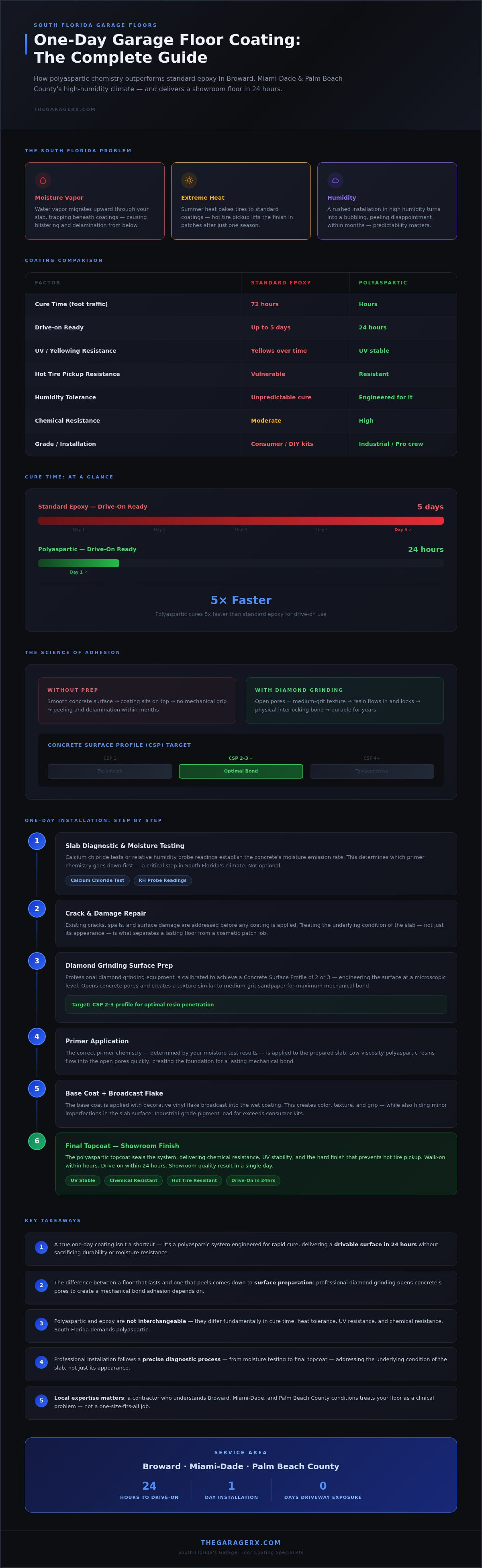
- A true one day garage floor coating isn't a shortcut — it's a polyaspartic system engineered for rapid cure, delivering a drivable surface in 24 hours without sacrificing durability or moisture resistance.
- The difference between a floor that lasts and one that peels comes down to surface preparation: professional diamond grinding opens the concrete's pores to create a mechanical bond that adhesion depends on.
- Polyaspartic and epoxy coatings are not interchangeable prescriptions — understanding their differences in cure time, heat tolerance, and chemical resistance is essential before choosing the right system for South Florida's climate.
- A professional installation follows a precise, step-by-step diagnostic process — from crack repair to final topcoat — that addresses the underlying condition of your slab, not just its appearance.
- Local expertise matters: a contractor who understands Broward, Miami-Dade, and Palm Beach County conditions will treat your floor as a clinical problem with a targeted solution, not a one-size-fits-all job.
What is a One Day Garage Floor Coating?
The term gets thrown around loosely, so let's be precise. A one day garage floor coating isn't a rushed DIY project or a watered-down finish applied in haste. It's a professionally installed polyaspartic system engineered specifically for rapid cure, delivering a floor you can walk on within hours and park on within 24 hours. That's not marketing language; it's chemistry doing exactly what it was designed to do.
Compare that to the standard big-box epoxy kit sitting on a shelf at your local home improvement store. Those systems typically require 72 hours of cure time before foot traffic and up to five days before you can safely drive on them. In South Florida's humidity, that window gets even less predictable. A polyaspartic system eliminates that uncertainty entirely.
The material difference is significant. Industrial-grade polyaspartic coatings applied by a professional crew bear almost no resemblance to consumer-grade epoxy kits beyond the fact that both end up on a floor. The pigment load, the adhesion chemistry, the topcoat hardness, and the application process are categorically different products serving different performance standards.
The Rise of Polyaspartic Technology
Polyaspartics are a subclass of polyurea coatings, but the distinction matters. Standard polyureas cure so rapidly that working time is measured in seconds, making them impractical for most residential installations. Polyaspartics are formulated with a controlled pot life that gives a trained crew enough working time to apply the coating properly while still curing far faster than epoxy once it's down.
For South Florida homeowners, one property stands out above the others: UV stability. Epoxy yellows under intense sun exposure. Polyaspartics don't. That's not a minor cosmetic footnote in a region where garage doors stay open through long, sun-drenched afternoons and Florida light is relentless year-round. A floor that holds its color is a floor that holds its value.
Why Homeowners in Davie Choose Speed
Clearing a garage for a full week is a genuine logistical problem. It means parking vehicles in the driveway, relocating tools and equipment, and leaving the space exposed to South Florida's afternoon storms for days. For homeowners with luxury vehicles, motorcycles, or high-value equipment, that's not a minor inconvenience; it's a real security and weather exposure concern.
The transformation aspect matters too. A single-day installation means you go to bed with a bare concrete slab and wake up to a showroom-quality floor. That's a compelling prescription for a problem most homeowners have been putting off for years.
The Science of Adhesion: How One-Day Systems Bond to Concrete
Adhesion isn't magic. It's mechanics. When a professional crew prepares your slab using diamond grinding equipment calibrated to achieve a Concrete Surface Profile of 2 or 3, they're not just cleaning the floor. They're engineering a surface at the microscopic level, opening the concrete's pores and creating a texture similar to medium-grit sandpaper. That profile gives the resin something to grab onto, a physical interlocking bond that no chemical adhesive alone can replicate.
Rapid-cure polyaspartic resins are formulated with low viscosity, meaning they flow into those open pores quickly and decisively before the cure reaction accelerates. The speed of the system doesn't compromise penetration; it simply compresses the window in which that penetration happens. A trained crew works with that chemistry, not against it.
Moisture vapor transmission is the leading cause of coating failure in Davie and across South Florida: it's the process by which water vapor migrates upward through a concrete slab and becomes trapped beneath an impermeable coating, eventually forcing it to blister and delaminate from below.
Moisture Management in South Florida
Before a single coat is applied on any professional one day garage floor coating installation, the slab gets tested. Calcium chloride tests or relative humidity probe readings establish the concrete's moisture emission rate. This diagnostic step isn't optional in Broward County; it's the prescription that determines which primer chemistry goes down first.
High-solids polyaspartic primers are specifically formulated to tolerate elevated moisture conditions that would cause a standard epoxy primer to fail at the bond line. Epoxy primers require a drier slab and a longer cure window. In South Florida's climate, those conditions are difficult to guarantee. A moisture-blocking polyaspartic primer bridges the gap, creating a vapor-resistant barrier that protects every layer above it. This is precisely where the competitor argument that "one-day systems require epoxy primers" falls apart. The chemistry has advanced. High-performance direct-to-concrete polyaspartic primers exist specifically because the industry recognized that epoxy's moisture sensitivity was a liability in humid environments.
Hot Tire Pickup: The Ultimate Durability Test
Here's the physics. A vehicle driven on a hot Florida afternoon builds heat in its tires. When that tire sits on a coated floor and cools, it creates a mild vacuum-like adhesion against the surface. A thermoplastic coating, meaning one that softens under heat, gets grabbed by that cooling rubber and peels away in patches. It's not dramatic. It's slow, ugly, and entirely preventable.
Polyaspartics are thermoset coatings. Once cured, the cross-linked polymer structure doesn't soften under heat. The tire cools, releases, and the floor stays intact. That's not a marketing claim; it's a documented performance characteristic you can verify in polyaspartic floor coating reviews focused on real-world durability.
If you want to understand how these factors apply specifically to your slab's condition, consulting a South Florida coating specialist before committing to a system is the most efficient first step.
Epoxy vs. Polyaspartic: Which is the Right Prescription?
Choosing between epoxy and polyaspartic isn't a matter of brand preference. It's a clinical decision based on your slab's condition, your garage's purpose, and what South Florida's climate will actually do to each system over time. Getting this diagnosis wrong is expensive. Getting it right means a floor that performs for years without intervention.
The most obvious difference is cure time. Standard epoxy systems require 24 to 72 hours before foot traffic and up to five days before vehicle traffic. Polyaspartic systems cure to foot traffic in hours and accept vehicles within 24 hours. But cure speed is a symptom of a deeper chemical difference, not the whole story.
Chemical resistance tells a more complete picture. Both systems handle oil and gasoline spills effectively when properly installed. Where they diverge is UV stability. Epoxy is an aromatic compound, meaning its molecular structure degrades under ultraviolet light exposure. In a South Florida garage where afternoon sun floods through an open door, that degradation shows up as yellowing and chalking within one to two years. Polyaspartics are aliphatic compounds. Their molecular structure doesn't react to UV radiation the same way, which is why the color you choose on day one is still the color you'll see years later.
When Epoxy Is the Better Choice
Epoxy isn't obsolete. There are specific diagnoses where its slower cure and higher build thickness make it the right prescription. Severely damaged slabs with significant surface porosity sometimes benefit from a high-build epoxy base coat that fills micro-voids more aggressively before a polyaspartic topcoat is applied. Purely interior-style garage conversions, where the space functions more as a finished room than a working garage and UV exposure is minimal, are also candidates. Metallic epoxy systems, in particular, create liquid-metal visual effects that are difficult to replicate with other chemistries. For homeowners prioritizing dramatic aesthetics over rapid return-to-service, that tradeoff may be worth it. You can explore those applications in depth in our high-performance epoxy coating guide.
The Polyaspartic Advantage for One-Day Success
The claim that polyaspartic coatings are significantly stronger than standard epoxy comes down to flexibility versus brittleness. Epoxy, once cured, is rigid. Concrete moves. It expands in Florida's heat and contracts in cooler months. A rigid coating bonded to a moving substrate develops micro-cracks over time. Polyaspartic coatings retain a degree of flexibility within their cross-linked structure, allowing them to move with the slab rather than against it.
For a high-traffic South Florida garage, the professional prescription is clear: a polyaspartic system delivers UV stability, hot tire resistance, rapid cure, and long-term flexibility in a single installation. That's not a compromise. It's the correct diagnosis for the environment.
- Cure time: Epoxy requires up to 72 hours; polyaspartic returns to vehicle traffic within 24 hours
- UV resistance: Epoxy yellows under sun exposure; aliphatic polyaspartics retain color long-term
- Flexibility: Polyaspartic moves with concrete expansion; rigid epoxy is more prone to micro-cracking
- Best use case for epoxy: High-build base coats on damaged slabs, metallic interior finishes with minimal UV exposure
- Best use case for polyaspartic: Any garage prioritizing a true one day garage floor coating result with long-term performance in South Florida's climate
The One Day Installation Process: Step-by-Step
Every legitimate one day garage floor coating installation follows the same clinical sequence. Skip a step, rush a phase, or substitute a material, and the floor tells on you within months. Here's exactly what a professional crew executes from the moment they arrive to the moment they hand back your garage.
Step 1: Concrete Preparation. Diamond grinding comes first. Industrial walk-behind grinders equipped with diamond-segmented tooling systematically remove the surface laitance, the weak, porous layer that forms on concrete as it cures, and open the substrate to achieve a Concrete Surface Profile that gives the resin a mechanical anchor. No prep step matters more than this one.
Step 2: Crack and Pit Repair. Once the slab is ground and vacuumed, every crack, spall, and surface void gets diagnosed individually. Rapid-set polyurea joint fillers and crack menders cure in minutes, not hours, so the repair phase doesn't become a bottleneck in the one-day timeline. The slab gets leveled and stabilized before any coating touches it.
Step 3: The Base Coat. A high-solids polyaspartic primer goes down directly onto the prepared concrete. In South Florida's humidity, this layer is the moisture management system. It penetrates the open pores, creates the vapor-resistant bond line, and sets the foundation for everything above it.
Step 4: The Flake Broadcast. Vinyl color chips get broadcast into the wet base coat at full coverage density. This isn't a decorative afterthought. More on that below.
Step 5: The Topcoat. A UV-stable, aliphatic polyaspartic clear coat seals the entire system. This final layer is what delivers chemical resistance, gloss retention, and the hard surface that stands up to daily traffic without degrading under Florida's sun.
Diamond Grinding vs. Acid Washing
Most one-day DIY kits instruct homeowners to etch the concrete with muriatic acid before applying the included epoxy paint. Acid washing dissolves surface contamination and creates a mild chemical profile, but it doesn't achieve the mechanical tooth that a diamond-ground surface delivers. The result is a coating bonded to a chemically altered surface rather than a mechanically opened one. In South Florida's humidity, that distinction is the difference between a floor that lasts and one that starts delaminating before the first rainy season ends. Professional crews in Davie use walk-behind planetary grinders and hand grinders for perimeter work, equipment that costs more than most homeowners spend on an entire DIY project. Mechanical preparation is non-negotiable for any installation backed by a professional warranty because it's the only method that produces a consistent, verifiable surface profile.
The Importance of Full-Chip Broadcast
Vinyl chips serve three functions that color alone can't. First, they create a randomized texture in the topcoat surface that provides meaningful slip resistance, a critical property in a South Florida garage where humidity and tracked-in rain are daily realities. Second, the chip layer adds an additional stratum of impact resistance between the base coat and the topcoat, distributing point loads from dropped tools or equipment. Third, full-coverage broadcast eliminates the visual evidence of any minor surface imperfections in the slab beneath. The result is a floor that performs as well as it looks, which is the same logic behind a complete garage organization system transformation in South Florida where every element serves both a functional and aesthetic purpose.
If you want a precise assessment of your slab's condition and a clear installation timeline, connect with The Garage RX team before scheduling your project.
Why The Garage RX is the Best Choice for Your Floor
Most contractors coat floors. The Garage RX diagnoses them. That distinction isn't semantic; it's the difference between a crew that shows up with a bucket and a crew that arrives with a protocol. Before a single grinder touches your slab, the underlying concrete condition gets assessed: moisture emission rates, existing crack patterns, surface contamination, and the specific demands your garage places on the finished system. The prescription follows the diagnosis. It doesn't precede it.
That approach matters most in Broward, Miami-Dade, and Palm Beach counties, where the variables are specific and unforgiving. A contractor based in Davie understands what South Florida's summer humidity does to an uncured base coat. They know the thermal cycling a luxury vehicle's tires impose on a coated surface after sitting in afternoon heat on I-595. That local fluency isn't something you can import from a national franchise; it comes from working these slabs, in this climate, repeatedly.
Pricing transparency is built into every project from the first conversation. There are no moisture surcharges discovered mid-installation, no surprise fees for crack repairs that any honest site assessment would have caught upfront. The quote you receive reflects the full scope of the work required. That's not a courtesy; it's the standard the practice holds itself to.
A completed floor coating also sets the stage for what comes next. A showroom-quality surface is the natural foundation for a custom garage cabinet installation that transforms the entire space. The floor and the storage system work as a unified environment, not as separate projects bolted together.
Our Professional Prescription for Garage Chaos
A clean floor changes how a space feels before a single cabinet goes up. It signals order. It resets the psychology of the room from a place where things get lost to a space that works deliberately. The crews who execute every one day garage floor coating installation for The Garage RX operate with that outcome in mind: disciplined sequencing, clean perimeter work, and a finished surface that reflects the same precision that went into preparing it. Pride in the result isn't incidental. It's the standard every Davie project is held to.
Start Your Transformation Today
Your slab has a specific condition. It deserves a specific prescription, not a generic estimate. A professional consultation identifies exactly what your floor requires, what system is appropriate for your garage's use, and what the finished result will look like long after installation day. That investment compounds over time; a properly coated garage floor protects the slab beneath it, adds measurable appeal to the property, and eliminates the recurring cost of failed DIY systems.
The floor is ready when you are. Schedule your professional garage floor consultation with The Garage RX and get a diagnosis built around your slab, your climate, and your garage.
Your Slab Has a Diagnosis. It's Time to Fill the Prescription.
A bare concrete slab isn't a neutral starting point. It's an active problem: absorbing moisture, degrading under traffic, and waiting to fail beneath whatever coating gets applied without proper preparation. The difference between a floor that lasts and one that peels comes down to chemistry, preparation, and the expertise to sequence both correctly in South Florida's climate.
A true one day garage floor coating isn't a shortcut. It's a precise system built around industrial-grade polyaspartic materials, diamond-ground preparation for maximum adhesion, and a diagnostic process that treats your specific slab rather than applying a generic solution to it.
The Garage RX has been serving Broward, Miami-Dade, and Palm Beach counties since 2018 with exactly that approach. Every project starts with an honest assessment and ends with a floor that performs as well as it looks.
Your garage is ready for a real prescription. Get your professional garage floor prescription from The Garage RX and walk into a transformed space by tomorrow.
Frequently Asked Questions About One Day Garage Floor Coating
Can you really drive on a one-day garage floor coating after 24 hours?
Yes, and this is one of the defining characteristics of polyaspartic chemistry. The cross-linked polymer structure reaches vehicle-ready hardness within 24 hours of application, not because corners are cut, but because the curing reaction is fundamentally faster than epoxy at the molecular level. A standard epoxy system requires up to five days before you should park on it. Polyaspartic delivers the same durable result in a fraction of that time.
How does South Florida humidity affect the 'one-day' curing process?
Humidity is actually less of a liability for polyaspartic systems than it is for epoxy. High-solids polyaspartic formulations tolerate elevated ambient moisture conditions that would compromise an epoxy primer's bond line. In Broward, Miami-Dade, and Palm Beach counties, where relative humidity regularly climbs during summer afternoons, this chemical tolerance isn't a bonus feature; it's the reason polyaspartic is the clinically correct prescription for a South Florida one day garage floor coating project.
Is polyaspartic coating better than the epoxy kits found in hardware stores?
They're not comparable products. Hardware store epoxy kits are thin, consumer-grade paints that bond to surface laitance rather than penetrating open concrete pores. Professional polyaspartic systems are applied over diamond-ground slabs, use high-solids chemistry, and cure into a thermoset structure that resists hot tire pickup, UV yellowing, and chemical exposure. The kit on the shelf costs less upfront and costs significantly more in failed re-installations within a few years.
What happens if my garage floor has existing cracks or moisture issues?
Both conditions get diagnosed and addressed before any coating goes down. Cracks are filled with rapid-set polyurea joint fillers that cure in minutes without stalling the installation timeline. Moisture emission rates are measured using calcium chloride tests or relative humidity probes, and the primer chemistry is selected based on those readings. A slab with elevated moisture doesn't automatically disqualify a project; it changes the prescription, not the outcome.
Are one-day garage floor coatings slippery when wet?
A properly installed system with a full-chip broadcast is not slippery. Vinyl color chips embedded into the base coat create a randomized surface texture that provides meaningful slip resistance under wet conditions, including tracked-in rain and humidity condensation, both of which are daily realities in South Florida garages. A smooth, chip-free clear coat applied without that broadcast layer would be a different story, which is one reason full-coverage chip installation isn't optional on a professionally specified job.
How long will a professional one-day polyaspartic floor actually last?
A professionally installed polyaspartic system on a properly prepared slab is designed to perform for many years under normal residential garage use. Longevity depends on three variables: the quality of surface preparation, the grade of materials used, and how the floor is maintained after installation. Skipping diamond grinding or using lower-solids formulations compresses that lifespan significantly. A floor installed with the correct diagnostic protocol and industrial-grade chemistry holds up far longer than any consumer-grade alternative.
Do I need to empty my entire garage for a one-day installation?
Yes, the full slab needs to be accessible before the crew arrives. That means vehicles, storage items, shelving units, and any floor-mounted equipment need to be cleared out completely. The diamond grinding process can't work around obstacles, and coating application requires unobstructed access to every square foot. The good news is that the 24-hour return-to-use window means your garage is functional again the following day, so the logistical disruption is genuinely minimal compared to multi-day epoxy systems.
What maintenance does a polyaspartic garage floor require?
Routine maintenance is straightforward: regular sweeping to remove abrasive grit and periodic mopping with a pH-neutral cleaner. Avoid harsh degreasers or acidic cleaning products, which can dull the topcoat's gloss over time. Polyaspartic's chemical resistance handles oil drips and fluid spills without staining if they're wiped up reasonably promptly. There's no resealing schedule required the way some natural stone or porous surfaces demand. The system is designed to perform without ongoing intervention.