

Is your garage ceiling a secure storage solution or a structural liability waiting to fail? Many homeowners install heavy-duty racks without realizing that the overhead garage storage weight capacity of the rack itself is only half the equation. While a high-end unit might be rated for 800 pounds, your ceiling's actual load limit depends on the structural health of your trusses and the existing weight of drywall or insulation. In the unique construction landscape of South Florida, understanding these limits is essential for long-term home safety.
You've likely felt a sense of hesitation when parking an expensive vehicle directly under a loaded storage system. It's a valid concern; a standard residential ceiling is often only rated for a live load of 10 pounds per square foot. This guide provides a professional diagnosis of your garage's structural limits. You'll learn how to accurately calculate safe weight thresholds, identify the difference between joists and trusses, and develop a specialized plan for a secure installation that protects your home and your assets.
Key Takeaways
- Distinguish between the hardware rating of your racks and the actual overhead garage storage weight capacity of your home’s ceiling structure to prevent structural failure.
- Identify symptoms of structural stress hidden behind drywall, like bowing or cracking, before beginning any installation.
- Compare the safety profiles of lightweight wire racks against industrial-grade steel systems to ensure your hardware meets your specific storage needs.
- Follow a strategic loading prescription that categorizes items by weight and usage frequency for optimal balance and accessibility.
- Learn why a professional diagnostic assessment is critical for homes in South Florida to ensure long-term durability and safety.
Overhead Garage Storage Weight Capacity: Ratings vs. Reality
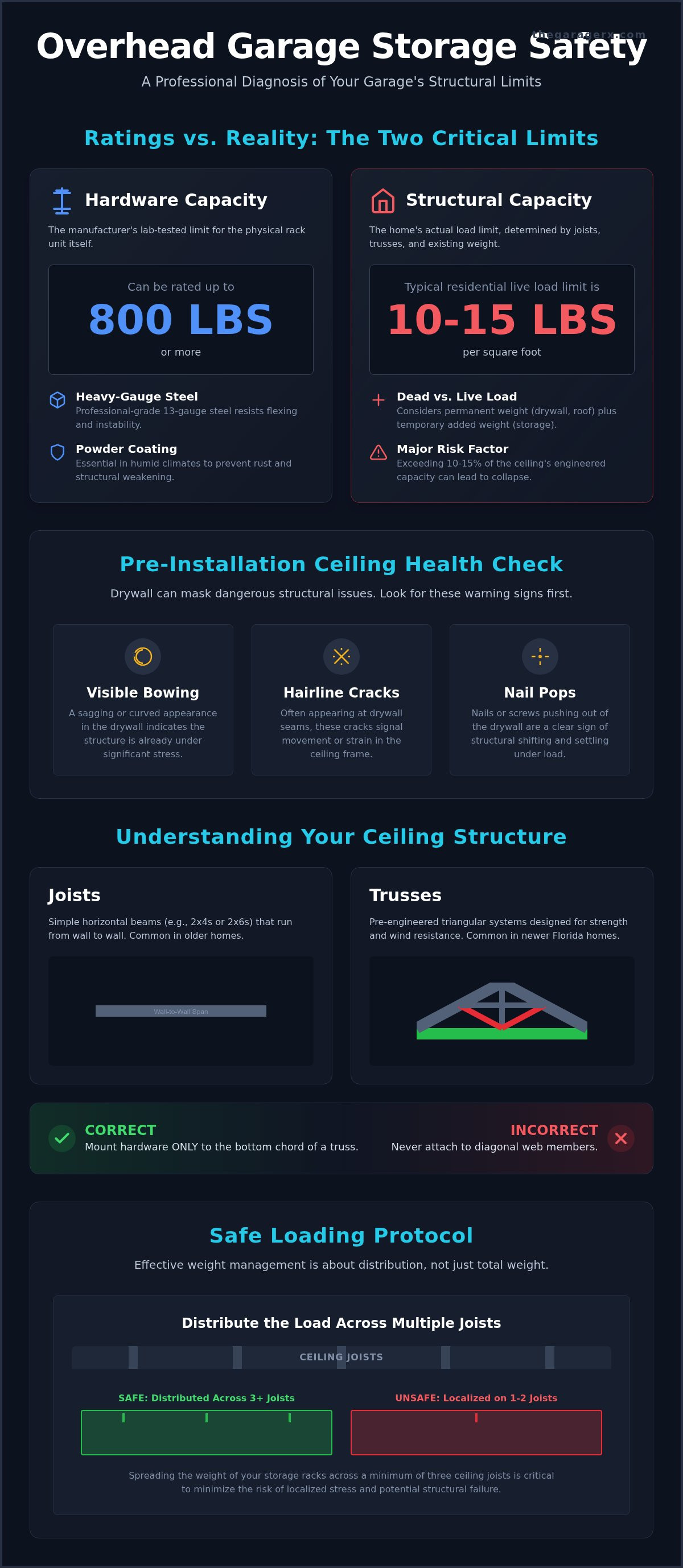
Purchasing a heavy-duty rack is only the initial step in a successful garage transformation. Many homeowners focus solely on the bold weight rating printed on the packaging, assuming that a high number is a universal guarantee of safety. This is a dangerous misconception. Truly understanding your overhead garage storage weight capacity requires you to look beyond the hardware and examine the structural health of your home. A rack rated for 750 pounds is functionally useless if the ceiling joists it attaches to are only engineered to handle a fraction of that pressure.
Hardware Capacity: The Manufacturer’s Limit
Hardware capacity is the laboratory-tested limit of the physical rack unit. To achieve a professional-grade rating, manufacturers use heavy 13-gauge industrial steel. Thinner steel gauges found in big-box stores often flex under weight, which leads to long-term instability. In the humid climate of Davie and surrounding areas, a high-quality powder coating is a non-negotiable requirement. This finish prevents rust from eating into the steel and weakening the frame over time. Hardware capacity represents the maximum load the steel frame can support before experiencing physical deformation.
Structural Capacity: The Home’s Limit
Your home’s ceiling has a much stricter set of rules than a steel rack. Structural capacity is defined by two factors: dead load and live load. Dead load is the permanent weight of your ceiling, including the drywall, insulation, and the roof structure itself. Live load is the temporary weight added to that structure, such as your stored bins or a worker performing roof repairs. Most residential garages are designed with a live load limit of approximately 10 to 15 pounds per square foot. Overhead storage systems must be carefully integrated into this existing ecosystem. Exceeding 10-15% of a ceiling’s total engineered capacity is a major risk factor that can lead to visible bowing or structural collapse.
We treat every garage as a unique patient. Before any hardware is mounted, a professional diagnostic assessment is required to determine the ceiling's actual health. This process involves more than simply finding a stud. We evaluate several critical factors:
- Joist dimensions: Determining if the structure uses 2x4 or 2x6 members.
- Wood species: Assessing the load-bearing quality of the lumber.
- Total span: Measuring the distance between support walls.
- Visual symptoms: Identifying existing stress marks or cracks in the drywall.
This diagnostic approach ensures that your storage solution is a safe intervention rather than a structural hazard. By aligning the rack's potential with the ceiling's reality, we create a storage environment that is both high-capacity and high-security.
Evaluating Your Garage Ceiling’s Structural Health
Drywall is a cosmetic layer that often masks structural defects. In Davie and throughout South Florida, many garages feature finished ceilings that hide the very members responsible for your overhead garage storage weight capacity. Before drilling a single hole, you must look for symptoms of a compromised ceiling. Visible bowing in the drywall, hairline cracks at the seams, or nail pops are all indications that the structure is already under stress. If your ceiling shows these signs, it is not a candidate for additional load until the underlying issues are remediated.
Joists vs. Trusses: A Florida Perspective
Standard ceiling joists are horizontal beams that run from wall to wall. In older Florida homes, you might find 2x4 or 2x6 joists with limited spans. Newer builds in Broward County typically utilize hurricane-rated truss systems. These are complex, pre-engineered triangles designed to resist uplift during high-wind events. While trusses often provide higher load tolerances, they are sensitive to point loads. You must only mount hardware to the bottom chord of the truss. Attaching to the diagonal web members can compromise the entire roof structure. The International Residential Code provides strict guidelines on these spans and allowable loads to ensure the safety of the dwelling.
Calculating the Load Distribution
Effective weight management is about distribution, not just suspension. Mapping the skeleton of your garage requires a high-quality stud finder or a professional structural scan. Once the joists are located, the goal is to spread the weight of your storage racks as widely as possible. Weight should always be distributed across at least three ceiling joists to minimize the risk of localized failure. Most residential garage ceilings are engineered for a live load of 10 pounds per square foot. If you are unsure if your home can handle the added stress, a professional diagnostic consultation can identify the exact load limits of your specific construction.
Spanning multiple joists allows the storage system to act as a unified part of the house rather than a concentrated weight hanging from a single point. This approach prevents creep, which is a slow deformation of wood over time that occurs when a structure is consistently pushed to its limit. If your garage ceiling is currently sagging or shows signs of previous water damage, it is unfit for overhead storage. Moisture weakens wood fibers and significantly reduces the weight capacity of your ceiling, making professional inspection a mandatory safety step.
Deciphering Rack Specs: From 250lbs to 750lbs
Selecting the right hardware is a critical part of the safety prescription for your home. Not all steel is created equal, and a rack claiming a high weight capacity might look sturdy while hiding significant engineering flaws. Your actual overhead garage storage weight capacity is tied directly to the gauge of the metal and the quality of the bracing. Lightweight wire racks found in retail stores are often designed for light seasonal decor; they lack the structural rigidity required for heavy bins, tools, or equipment. When these units are pushed to their limits, the wire decking can deform, creating a hazardous situation for anything parked beneath it.
Steel Gauge and Bracing Systems
Industrial-grade systems utilize 14-gauge steel as the professional standard for heavy storage. This thicker material provides the necessary resistance to bending and torsion under load. To prevent the common "shelf sag" seen in lower-quality models, we look for C-channel beams. These beams distribute weight evenly along the entire length of the rack, ensuring that the center does not become a weak point. Diagonal bracing is another essential feature, providing lateral stability that prevents the rack from swaying or shifting when you are loading or unloading items. Without this bracing, a rack is susceptible to "racking," a structural failure where the unit folds sideways under pressure.
The Weakest Link: Mounting Hardware
The hardware is often where a DIY project encounters its first complication. Big-box store lag bolts are frequently manufactured from lower-grade zinc that can shear off under the high torque required for a secure installation. If a bolt head snaps during the drive, the integrity of that mounting point is compromised. In the humid environment of Davie and surrounding Broward County, this risk is amplified. Standard zinc hardware will oxidize over time, leading to "rust creep" that eats away at the bolt's diameter and weakens its grip on the wood. Professional installations prioritize high-corrosion-resistant hardware or stainless steel to ensure the connection remains permanent. For a deeper look at these technical standards, you can explore overhead garage storage racks Miami to understand the professional prescription for your space.
Bolt length is a variable that cannot be overlooked. A standard three-inch lag bolt is often sufficient, but homes with double-layered drywall or fire-rated ceilings require longer hardware. The goal is to achieve at least two inches of penetration into the solid wood of the ceiling joist. Anything less than this depth is a liability. By treating the mounting process as a precise surgical procedure, we ensure that the rack becomes a permanent, safe extension of your home's structure.
Safe Loading Protocols for Overhead Systems
A professional installation is only the first phase of maintaining a secure garage environment. Your daily interactions with the system determine its long-term health. Even the most robust overhead garage storage weight capacity can be undermined by poor loading habits that create unnecessary stress on the rack’s frame and your home’s ceiling. Think of loading as the "daily treatment" required to keep your storage system in peak condition. By following a disciplined protocol, you ensure that your gear remains elevated and your vehicles stay protected.
Weight Distribution Strategies
Strategic placement is the key to structural longevity. You must prioritize placing your heaviest items, such as storage totes or off-season tires, directly over the vertical support brackets. This positioning transfers the weight directly into the ceiling joists rather than forcing the horizontal beams to carry the full load. Lighter, bulky items like holiday decorations or empty luggage should occupy the center of the rack. Avoid "point loading," which occurs when a single, high-density object sits in the middle of a wire grid. This concentrated pressure can lead to localized sagging or decking failure, even if the total weight is well below the rack's limit.
Seasonal Rotation and Inventory Management
Organization is a safety feature. Utilize clear plastic bins to maintain high visibility of your inventory without needing to move heavy containers frequently. For maximum safety, you should never store combustible materials, such as fuel cans, chemicals, or propane tanks, in an overhead system. The heat that accumulates near the ceiling in South Florida can create a hazardous environment for pressurized or flammable goods. We advise homeowners to label every bin with its estimated weight. This simple step prevents you from accidentally creeping over your system's capacity as you add new items over time.
The "center of gravity" rule is a vital safety concept for ceiling-mounted platforms. You want the heaviest mass to be as close to the mounting points as possible. This reduces the leverage force exerted on the lag bolts and the wood fibers of your joists. If you feel any resistance or hear creaking while loading, stop immediately. These are symptoms of a system reaching its limit. To ensure your system remains a high-performance asset, schedule a professional diagnostic check if you notice any changes in the rack's alignment or stability.
Perform a brief safety inspection annually. Check for loose nuts, signs of rust on the hardware, or any bowing in the support beams. In Davie’s humid climate, metal and wood can shift slightly over the years. Verifying the integrity of your mounting points ensures that your overhead storage remains a reliable solution for the life of your home. A disciplined approach to loading turns a simple rack into a sophisticated, high-capacity storage tool.
The Garage RX Prescription: Professional Installation
A weekend DIY project might save on initial labor costs, but it often sacrifices the long-term health of your home. Professional installation is a specialized intervention that prioritizes your family's safety and the structural integrity of your property. We utilize advanced diagnostic equipment, such as deep-sensing structural scanners, to identify the exact center of your ceiling joists. This precision is vital because a lag bolt driven into the edge of a joist significantly reduces the overhead garage storage weight capacity and can lead to wood splitting over time. Our team understands the specific challenges of Broward County construction, from hurricane-rated trusses to high-humidity environments that demand industrial-grade materials.
True garage transformation is a holistic process. Many of our clients find that professional organization integrates perfectly with a garage floor coating Davie FL to create a clean, high-end environment. By lifting your inventory off the floor and onto secure overhead racks, you protect your new floor coating while maximizing every square inch of available space. This methodical approach moves your garage from a state of chaotic storage to a disciplined, high-performance workspace.
Motorized Overhead Lifts: The High-End Solution
For homeowners who prioritize convenience and physical safety, motorized overhead storage systems represent the gold standard. These units eliminate the need for ladders or heavy lifting, which are common causes of household injuries. Smart lifts come equipped with advanced safety features, including weight sensors that prevent the motor from operating if the unit is overloaded. Auto-stop technology ensures the rack stops exactly where it should, preventing damage to the ceiling or the items below. In the luxury garages of South Florida, these motorized solutions provide the ultimate blend of high-tech functionality and structural security. They ensure that your overhead garage storage weight capacity is managed by a computer-controlled system rather than human guesswork.
The Peace of Mind Guarantee
Choosing a professional installation provides a level of peace of mind that a DIY kit cannot match. We stand by our work with a commitment to precision, ensuring every lag bolt is perfectly seated and every bracket is balanced for optimal load distribution. This detail-oriented approach mitigates the liability risks associated with falling racks and structural damage. Our technicians are trained to spot the "symptoms" of structural fatigue that an untrained eye might miss. Don't leave your ceiling's health to chance. Schedule your professional garage diagnostic today to ensure your storage plan is safe, secure, and built to last.
Secure Your Space with a Professional Plan
Managing your overhead garage storage weight capacity requires a precise understanding of your home's unique structural skeleton. You now know that a rack's laboratory rating is only valid if the ceiling joists can support the load. By prioritizing industrial-grade 14-gauge steel racks and adhering to strict weight distribution protocols, you protect your vehicles and your home's integrity. Whether you require stationary heavy-duty racks or specialized motorized lifting solutions, the goal is a transformation that offers both relief and long-term durability.
The Garage RX has provided expert installation in Davie since 2018. We approach every project with a diagnostic mindset to ensure your storage system is a safe, high-performance asset. Don't let environmental chaos or structural uncertainty compromise your garage. Our team is ready to evaluate your space and provide a specialized plan for a secure, organized environment. Prescribe a cure for your cluttered garage; book a professional consultation today. You deserve the peace of mind that comes with a professionally engineered storage solution.
Frequently Asked Questions
How much weight can a 4x8 overhead garage rack actually hold?
Most industrial-grade 4x8 racks are rated to hold between 600 and 800 pounds. It is vital to remember that this number refers to the hardware's capacity, not necessarily your ceiling's limit. The actual overhead garage storage weight capacity of your system is always determined by the weakest link, which is often the wooden structure of your home rather than the steel rack.
Can my garage ceiling collapse from too much weight?
Yes, structural failure can occur if the live load exceeds the engineered limits of your ceiling joists or trusses. Excessive weight causes wood fibers to fatigue and eventually snap, which can lead to a localized or total collapse. Professional installation prevents this by distributing the weight across multiple structural members to ensure the load stays within safe parameters.
Is it safe to install overhead storage on a finished drywall ceiling?
Installation is safe only when the mounting brackets are anchored directly into the center of the wooden joists. Drywall is a cosmetic material with no structural load-bearing capacity. We use precision scanning tools to locate the ceiling's skeleton through the drywall, ensuring every lag bolt achieves maximum "bite" into solid wood for a secure connection.
What is the difference between ceiling joists and trusses for storage?
Joists are standard horizontal beams that run wall-to-wall, while trusses are pre-engineered triangular structures common in newer Broward County homes. Trusses are highly efficient but sensitive to how weight is applied. You must only mount storage hardware to the bottom chord of a truss; attaching to the diagonal webbing can compromise the roof's integrity and void your home's warranty.
How do I know if my garage ceiling is strong enough for racks?
A professional diagnostic assessment is the most reliable way to verify your ceiling's health. We evaluate joist size, wood species, and the distance between support walls to calculate your true overhead garage storage weight capacity. If you see existing symptoms like sagging drywall or "nail pops," your ceiling may already be under stress and requires an inspection before adding more weight.
Should I use a motorized overhead lift or a stationary rack?
Choose a motorized lift if you need to access heavy items frequently or want to avoid the physical strain of using a ladder. Stationary racks are the ideal solution for long-term storage of seasonal items. Motorized systems offer an added layer of safety with built-in weight sensors that prevent the unit from moving if it exceeds its programmed limit.
Does overhead storage increase the value of my home in Davie?
High-end, professionally installed storage systems are significant selling points for South Florida buyers who prioritize an organized lifestyle. A clean, high-performance garage suggests the entire property has been maintained with care. When paired with other upgrades like floor coatings, overhead racks help transform the garage into a premium extension of the home's living space.
How often should I check the bolts on my overhead storage racks?
Perform a visual safety check of your racks at least once a year. Look for signs of oxidation on the hardware or any nuts that may have loosened due to home settling or vibration. In our humid climate, it is also important to inspect the drywall around the mounting points for any new cracks or signs of moisture that could weaken the wood underneath.