

In South Florida, the sun does more than just heat your driveway; it actively degrades the chemical bonds of your home's surfaces. If you have noticed your garage floor turning a sickly shade of yellow or beginning to chalk and peel near the door opening, you aren't looking at a cleaning issue. You are witnessing the "sunburn" effect that destroys standard epoxy systems. It's a common frustration for homeowners who expect a premium finish but receive a material that isn't engineered for our specific UV index.
You deserve a space that remains as crisp and clean as the day it was installed. This article explores why a specialized uv resistant garage floor coating is a requirement for survival in our climate rather than a luxury upgrade. We will break down the critical differences between traditional epoxy and advanced polyaspartic systems, helping you choose a solution that never ambers or delaminates. We will also preview the professional diagnostic process used to counter moisture vapor and heat, ensuring your investment stands up to the unique environmental pressures of the Sunshine State.
Key Takeaways
- Identify the chemistry behind "ambering" and "chalking" to understand why standard epoxy resins fail under intense solar exposure.
- Compare the molecular architecture of epoxy and polyaspartic systems to see why aliphatic coatings offer permanent clarity.
- Evaluate the specific risks that South Florida’s high UV index and humidity pose to your concrete’s long-term health.
- Learn to distinguish between low-quality DIY kits and a professional-grade uv resistant garage floor coating that uses 100% solids and multi-layer protection.
- Discover how a diagnostic "The Garage RX" treatment identifies moisture and heat vulnerabilities before the installation process begins.
Table of Contents
The 'Sunburn' Effect: Why Most Garage Floor Coatings Fail
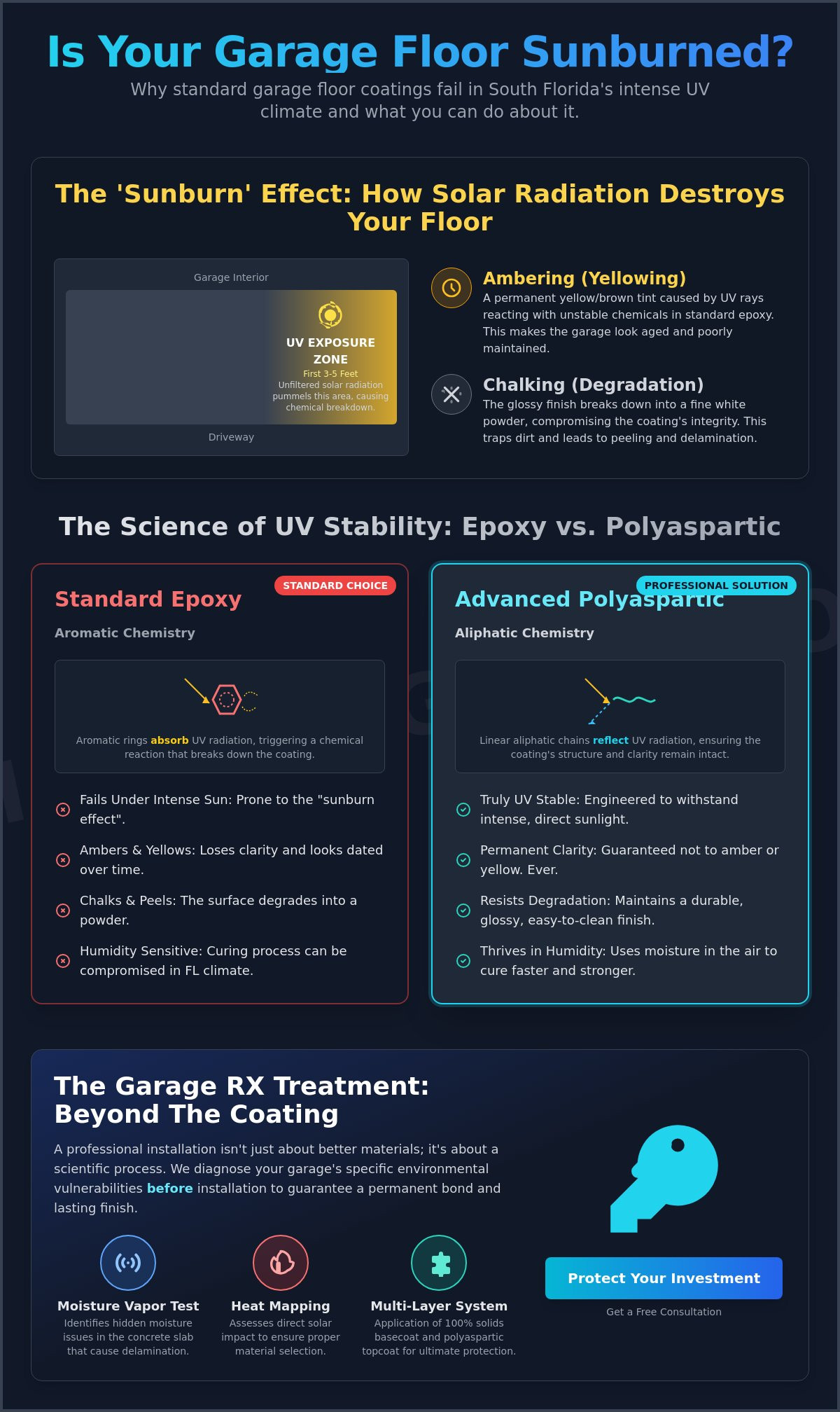
The South Florida sun acts as a relentless catalyst for chemical failure in traditional garage flooring. While the interior of your garage might stay relatively shaded, the "UV Exposure Zone" tells a different story. This is the critical first 3 to 5 feet of concrete just inside the garage door opening. In this specific area, unfiltered solar radiation pummels the surface for hours every day. Most standard coatings simply aren't built to survive this level of intensity. They suffer from a phenomenon we call the "sunburn" effect, where the coating's molecular structure literally unravels under heat and light.
This failure isn't just a matter of losing a bit of shine. It is a progressive chemical breakdown that compromises the entire installation. When a coating isn't engineered for our specific climate, the bond between the resin and the concrete slab begins to weaken. What starts as a slight change in hue eventually leads to a complete loss of protection for your concrete investment.
Diagnosing Ambering in Standard Epoxy
Ambering is the most immediate sign of a failing system. It manifests as a distinct yellow or brownish tint that develops over clear topcoats, often appearing first in patches near the driveway transition. This happens because standard epoxy resins often rely on aromatic amines. These chemicals are highly effective for bonding but possess a significant weakness: they are not UV-stable. When UV rays hit these molecules, they trigger a chemical reaction that changes the color of the resin permanently.
A yellowed, "aged" looking floor significantly detracts from a home’s aesthetic. It creates a visual mismatch between the pristine interior of the garage and the entrance. This discoloration can negatively impact resale value by making the garage appear poorly maintained or dated. Because the yellowing occurs within the chemical structure of the epoxy, no amount of scrubbing or professional cleaning can reverse the damage. The only solution is a total removal and replacement with a high-quality uv resistant garage floor coating.
The Hidden Danger of Surface Chalking
Beyond the color change lies a more destructive process known as chalking. This occurs when UV radiation breaks the primary molecular bonds of non-resistant polymers. The smooth, glossy finish of your floor gradually degrades into a fine white powder. You might notice this powder on your shoes or tires before you see the visible damage on the floor. This degradation creates a porous, high-friction surface that traps dirt and makes maintenance a nightmare.
As the top layer of protection powders away, the integrity of the entire system is compromised. What begins as surface dullness quickly progresses to total coating delamination. Understanding Polyaspartic ester chemistry is essential here; it provides the aliphatic structure necessary to prevent this breakdown. Without a professional uv resistant garage floor coating, the Florida sun will eventually turn a beautiful floor into a dusty, peeling mess that no longer protects the underlying concrete from oil stains or hot tire pickup.
Polyaspartic vs. Epoxy: The Science of UV Stability
Standard epoxy and professional polyaspartic coatings may look similar in the bucket, but their molecular blueprints are worlds apart. Epoxy resins are typically aromatic. This means their chemical rings absorb ultraviolet light, which triggers the ambering and chalking discussed previously. Polyaspartic systems are aliphatic. Their linear molecular chains reflect UV radiation rather than absorbing it. This fundamental difference is why a high-end uv resistant garage floor coating remains crystal clear while cheaper alternatives turn yellow within months.
The performance gap extends to how these materials handle the South Florida climate during installation. Epoxy often struggles with high humidity, which can blush or bloom during the curing process. In contrast, polyaspartics utilize moisture in the air to facilitate their chemical cross-linking. This allows for a faster, more reliable cure even on the most humid Miami afternoons. Understanding the properties of polyaspartics reveals why they are superior for local environments where moisture and sun are constant variables.
Why Aliphatic Chemistry Matters
The distinction between "UV resistant" and "UV stable" is more than just marketing wordplay. Many epoxy products are labeled as UV resistant because they contain additives designed to slow down discoloration. These additives eventually sacrificialy deplete, and the yellowing begins. An aliphatic polyaspartic system is inherently UV stable. It doesn't rely on temporary additives because its core chemistry is immune to solar degradation. Aliphatic polyaspartic is the gold standard for sun-exposed concrete. This stability ensures that your decorative flake pattern looks the same in year ten as it did on day one.
Durability Beyond the Sun
UV stability is often a gateway to better overall performance. Because polyaspartic esters maintain their molecular integrity under sun stress, they also offer superior resistance to hot tire pickup. This occurs when heated tires soften a low-quality coating, causing it to peel away when the car moves. A professional-grade uv resistant garage floor coating maintains a higher heat tolerance, preventing this common failure point.
Florida’s thermal cycling also demands a flexible material. Our floors expand and contract as temperatures swing from midday heat to evening rain. Polyaspartic coatings provide better elongation than brittle epoxies, allowing the surface to breathe without cracking. If you are noticing signs of wear or discoloration on your current surface, a professional consultation can help determine if a polyaspartic floor coating is the right prescription for your home. This level of durability requires a precise diagnostic application to ensure the bond between the aliphatic topcoat and the concrete remains permanent.
The South Florida Stress Test: Humidity and Intense UV
Florida isn't just sunny; it's chemically aggressive. In cities like Davie and Miami, the UV index frequently hits extreme levels. This isn't a problem for your skin alone. Your garage floor faces the same radiation. When you combine this with the "Greenhouse Effect," the stakes rise. South-facing garage doors act as massive solar collectors. They trap heat inside the space, baking the concrete and any inferior coating applied to it. Without a high-spec uv resistant garage floor coating, the material will simply cook until it detaches from the substrate.
This environmental pressure is a constant diagnostic challenge. The heat doesn't just sit on the surface; it penetrates the slab, expanding the air and moisture trapped within the concrete. If the topcoat has already been weakened by solar radiation, it lacks the tensile strength to hold back this internal pressure. The result is a floor that looks aged, brittle, and ready to flake away at the first sign of a heavy vehicle.
The Broward County Sun Factor
Florida receives significantly more annual UV radiation than northern states. This constant bombardment is why "standard" coatings fail here so quickly. Many homeowners in Broward County leave their garage doors open during the day for ventilation or while working on projects. This habit exposes the interior floor to direct, unfiltered light. If your home is near the coast, salt air adds another layer of complexity. Salt crystals can settle into micro-cracks of a degrading coating. These crystals attract moisture and accelerate the breakdown of the polymer bonds, leading to a finish that looks dull and feels abrasive.
Moisture and UV: A Destructive Duo
The real danger lies in what happens beneath the surface. South Florida’s high water table means moisture is constantly pushing up through your concrete slab. This process is known as moisture vapor transmission. When the sun heats the surface, it creates a pressure differential. If a coating has been weakened by UV rays, this trapped moisture can cause osmotic blistering. You’ll see small bubbles or "pimples" forming in the finish. These aren't just aesthetic flaws; they are sites of total coating failure.
Professional surface profiling is the only way to prevent this cycle. Surface preparation accounts for 30-40% of the total project cost because it is the most critical step in creating a permanent bond. We use mechanical diamond grinding to open the "pores" of the concrete. This allows a moisture-vapor barrier to penetrate deep into the slab. By pairing a high-performance barrier with a uv resistant garage floor coating topcoat, you create a shield that protects from both the ground up and the sky down. It's a diagnostic approach to an environmental problem that most DIY kits simply ignore.
Choosing the Right UV Resistant Coating for Your Home
Selecting a flooring system for a South Florida garage requires a diagnostic approach to material chemistry. You aren't just buying a color; you are investing in a multi-layered defense system. A high-performance uv resistant garage floor coating must be built from the ground up to handle solar stress. This begins with verifying the solids content of the resin. Retail "store bought" kits are often solvent-based, meaning up to 50% of the product evaporates during the curing process. This leaves behind a thin, brittle film that is easily penetrated by UV rays. In contrast, professional-grade systems use 100% solids, ensuring every drop applied stays on the floor to create a thick, resilient barrier.
A reliable installation follows a strict multi-layer protocol. This isn't a single coat of paint. It is a synchronized system consisting of a moisture-wicking primer, a high-build base coat, a full broadcast of decorative flakes, and a dedicated UV-stable topcoat. To verify a contractor's claims, ask for the Technical Data Sheet (TDS). Look specifically for the term "aliphatic." If the documentation only mentions "UV resistance" without specifying an aliphatic chemical structure, the material is likely a standard aromatic resin that will eventually amber. Selecting the right flake blend also plays a practical role. Earth-toned gray or tan mixtures are excellent at hiding the fine dust and salt spray common in coastal areas like Davie and Miami.
Red Flags in 'UV Resistant' Marketing
Marketing terms can be deceptive. Many DIY kits use the phrase "UV resistant" as a catch-all term, but this often means the product simply contains a temporary additive to delay yellowing. These additives act like a low-SPF sunscreen that eventually wears off. Another red flag is the "one-day" install that utilizes a single type of resin for every layer. While speed is convenient, it shouldn't come at the cost of stability. If the topcoat isn't a true aliphatic polyaspartic, the Florida sun will degrade the finish regardless of how fast it was applied. Always check the fine print of warranties; many retail products specifically exclude damage caused by "environmental factors" like solar exposure.
Professional Grade vs. Retail Kits
The difference between an industrial-grade installation and a retail kit is measured in microns. Professional polyaspartic systems are significantly thicker and more flexible than the thin epoxies found at big-box stores. This thickness is vital for absorbing the energy of UV radiation without cracking. Furthermore, industrial-grade materials require specialized equipment, such as mechanical diamond grinders and high-speed mixers, to ensure the chemical bond is permanent. When deciding on the best material for your space, many homeowners ask is polyaspartic better than epoxy for our specific climate. The answer lies in the aliphatic chemistry that resists the intense heat and light of the South Florida sun. If you want a floor that stands up to the stress of daily use and solar radiation, you can request a professional floor evaluation to see which system fits your home’s specific needs.
The Garage RX Treatment: Professional UV-Stable Installations
The Garage RX applies a diagnostic lens to every installation, treating each concrete slab as a unique case with its own environmental history. We don't believe in a one-size-fits-all application. Instead, our process begins with an assessment of your floor’s specific UV exposure levels and moisture vapor transmission rates. This clinical approach ensures that the final uv resistant garage floor coating is perfectly calibrated to the specific pressures of your South Florida home. By identifying these variables early, we prevent the "sunburn" failures that plague standard installations.
Our multi-step polyaspartic application is a methodical plan of action designed for permanent results. After mechanical diamond grinding opens the pores of the concrete, we apply a high-bond primer followed by a dense base coat. The aesthetic transformation occurs during the full broadcast of our decorative flake systems. These flakes aren't just for style; they add a layer of impact resistance and texture. Finally, we seal the system with a high-build aliphatic topcoat. This final layer acts as the primary shield, ensuring your floor maintains its "day one" clarity and color for years to come.
A Specialized Plan of Action for Davie Homeowners
Davie residents face a specific set of environmental challenges, from high humidity to intense, direct sunlight. Our commitment to using only 100% solids aliphatic topcoats is a direct response to these local conditions. We understand that a garage in Broward or Miami-Dade is often the most used entrance to the home. It needs to be more than just functional. It must be resilient. Our local expertise allows us to anticipate how the Florida heat will interact with the curing process, ensuring a bubble-free, industrial-strength finish. This professional intervention provides the peace of mind that comes from knowing your investment is protected by the highest chemical standards in the industry.
Beyond Flooring: A Total Garage Transformation
A professionally cured floor is the foundation of a high-end, organized environment. Once the UV-stable floor is in place, the rest of the space can be elevated to match. Our uv resistant garage floor coating systems are designed to complement a full range of storage solutions. A clean, sun-protected floor creates the perfect backdrop for custom garage cabinets and versatile garage slatwall systems. This holistic approach moves your garage from a state of environmental chaos to a serene, high-functioning extension of your living space.
The recovery of your garage starts with a precise understanding of your floor's current health. If you are ready to move past the frustration of yellowing, peeling concrete, it is time for a professional consultation. Schedule your professional garage floor diagnostic today to discover how a specialized polyaspartic system can transform your home. We provide the technical precision and orderly execution required to turn a dysfunctional garage into a durable, high-end asset.
Secure Your South Florida Flooring Investment
A high-performance garage floor is more than a luxury; it's a necessary intervention against the aggressive Florida environment. You now understand that aliphatic chemistry is the only barrier standing between your concrete and the destructive "sunburn" effect. Choosing a professional uv resistant garage floor coating ensures your space remains clear, stable, and resilient against both high humidity and intense solar radiation. Standard epoxies simply can't compete with the molecular stability of a properly applied polyaspartic system.
The Garage RX has served homeowners across Broward, Miami-Dade, and Palm Beach since 2018. As local Davie-based experts, we specialize in high-performance polyaspartic systems that are engineered specifically for our local climate. We move your garage from a state of environmental decay to a state of high-end organization. Don't settle for a temporary fix that will yellow and peel within the year. Your home deserves a specialized plan of action that guarantees long-term durability.
Get a Professional Diagnostic for Your Garage Floor at The Garage RX. Our team is ready to provide the technical precision your home deserves. Let's transform your garage into a durable, pristine asset that stands the test of time.
Frequently Asked Questions
Will a UV resistant coating prevent my garage floor from fading entirely?
An aliphatic polyaspartic system is engineered to maintain its color and clarity indefinitely under solar stress. While standard resins eventually break down, these advanced systems reflect radiation rather than absorbing it. This chemical stability ensures that your decorative flake pattern remains vibrant even in the high-exposure areas near your garage door. It is the most effective intervention available for preventing the dullness and discoloration caused by the Florida sun.
Can I apply a UV-resistant topcoat over my existing yellowed epoxy floor?
Applying a new topcoat over a failing system is not a recommended plan of action. A professional uv resistant garage floor coating requires a direct, mechanical bond to the concrete substrate to ensure its longevity. If the underlying epoxy is already yellowing or peeling, it indicates a structural failure that a new layer cannot fix. We utilize diamond grinding to remove compromised materials before installing a stable, high-performance system.
How can I tell if my current garage floor coating is UV stable?
Check for a "chalky" white powder on the surface or a distinct yellow tint near the driveway transition. These are clear diagnostic signs of aromatic resin failure. You can also examine the texture; UV-degraded coatings often become brittle and lose their original gloss. If your floor was installed using a retail DIY kit, it likely lacks the aliphatic chemistry required to remain stable in our local climate.
Is polyaspartic flooring more expensive than standard garage epoxy?
Polyaspartic systems typically require a higher initial investment than basic epoxy applications. This cost reflects the premium aliphatic resins and the specialized industrial equipment needed for a professional installation. However, the long-term value is far superior. You avoid the significant expense of total removal and replacement that occurs when standard epoxy ambers and peels. It is a permanent solution for homeowners who value durability and functional beauty.
How long does a professional UV-resistant garage floor installation take?
Most professional installations are completed in just one to two days. The diagnostic preparation and mechanical grinding occur on the first morning to ensure a clean substrate. Because polyaspartic resins cure much faster than traditional epoxy, the layers bond quickly even in high humidity. You can typically return to walking on the surface within 24 hours, making it an efficient transformation that minimizes disruption to your daily routine.
Does 'UV Resistant' mean the floor won't get hot in the Florida sun?
UV resistance refers to chemical stability, not thermal temperature. A uv resistant garage floor coating will still absorb heat from the sun, especially if you select a darker flake blend. The critical difference is that a UV-stable system will not soften or delaminate when it gets hot. It maintains its molecular integrity and bond to the concrete, whereas standard epoxy often fails and peels under the same thermal pressure.
What happens if I use a non-UV stable coating in a south-facing garage?
A south-facing garage door acts as a solar collector, which will cause a non-stable coating to fail rapidly. You will likely see significant yellowing within the first six months. This chemical breakdown leads to "hot tire pickup," where the weakened resin attaches to your tires and pulls away from the floor. This creates a dysfunctional, peeling mess that requires a total professional redo to restore the floor’s protection.
Are there specific colors that resist UV fading better than others?
Neutral flake blends like grays, tans, and earth tones provide the best long-term aesthetic results. These multi-colored patterns are excellent at masking fine dust and salt spray common in South Florida. While our aliphatic topcoats protect all colors from chemical yellowing, these high-contrast blends maintain their "day one" look the longest. They offer a clean, high-end appearance that complements both custom cabinets and organized storage systems perfectly.