

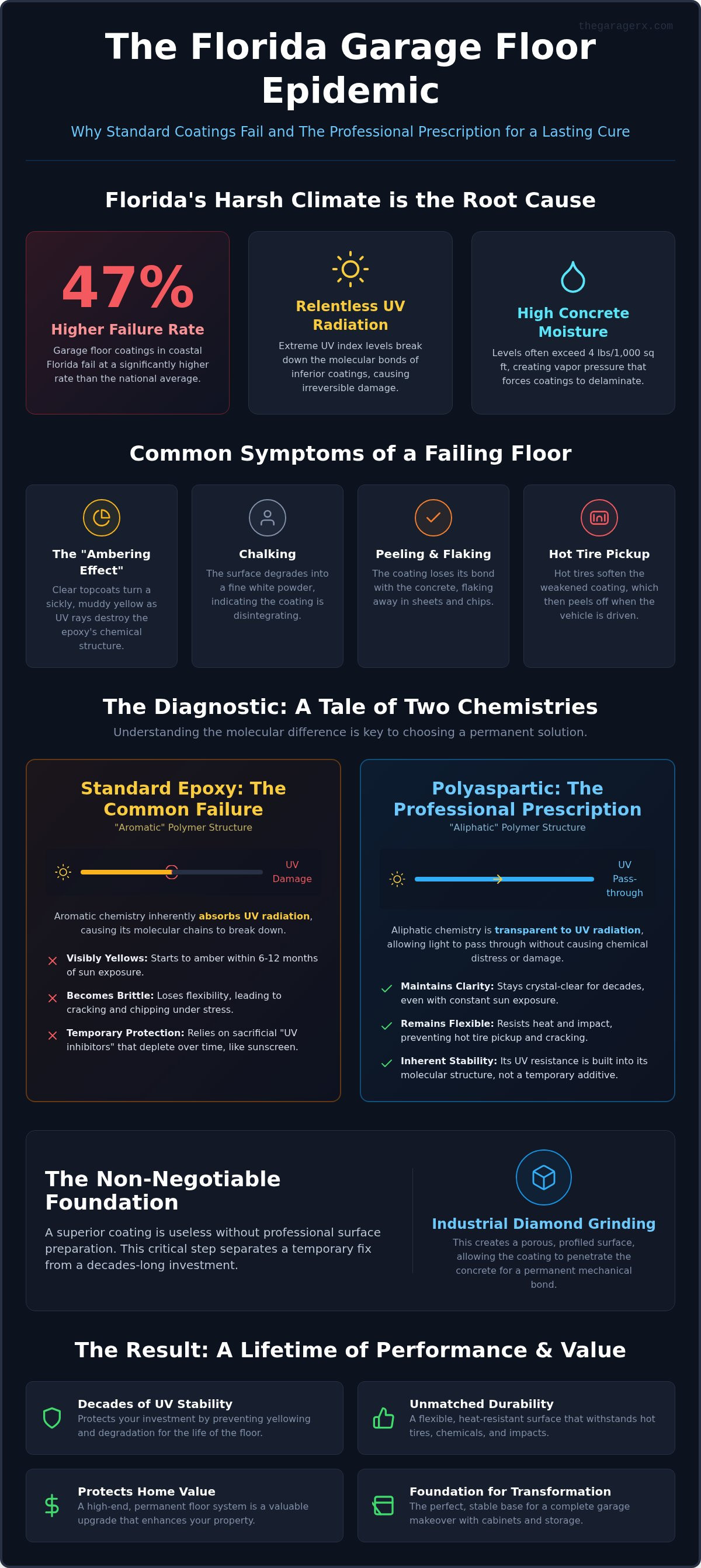
Did you know that garage floor coatings in coastal Florida fail at a rate 47% higher than the national average? It's a staggering figure that points to a specific environmental pathology: our relentless UV rays and concrete moisture levels that regularly exceed 4 lbs per 1,000 square feet. You've likely seen the symptoms of this climate-driven decline yourself. Maybe your once-clear floor has turned a sickly amber, or perhaps you're tired of seeing the coating peel away under your tires. It's frustrating to watch a home improvement project chalk and flake until it's a shadow of its former self.
You don't have to settle for a surface that's destined to fail. Finding the best garage floor coating for florida humidity requires a professional-grade prescription that prioritizes UV stability and moisture management over cheap, store-bought fixes. This guide explains why polyaspartic systems are the necessary cure for yellowing floors. We'll explore how a high-end, UV-resistant finish can protect your property value and provide a durable, heat-resistant surface that maintains its color for decades.
Key Takeaways
- Understand the "ambering effect" and how South Florida’s intense UV rays physically break down the molecular bonds of standard epoxy coatings.
- Identify why polyaspartic technology is the best garage floor coating for florida humidity thanks to its inherent UV stability and moisture-resistant properties.
- Learn the connection between sun exposure and hot tire pickup, preventing the common frustration of coatings peeling away under your vehicle.
- Discover the critical diagnostic preparation steps, such as industrial diamond grinding, that separate professional installations from temporary DIY fixes.
- See how a UV-stable floor system serves as the foundation for a complete garage transformation that protects your home’s value for decades.
The South Florida Sun vs. Your Garage Floor: Why Standard Coatings Fail
Standard epoxy floors often fail because they lack the molecular resilience to handle South Florida’s aggressive light spectrum. When homeowners search for the best garage floor coating for florida humidity, they often focus on water resistance while overlooking the impact of solar radiation. UV resistance isn't just about aesthetic color; it's about long-term structural integrity. UV stability is the ability of a coating to maintain its chemical structure under intense solar radiation. Without this stability, the polymer chains within the coating begin to snap. This leads to the "ambering effect," where clear topcoats turn a muddy yellow as the sun breaks down the epoxy's molecular bonds. In Davie, where the UV index frequently hits extreme levels, this degradation happens much faster than in northern climates.
The Open Garage Lifestyle in Davie
Living in South Florida means the garage door is rarely shut. Whether you're working on a car or organizing weekend gear, that open door invites a flood of UV radiation. This frequent exposure accelerates floor damage significantly. If your garage features windows, the UV assault is constant even when the door is closed. For these high-exposure environments, choosing aliphatic polyaspartics is a mandatory requirement. Unlike standard epoxy, these materials are chemically engineered to remain clear and flexible regardless of sun exposure. This ensures your investment doesn't become a brittle, yellowing liability within a few years of installation.
Signs Your Current Floor Has Sun Damage
A proper diagnosis starts with a visual inspection of common failure points. Look for distinct yellowing near the garage door threshold where the sun hits the floor most directly. You might also notice "chalking," which is a dusty white residue that indicates the surface is literally disintegrating into powder. As the coating becomes brittle and loses its gloss, it becomes increasingly porous. This allows oil and chemicals to penetrate deep into the surface, causing permanent staining. Once the topcoat is compromised, the failure of the entire floor system is inevitable. A stable, high-end floor provides the perfect foundation for other upgrades, such as Custom Garage Cabinets in Davie & South Florida, ensuring your entire space remains organized and aesthetically pleasing.
Polyaspartic vs. Epoxy: A Diagnostic Look at UV Stability
Choosing the best garage floor coating for florida humidity requires a look beneath the surface at the molecular level. Most homeowners are familiar with epoxy, but few realize that standard epoxy is chemically classified as an "aromatic" polymer. This means its chemical structure naturally absorbs UV radiation, leading to the inevitable breakdown of its physical properties. Polyaspartic coatings, by contrast, are "aliphatic." They are engineered to be transparent to UV light, allowing the radiation to pass through without causing chemical distress. This fundamental difference is why a polyaspartic system is widely considered the professional prescription for the South Florida climate.
The Limits of UV-Resistant Epoxy
Many epoxy products claim to be UV resistant, but this is often a temporary condition. Manufacturers achieve this resistance by adding UV inhibitors, which act much like a sunscreen. Just as SPF wears off after a few hours at the beach, these inhibitors eventually deplete. Once they are gone, the epoxy begins to amber and become brittle. This brittleness is a primary precursor to delamination. In our high-moisture environment, these brittle coatings often suffer from bond-related failures of non-breathable floor coatings, where trapped vapor pressure forces the rigid material to pop off the concrete. While epoxy serves well in climate-controlled, sun-protected interiors, it is rarely the right intervention for a South Florida garage.
Why Polyaspartic is the Professional Prescription
Polyaspartic technology offers a permanent solution to the yellowing timeline. While a standard epoxy might show visible ambering within 6 to 12 months of installation, a high-quality polyaspartic system maintains its crystal-clear finish for decades. This durability is critical for preventing hot tire pickup, as the material remains flexible and heat-resistant even under the weight of a heavy SUV. The rapid cure time of polyaspartic also allows for a One-Day installation, minimizing the disruption to your household schedule. Before you commit to a system, it is helpful to review the Polyaspartic Floor Coating Reviews: The Truth About Durability in 2026 to see how these systems perform in real-world conditions. If you are ready to diagnose your garage’s specific needs, a professional consultation with The Garage RX can help you determine the most effective plan of action for your home.
Beyond Fading: Why UV Resistance Prevents Hot Tire Pickup
Visual ambering is often the first symptom of a deeper structural pathology. While many homeowners view yellowing as a cosmetic nuisance, it actually signals the chemical breakdown of the floor’s polymer matrix. In South Florida, this degradation directly leads to "hot tire pickup," a common failure where the coating peels away under the weight and heat of your vehicle. Identifying the best garage floor coating for florida humidity requires a system that treats UV stability as a structural necessity rather than an optional aesthetic upgrade. A UV-stable topcoat acts as a thermal shield, preserving the mechanical bond between the coating and the concrete slab beneath.
The Science of Hot Tire Pickup
When you drive on sun-baked Florida asphalt, your tires can easily reach temperatures exceeding 130 degrees. As you pull into your garage, that heat is transferred directly to the floor. If the surface has been weakened by constant UV exposure, the polymer reaches its "glass transition temperature" and begins to soften. This makes the coating slightly sticky, allowing it to bond to the hot rubber of your tires. When you next move the vehicle, the tires pull the coating right off the concrete. This physical delamination is a result of the coating’s internal strength being compromised by solar radiation. UV resistance prevents the chemical softening that leads to tire-related peeling. A U.S. Army Corps of Engineers study on concrete coatings confirms that polyurea-based systems, including polyaspartics, maintain superior tensile strength and adhesion under these extreme thermal loads.
Humidity and the Blistering Effect
South Florida humidity compounds this issue by introducing hydrostatic pressure from within the concrete. When UV rays damage a standard coating, they create microscopic pores in the surface. These pores allow moisture to seep in, while also providing a path for sun-warmed vapors to expand. This process creates blisters and bubbles that eventually pop, leaving your garage floor vulnerable to salt, oil, and chemicals. A high-end, UV-stable polyaspartic system remains non-porous and flexible, creating a sealed defense that resists this internal pressure. Proper preparation is vital to ensure this seal holds. You can find detailed information on essential surface preparation in our guide to High-Performance Epoxy Coating for Garage Floor. By combining rigorous diagnostic testing with UV-stable chemistry, you ensure the longevity of your high-end garage environment.
The Professional Prescription: Ensuring Maximum Coating Longevity
A high-end garage transformation requires more than just a premium product. It demands a disciplined, methodical approach to installation. To achieve a surface that resists the South Florida heat, we follow a rigorous four-step protocol. This diagnostic process ensures the material bonds permanently to the substrate, preventing the failures common with inferior systems. Identifying the best garage floor coating for florida humidity is only half the battle; the execution determines the lifespan of your investment.
- Step 1: Diagnostic Concrete Testing. Technicians evaluate moisture vapor transmission and concrete hardness. Because South Florida slabs often maintain moisture levels between 4 and 6 lbs per 1,000 square feet, this step is vital for preventing future delamination.
- Step 2: Industrial Diamond Grinding. We use heavy machinery to remove the "laitance" or cream layer of the concrete. This opens the pores and creates a mechanical profile for the coating to grip.
- Step 3: Multi-Layer Application. Our systems utilize a high-solids base coat, a full broadcast of decorative flakes, and a specialized, UV-stable topcoat.
- Step 4: Controlled Curing. Professional installers manage the rapid cure time of polyaspartics, ensuring the material sets correctly despite local temperature fluctuations.
If you are ready for a specialized intervention in your space, you can schedule a professional consultation with The Garage RX to diagnose your floor's specific needs.
Why DIY Sun-Proof Kits Often Fail
The "Acid Etch" myth is one of the primary reasons DIY projects fail in Davie. Most retail kits suggest using a mild acid solution to prep the floor. This liquid cleaner is rarely strong enough to penetrate the dense concrete used in modern Florida homes. Additionally, DIY products are typically "low-solids" formulas. These coatings are diluted with water or solvents that evaporate during the drying process, leaving behind a thin, fragile layer. A professional-grade system provides a "high-build" finish that is several times thicker and significantly more durable than any store-bought alternative. Achieving a uniform, UV-stable topcoat without industrial equipment is nearly impossible for the average homeowner.
Maintenance for a Sun-Shielded Floor
Maintaining a high-end finish is remarkably simple. Regular cleaning with a soft foam squeegee and a pH-neutral cleaner is usually all that is required to preserve the wet-look gloss. Avoid harsh chemicals like bleach or ammonia. These substances can strip the surface over time and may compromise the clarity of the topcoat. Because our aliphatic polyaspartic systems are inherently stable, you will never need to apply a "re-dose" of UV protection. The sun-shielding properties are baked into the chemical structure of the floor, ensuring it remains as vibrant as the day it was installed. This long-term stability is what allows your garage to transition from a messy storage area to a high-functioning extension of your home.
Transforming Your Space with The Garage RX’s Sun-Shield Systems
South Florida homeowners often treat their garages as a secondary thought until the heat and humidity make the space unusable. A professional, UV-stable transformation changes that dynamic. By installing a system that won't amber or peel, you're not just buying a floor; you're investing in a permanent spatial resolution. The Garage RX applies local expertise to every project, ensuring that our installations withstand the specific atmospheric pressures of Broward and Miami-Dade counties. Choosing the best garage floor coating for florida humidity is the critical foundation for any high-end garage renovation.
Once your floor is cured and stabilized, the path to a fully optimized environment becomes clear. A high-performance surface is the ideal stage for further upgrades. For instance, a durable polyaspartic floor integrates seamlessly with Custom Garage Cabinets in Davie & South Florida. This combination moves your garage from a state of environmental chaos to one of disciplined organization. You'll gain the satisfaction of a space that looks as clean as a showroom while providing the rugged durability needed for a working Florida household.
The RX Difference: From Diagnosis to Installation
Our process begins with a formal consultation to understand the unique stressors on your concrete. We offer a wide range of customization options, including specialized flake blends and varying levels of slip-resistance to suit your lifestyle. This isn't a one-size-fits-all application; it's a specialized plan of action. A clean, organized garage significantly boosts property resale value by demonstrating that the home has been maintained with technical precision. It's a signal to future buyers that every inch of the property has received expert-led care. We take pride in craftsmanship that balances functional beauty with long-term durability.
Next Steps for Your Garage Transformation
Reclaiming your garage from the sun shouldn't be a weeks-long ordeal. Our One Day installation process is designed for busy families who need immediate results without compromising on quality. We arrive, prep, and coat your floor with the efficiency of an organized team, leaving you with a finished product by sunset. If you're tired of looking at a dusty, yellowing floor, it's time for a professional intervention. Contact The Garage RX today for your floor prescription! We'll provide a comprehensive assessment and a clear roadmap for your garage’s recovery.
Secure Your Garage’s Future Against the Florida Sun
A dysfunctional garage floor isn't just an eyesore; it's a symptom of environmental stress that requires a specialized intervention. We've seen how standard epoxy fails under the weight of South Florida’s UV index and how moisture vapor pressure can destroy a poorly prepared surface. By choosing an industrial-grade polyaspartic system, you're investing in the best garage floor coating for florida humidity. This isn't a temporary cosmetic fix. It's a permanent structural resolution that eliminates ambering, prevents hot tire pickup, and creates a serene, organized foundation for your home.
The Garage RX provides a comprehensive plan of action for homeowners in Davie, Miami, and the Palm Beaches. Every project begins with professional diamond grinding to ensure an unbreakable mechanical bond. Don't let the sun dictate the lifespan of your floor. It's time to transition from a cluttered, deteriorating space to a high-end environment that adds tangible value to your property.
Get Your Professional Garage Floor Prescription from The Garage RX
Reclaim your space today and enjoy a surface that remains vibrant and durable for decades to come.
Frequently Asked Questions
Is UV resistant garage floor coating really necessary in South Florida?
Yes, UV protection is mandatory for South Florida homes. The local UV Index frequently reaches extreme levels, which accelerates the degradation of standard polymers. Without UV protection, coatings undergo a chemical breakdown that leads to ambering and brittleness. This isn't just about looks; it's about preventing the physical disintegration of the floor system. A UV-stable surface acts as a necessary intervention to protect your concrete from the relentless solar radiation common in Davie and Miami.
What is the difference between UV resistant and UV stable coatings?
UV resistant coatings typically use additives like sacrificial inhibitors to slow down sun damage, much like a temporary sunscreen. UV stable coatings, such as aliphatic polyaspartics, are chemically engineered at the molecular level to remain unaffected by solar radiation. This makes polyaspartic technology the best garage floor coating for florida humidity because it won't amber or lose structural integrity over time. Stability offers a permanent resolution, while resistance only delays the inevitable failure.
Will a UV resistant coating prevent my garage floor from peeling under hot tires?
It is a critical factor. Hot tire pickup occurs when a coating softens under heat and bonds to your tires. UV radiation accelerates this by breaking down the polymer's internal strength, lowering its heat tolerance. A UV-stable system maintains its chemical bonds even when exposed to direct sunlight and high temperatures. By preventing the surface from becoming sticky or brittle, these professional systems ensure the coating stays bonded to the concrete rather than your vehicle's tires.
Can I apply a UV resistant topcoat over my existing yellowed epoxy floor?
We don't recommend this approach. Yellowing is a symptom of deep molecular degradation within the existing epoxy layer. Applying a new topcoat over a failing foundation is like putting a bandage on an infected wound. The underlying epoxy will continue to become brittle and eventually delaminate from the concrete, taking the new topcoat with it. A successful transformation requires a full diagnostic removal of the old material followed by industrial diamond grinding to open the concrete's pores.
How long does a professional UV resistant polyaspartic coating last?
A professionally installed polyaspartic system is designed to maintain its color and structural integrity for decades. Unlike standard epoxy, which may show signs of ambering within a year, polyaspartic chemistry remains clear and flexible. Its longevity depends on proper surface preparation, such as diamond grinding, which creates a permanent mechanical bond. When maintained with simple, non-abrasive cleaning protocols, these high-end floors provide a durable solution that outlasts the ownership of most South Florida homes.
Do UV resistant coatings make the garage floor slippery when wet?
Any smooth, non-porous surface can become slippery when wet, but this is easily managed during the installation process. We prescribe the use of anti-slip additives or decorative vinyl flakes to create a textured profile. These inclusions increase traction without compromising the UV-stable properties of the topcoat. This ensures your garage remains a safe, high-functioning environment even during South Florida's frequent afternoon thunderstorms. Safety and durability are balanced through careful, expert-led project planning and execution.
How much does a professional UV resistant garage floor installation cost in Davie?
Identifying the best garage floor coating for florida humidity requires a look at your slab's moisture levels and hardness. Costs for a professional installation vary based on the square footage and the current condition of your concrete. Factors such as the level of diamond grinding required and the choice of flake customization will influence the final project scope. We provide transparent communication regarding costs after a formal diagnostic assessment of your space to ensure no surprise expenses occur.
What happens if I use a non-UV resistant coating in a garage with sun exposure?
You will likely observe visible failure within six to twelve months. The coating will begin to amber, turning a muddy yellow color that clashes with your home’s aesthetic. Over time, the sun’s radiation causes the material to chalk, leaving a white, powdery residue on your shoes and tires. Eventually, the coating becomes so brittle that it cracks and peels away. This leaves your concrete slab vulnerable to moisture, oil stains, and permanent structural damage.