

Polyaspartic coatings never fail on a chemical level; peeling happens almost exclusively when concrete preparation fails. If you've watched a neighbor's DIY epoxy blister and rip away under hot tires, you're likely asking: will polyaspartic flooring peel under the same brutal conditions? When installed with diagnostic precision, high-performance polyaspartic forms an uncompromising mechanical grip that resists lifting, chipping, and hot-tire pickup.
It's completely reasonable to feel skeptical. South Florida's relentless coastal humidity and hidden slab moisture vapor routinely destroy inferior floor finishes, leaving homeowners frustrated with unsightly, bubbling surfaces. You shouldn't have to worry about your garage floor softening under hot tires or peeling off in sheets after a routine afternoon drive.
In this guide, you'll discover the science behind concrete adhesion, the specific installation errors that trigger coating failure, and how industrial-grade mechanical preparation guarantees a permanent bond. Here is the truth about what it takes to keep your garage floor flawlessly anchored for decades to come.
Key Takeaways
- Discover why the core question of whether will polyaspartic flooring peel hinges on substrate preparation rather than chemical failure.
- Identify the four primary diagnostic installation errors, including unmitigated moisture vapor transmission, that trigger coating delamination.
- Compare polyaspartic and traditional epoxy to understand how superior thermal flexibility permanently prevents hot tire pickup.
- Learn why industrial diamond grinding creates the specific concrete profile required for deep mechanical bonding, outperforming DIY acid etching.
- Explore how a specialized diagnostic installation protocol neutralizes South Florida's severe humidity and coastal slab moisture challenges.
Will Polyaspartic Flooring Peel? The Short Answer and Science of Adhesion
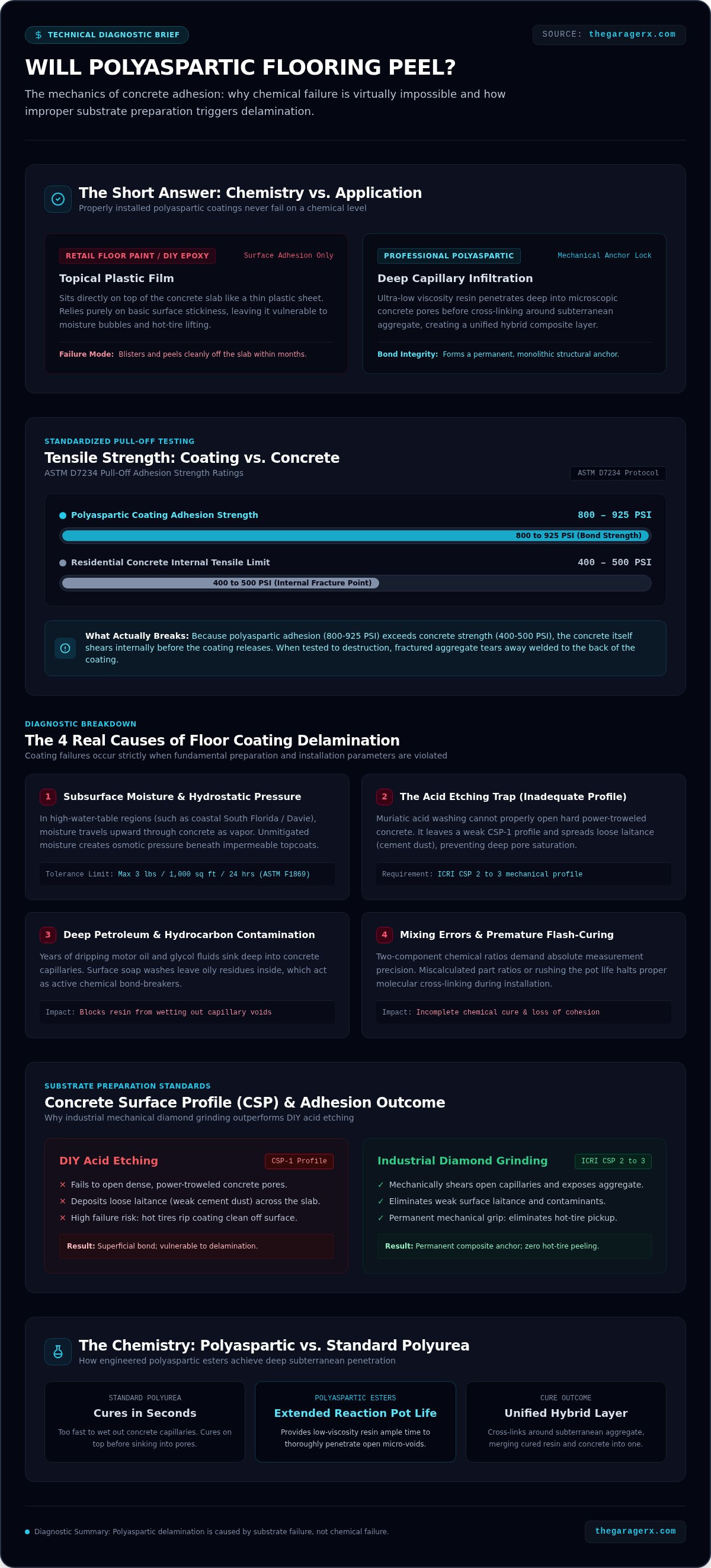
To settle the primary concern directly: properly installed polyaspartic will not peel. When evaluating whether will polyaspartic flooring peel under severe daily traffic, the answer comes down to concrete bond mechanics. Retail floor paints sit atop the slab like thin plastic film, depending solely on surface stickiness. Professional polyaspartic operates like an injected structural anchor. It flows deep into the concrete slab's microscopic capillaries before curing, creating a dense mechanical lock within the substrate. This diagnostic distinction explains why verified polyaspartic floor coating reviews consistently highlight permanent bond integrity while consumer paint kits blister and lift within months.
The Chemistry of Polyaspartic Adhesion
Polyaspartic represents an advanced branch of aliphatic polyurea technology. Standard polyurea cures within seconds, which prevents it from sinking into concrete pores. By engineering specialized polyaspartic esters into the chemical formulation, chemists deliberately extend the reaction window. This extended pot life gives the ultra-low-viscosity resin ample time to wet out the concrete completely. The material penetrates open capillaries, saturates the micro-voids, and cross-links around subterranean aggregate. The resulting cure forms a hybrid composite layer where cured resin and solid concrete aggregate become one unified structure.
Peeling vs. Substrate Failure: What Actually Breaks?
Diagnosing a failing floor requires separating true coating delamination from internal concrete substrate failure. True polyaspartic does not peel from a properly prepared, receptive slab. Standardized tensile pull-off testing (such as ASTM D7234) demonstrates that polyaspartic coatings routinely exceed 800 to 925 psi of adhesion strength. In contrast, residential concrete typically fractures internally under 400 to 500 psi of tensile pull.
When destructive forces test a correctly installed floor, the concrete itself shears before the coating releases its bond. The failure manifests as fractured aggregate torn from the floor and welded to the back of the coating, rather than a bare film stripping cleanly off the surface. So, will polyaspartic flooring peel on its own once cured? The material's molecular bond to sound concrete makes that scenario physically impossible.
The 4 Real Causes of Polyaspartic Floor Peeling
Coating failures are diagnostic indicators of skipped installation fundamentals. Homeowners frequently ask, will polyaspartic flooring peel under standard garage use? The chemistry itself holds fast, but four distinct environmental and installation breakdowns will compromise the installation:
- Subsurface moisture vapor transmission (MVT) exerting hydrostatic force beneath the floor.
- Inadequate surface profiling caused by ineffective chemical washes.
- Deep petroleum and hydrocarbon contamination blocking pore saturation.
- Mixing errors or premature flash-curing during application.
High Concrete Moisture and Hydrostatic Pressure
Slab moisture poses a constant threat in high-water-table regions. In South Florida communities like Davie, ground water travels upward through porous concrete as vapor. When an unmitigated slab releases moisture, it encounters an impermeable topcoat. Direct-to-concrete polyaspartic typically handles up to 3 lbs of moisture vapor emission per 1,000 square feet over 24 hours (ASTM F1869). Exceeding this limit creates osmotic pressure that blisters the film right off the slab.
Inadequate Surface Profiling: The Acid Etching Trap
Retail kits push muriatic acid washes because they seem convenient. In practice, acid washing fails to open hard, power-troweled concrete. It leaves an inconsistent profile (CSP-1) and washes loose laitance, a weak top layer of cement dust, across the floor. Polyaspartic requires a textured mechanical profile conforming to International Concrete Repair Institute (ICRI) CSP 2 to 3 standards. Applying resin over acid-etched surfaces guarantees vehicle traffic will eventually tear the coating away.
Chemical Contaminants and Application Errors
Years of dripping motor oil and glycol fluid soak deep into concrete capillaries. Washing the surface with generic soap leaves hydrocarbon residues embedded inside, acting as permanent bond-breakers. In addition, chemical ratios require absolute precision. If an applicator rushes the pot life or miscalculates the two-component mix, the resin fails to cross-link. In extreme humidity, polyaspartic can flash-cure, skinning over before it wicks into the slab. Homeowners dealing with problematic concrete often consult thegaragerx.com to evaluate their floor's moisture levels and substrate integrity before choosing a permanent coating system.
Polyaspartic vs. Epoxy: Which Floor Coating Peels Easier?
Homeowners evaluating garage finishes regularly weigh polyaspartic against standard epoxy formulations. While retail paints lift within months, questions persist about how these two commercial polymers compare over the long haul. Specifically, will polyaspartic flooring peel faster than epoxy, or does it offer superior resilience? The answer lies in how each material manages heat friction, flexural tension, and thermal cycling.
Standard epoxy creates an exceptionally hard surface, but hardness often brings brittleness. When subjected to the shifting temperatures of a garage environment, rigid epoxies struggle to accommodate microscopic movement. In contrast, polyaspartic delivers up to three to four times the flexural strength and tensile elongation of basic epoxy. While dedicated high-performance epoxy coating for garage floor systems serve as remarkable, deep-penetrating base primers, polyaspartic stands alone in resisting surface-level peeling forces.
Understanding Hot Tire Pickup and Delamination
Hot tire pickup is the leading cause of floor failure in residential garages. Commuter vehicle tires build up intense friction heat on the road, easily reaching 120°F to 140°F. When you park on a traditional epoxy coating, that concentrated heat softens the polymer matrix. Synthetic plasticizers in the tire rubber migrate into the softened resin. As the tires cool down, the rubber contracts and physically plucks the coating off the concrete. Polyaspartic boasts heat deflection ratings exceeding 300°F, preventing thermal softening and completely eliminating hot tire pickup.
Flexibility and Elongation Under Concrete Movement
Concrete slabs are dynamic structures that expand, contract, and shift with temperature variations. Rigid epoxy cannot flex alongside these subtle thermal movements. Over time, that structural stiffness causes micro-cracking, edge curling, and stress delamination along expansion joints. Polyaspartic features superior elongation properties that bridge minor hairline fissures, flexing with the slab rather than snapping under pressure. So, will polyaspartic flooring peel under severe thermal shock? Its elastic recovery ensures it remains firmly anchored while brittle coatings fracture and release.
The Professional Concrete Preparation Protocol That Prevents Peeling
Eliminating delamination requires shifting away from cosmetic painting mindsets and adopting a clinical resurfacing standard. Homeowners worried about whether will polyaspartic flooring peel after heavy parking must realize that mechanical preparation dictates 90% of coating longevity. Skimping on concrete preparation creates hidden failure points across the substrate. A professional installation follows an exacting four-step procedure designed to make delamination structurally impossible:
- Substrate profiling using heavy planetary diamond grinding equipment.
- Clinical diagnostic moisture vapor and slab relative humidity testing.
- Precision polyurea joint chasing, crack healing, and pit mending.
- Industrial-grade HEPA de-dusting followed by specialized primer barrier application.
Mechanical Diamond Grinding vs. Surface Washing
Surface washing with mild detergents or DIY acid cannot profile concrete correctly. Professional installers employ multi-head planetary grinders fitted with metallic diamond segments. This heavy mechanical force shears away weak surface cream, uncovers fresh subterranean aggregate, and establishes an ICRI Concrete Surface Profile of CSP 2 to 3, which mimics medium-grit sandpaper. Handheld diamond angle grinders trace all perimeter edges and wall joints, eliminating weak boundary lines where retail products typically begin to peel.
Moisture Diagnostic Testing and Crack Repair
Before mixing any resins, certified installers measure moisture using calcium chloride dome kits (ASTM F1869) or in-situ relative humidity probes (ASTM F2170). If slab readings show high vapor movement, technicians apply specialized penetrating moisture-vapor-blocking primers rated for up to 15 to 20 lbs of vapor pressure. Existing cracks are chased out with diamond blades and filled with fast-curing polyurea mend material to restore monolithic strength across the foundation. When you want a permanent garage upgrade engineered against tropical moisture, schedule a full diagnostic concrete evaluation with thegaragerx.com.
Once mended and micro-profiled, the floor undergoes industrial HEPA vacuum filtration to pull fine particulate matter from every open capillary. By the time the primer touches the concrete, the open aggregate is completely receptive. With this systematic protocol in place, the lingering question of whether will polyaspartic flooring peel simply disappears, replaced by an unbreakable mechanical bond.
A Diagnostic Approach: How The Garage RX Eliminates Floor Peeling
Living with a peeling, blistered garage floor creates daily frustration. The Garage RX treats floor failure not as a cosmetic blemish, but as a symptom requiring targeted diagnostic intervention. Based in Davie, Florida, our team approaches every slab with clinical evaluation rather than guesswork. When local property owners ask will polyaspartic flooring peel in our demanding subtropical environment, we demonstrate how precise mechanical profiling and moisture mitigation eliminate bond failure at the root.
Engineered for South Florida Climate Demands
South Florida's unique coastal elements destroy typical coatings. High ambient humidity, torrential summer downpours, and sandy, porous ground exert relentless hydrostatic stress on concrete slabs across Broward, Miami-Dade, and Palm Beach counties. We evaluate these local dynamics before applying any resin. By utilizing fast-setting, commercial polyaspartic technology, the surface achieves walk-on cure within hours and accepts vehicle traffic in 24 hours. The resulting dense cross-linking locks out humidity and resists hot tire friction indefinitely.
The Complete Garage Transformation Ecosystem
A resilient floor provides the foundation for an organized, high-functioning garage. Once your slab is anchored against peeling, you can integrate storage that keeps clutter permanently off the concrete. Seamlessly pairing your durable polyaspartic floor with wall-hung custom garage cabinets protects your belongings from ground-level dampness and perimeter moisture.
Combining non-peeling flooring with complete garage organization systems south florida transforms chaotic storage spaces into clean, showroom-quality extensions of the home. So, will polyaspartic flooring peel when installed by dedicated specialists? Not when backed by an uncompromising diagnostic protocol. Contact The Garage RX today to schedule your comprehensive garage floor diagnostic assessment.
Permanently Protect Your Concrete Foundation
Delamination doesn't happen by accident, and it isn't a mystery. When asking whether will polyaspartic flooring peel in your home, the answer depends entirely on the clinical standard of your installation. Inferior retail coatings fail because they rely on fragile surface stickiness. Long-term durability requires industrial mechanical diamond grinding to strict CSP 2-3 specifications, unlocking open capillaries so the resin fuses directly into the slab.
Founded in 2018 with specialized local expertise across South Florida, The Garage RX installs hybrid systems formulated specifically to resist intense coastal humidity and hot tire pickup. You don't have to tolerate cracked, blistering concrete that disrupts your home's function and aesthetic appeal. Transform your space with a permanent structural solution. Prescribe the right cure for your garage floor with The Garage RX and enjoy a showroom-grade environment built to endure for decades.
Frequently Asked Questions
Can polyaspartic garage floor coating peel under hot car tires?
No, properly bonded polyaspartic coatings will not peel under hot commuter tires. Tires heating up from South Florida highways routinely reach 130°F, softening standard retail floor paint. Polyaspartic features heat deflection thresholds well above 300°F alongside dense polymer cross-linking. This chemistry prevents tire plasticizers from softening the resin. As your tires cool down in your Davie garage, they release cleanly without lifting the finish.
Why do DIY epoxy floor coatings peel while professional polyaspartic stays bonded?
DIY epoxy kits peel because they rely on mild acid washing and thin resins that merely dry atop the slab. Professional polyaspartic systems stay permanently bonded because installers use heavy rotary diamond grinders to open the concrete's internal pore structure. The low-viscosity resin sinks deep into the capillaries before curing, creating a tough mechanical interlock rather than depending on superficial surface stickiness.
What causes polyaspartic floor coatings to fail or blister?
Polyaspartic coatings fail almost exclusively due to underlying substrate issues rather than chemical breakdown. Subsurface moisture vapor pushing through damp South Florida concrete generates intense osmotic blister pressure. When diagnosing will polyaspartic flooring peel, improper mechanical profiling, unaddressed motor oil saturation, or coating over weak concrete laitance represent the root causes of perimeter delamination and bubbling.
How long will a professional polyaspartic garage floor coating last?
A professionally installed multi-layer polyaspartic floor system typically lasts 15 to 25 years in residential garages. Because the material resists UV yellowing, chemical spills, and coastal humidity, it significantly outlasts retail paints. Its flexible cross-linked chemistry accommodates daily vehicle parking and slab expansion cycles without cracking or chipping, providing Davie homeowners with a permanent foundation for their storage needs.
Can you apply polyaspartic over an old peeling epoxy coating?
No, you should never coat directly over existing, peeling epoxy. Any new topcoat is only as secure as the compromised layer underneath it. Professional contractors in Davie use planetary diamond grinders to strip away failing epoxy completely. This diagnostic removal exposes raw concrete, clears out contaminated aggregate, and ensures the new polyaspartic system anchors directly into open concrete pores.
What is hot tire pickup and why does it destroy garage floors?
Hot tire pickup occurs when vehicle tires heated by highway driving sit on low-grade floor coatings. Friction heat softens rigid resins, allowing tire plasticizer chemicals to migrate into the finish. As tires cool down, the rubber contracts and plucks the softened coating off the floor. Asking will polyaspartic flooring peel from this process is common, but polyaspartic resists thermal softening completely.
How do installers test concrete moisture before applying polyaspartic?
Installers measure slab vapor transmission using standardized diagnostic tools before mixing materials. In South Florida's high water table, technicians perform in-situ relative humidity testing (ASTM F2170) using sensor probes drilled into the concrete, or calcium chloride dome tests (ASTM F1869). These tests reveal whether subterranean hydrostatic pressure requires a deep-penetrating moisture vapor barrier primer prior to topcoat application.